

Starting from 2030, medical workers in Uzbekistan will be required to undergo state registration
In Uzbekistan, there are plans to change the procedure for admitting medical workers to the profession. In addition to a diploma, it will be required to undergo an independent assessment of knowledge and state registration. From 2027 to 2030, the system will be voluntary, and from 2030, it will become mandatory.
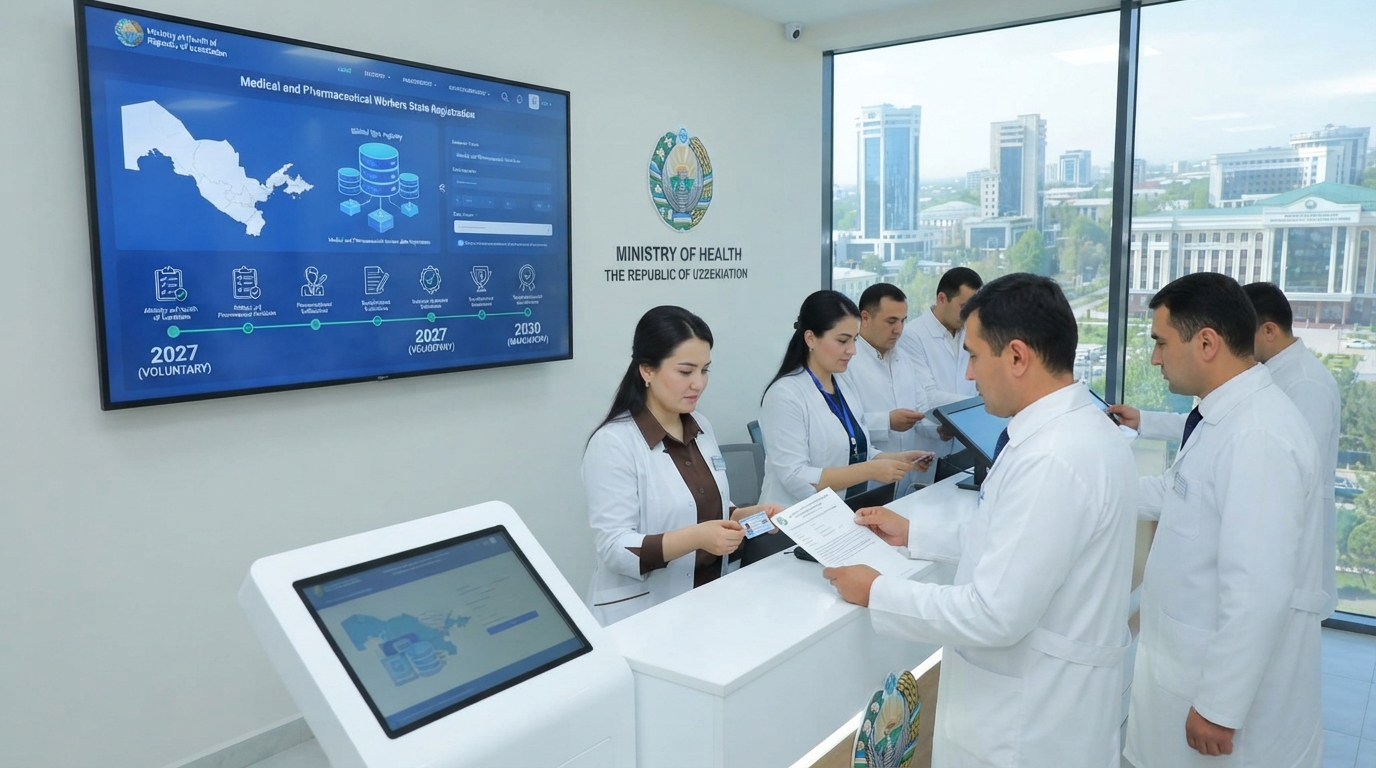
Starting from 2030, medical workers in Uzbekistan will be required to undergo state registration.
In Uzbekistan, there are plans to introduce state registration for medical and pharmaceutical workers. This was discussed on September 4 during a presentation to the president.
It is proposed to make registration voluntary from 2027 to 2030, and mandatory starting from 2030. In the future, specialists who have not registered will not be able to engage in medical or pharmaceutical activities.
To achieve this, there are plans to create a unified electronic registry of medical and pharmaceutical workers and link it with 16 information databases. The registry will accumulate data on the education, qualifications, and professional activities of specialists.
Sanjar Sharipov, Director of the Center for Assessing the Qualifications of Medical and Pharmaceutical Workers, reported that this concerns approximately 600,000 specialists. "It is envisaged to create a unified registry for them and ensure its openness and transparency," he said.
Registration will be linked to an independent assessment of knowledge and professional training. The exams are planned to be conducted in several stages — during training, after completion of the main program, and after residency.
Deputy Minister of Health Adham Khudaykulov stated that a diploma alone will no longer mean automatic admission to independent clinical work.
"An independent assessment system will appear, and it will be possible to work as a doctor only after passing registration," he said.
According to him, the first independent assessment is planned to be conducted during the training process, the next one — before the graduate is allowed to work as a doctor, and after residency, the specialist will have to undergo another assessment to work in a narrow specialty.
Rector of Tashkent State Medical University Shukhrat Boymurodov specified that the system will be structured as a three-stage process.
"After completing the second or third years, students will take an exam in fundamental disciplines. After completing the final year, a second stage is provided (by specialty — ed.), and after completing residency — the third," he said.
For the assessment, it is planned to create a unified bank of tests and tasks, as well as simulation bases. Those who do not pass the exam will be given an opportunity to retake it.
Financial incentives are provided for specialists who voluntarily join the system before the introduction of mandatory registration.
It is proposed to pay an allowance of up to 5 minimum wage amounts (6.8 million soums) to doctors and pharmacists with higher education who successfully pass the exam and are included in the state registry. For middle-level medical and pharmaceutical personnel — up to 2.5 minimum wage amounts (3.4 million soums).
The results of continuous professional education will also be taken into account during registration and qualification confirmation.
According to Sanjar Sharipov, the new system should become an additional mechanism for quality control and safety of medical care.
"It is envisaged to introduce a system of state registration of medical and pharmaceutical workers in accordance with international standards, as well as an independent assessment of their professional qualifications based on transparent criteria," he noted.
A separate center is planned to be established to organize state registration and qualification assessment.
The President instructed to implement the new rules in stages and to combine personnel training, independent assessment, state registration, and continuous professional development into a single system.
Separately, Minister of Health Eldor Adilov reported that during the presentation, the President instructed to extend the medical insurance system to the entire country by the end of 2026, ensure that purchased medicines and consumables reach patients, and strengthen work on preventing corruption in the healthcare system. He also instructed to develop incentives to attract compatriot medical specialists working abroad back to Uzbekistan.
Uzbekistan also plans to change the system of training doctors: starting from the 2027/2028 academic year, it is proposed to replace the "General Medicine" (Lechebnoe Delo) direction with a six-year "General Medicine" program. The training will be structured according to a 5+1 model — five years of training and one full year of practice.