

Medical training to be reformed in Uzbekistan
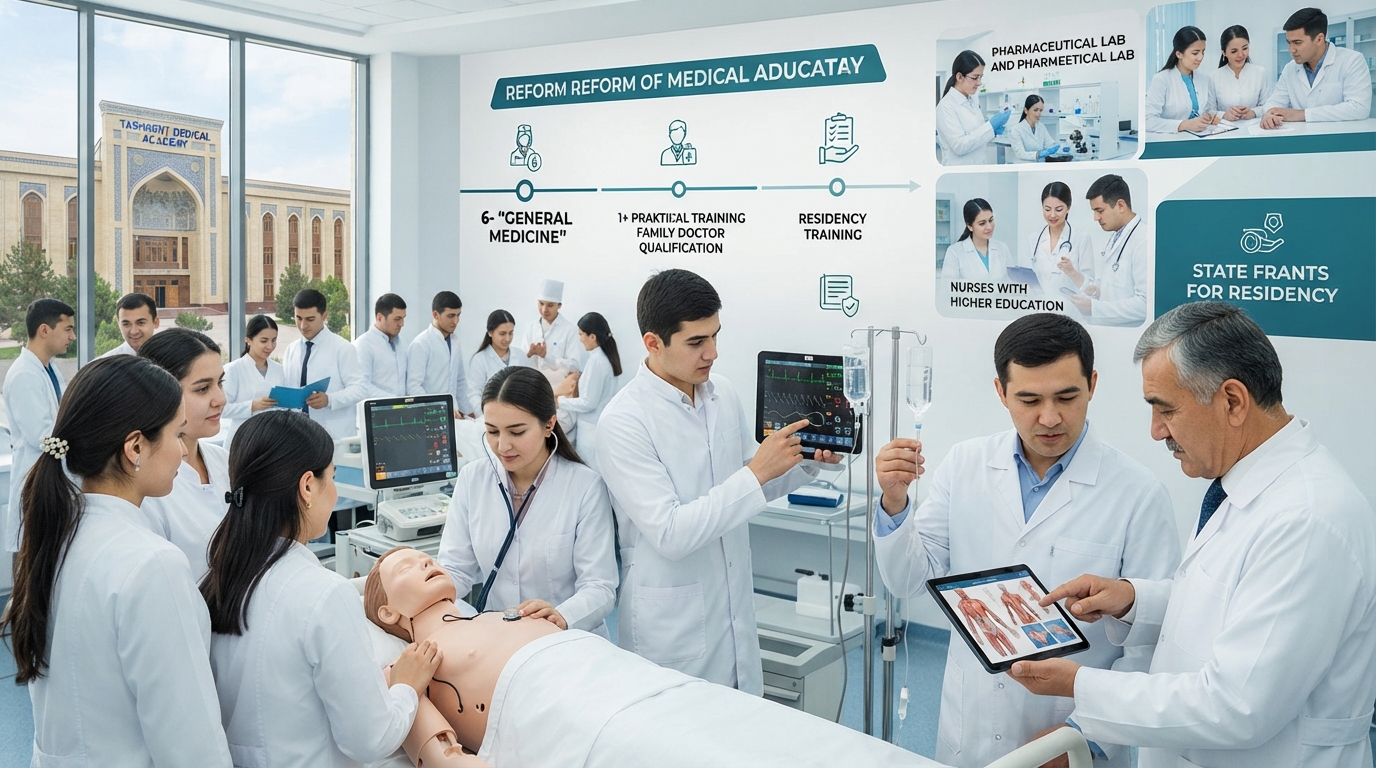
Starting from the 2027/2028 academic year, it is proposed to replace the "General Medicine" (Lechebnoye Delo) specialty in medical universities of Uzbekistan with a six-year "General Medicine" (Obshchaya Meditsina) program. The fifth year will be the final academic stage, while the sixth year will be fully dedicated to practice. Graduates will be able to work as family doctors.
Uzbekistan to Reform Medical Training System
On September 4, President of Uzbekistan Shavkat Mirziyoyev reviewed proposals to reform the training of medical and pharmaceutical personnel.
Starting from the 2027/2028 academic year, it is proposed to replace the "General Medicine" (Lechebnoe Delo) specialty with a six-year undergraduate program in "General Medicine" (Obshchaya Meditsina). After five years of study, students will undergo a full year of practical training, and graduates will be able to work as family doctors.
Admission quotas for medical universities are planned to be determined based on the needs of regions and medical institutions, as well as specialist shortages. The state order for medical specialties will be approved by the Ministry of Health.
The training of doctors is intended to shift from predominantly theoretical education to the development of practical skills and professional competencies. The proposals were prepared taking into account recommendations from Cambridge, Pennsylvania, and Harvard universities, with the participation of foreign and local specialists.
Rector of Tashkent State Medical University Shukhrat Boymurodov reported that approximately 70% of the training is planned to be oriented toward practice and the assessment of professional competencies.
"Substantive changes will take place in medical education. [...] Based on the 'General Medicine' (Lechebnoe Delo) specialty, the 'General Medicine' (Obshchaya Meditsina) specialty is being introduced. Student training will be aligned with the requirements of the World Health Organization and the World Federation for Medical Education," he said.
Deputy Minister of Health Adham Khudaykulov emphasized that the changes should cover the entire path of training medical workers — from school career guidance to residency.
In medical colleges, there are plans to update curricula, material and technical facilities, and the organization of practical training. In schools, they want to strengthen career guidance for students interested in medical specialties.
The training of highly specialized professionals is intended to be gradually concentrated within the residency system, while master's programs will be mainly reoriented toward training scientific and pedagogical personnel.
According to Adham Khudaykulov, residency training could last from two to five years, depending on the specialty.
"Another innovation is that residency will be fully funded by state grants. [...] Now, it is planned to completely transition residency to state grants so that specialists can work simultaneously, receive a decent salary, pay more attention to learning, and become qualified doctors," the Deputy Minister said.
The changes will also affect nursing staff. The role of nurses with higher education is to be expanded: it is expected that they will assist doctors more actively in diagnosis, treatment, and disease prevention.
Pharmaceutical education is planned to be more closely linked to production. To achieve this, they want to expand dual education, increase the share of practical classes, and involve students in production processes — from drug development to quality control and standardization.
Separately, it is proposed to change the system of professional development. Medical and pharmaceutical workers with higher education will need to earn at least 50 credits annually, while nursing and pharmaceutical staff with secondary education will need 28 credits.
Bobur Turaev, a pediatric cardiac surgeon at TSMU, explained the need for such a system by the rapid updating of medical knowledge and technologies.
"Medicine is a constantly changing field. From year to year, new methods of treatment and diagnosis enter practice, and the medicine a specialist studied when receiving their degree can change in a few years," he noted.
Credits can be earned not only through professional development courses but also for participating in conferences, online learning, and professional development directly at the workplace.
To coordinate this system, it is proposed to establish a Center for Continuous Professional Development.