

Spare part from a file: why Uzbekistan needs an additive technology center
When a rare imported part fails at a plant, a replacement is sometimes awaited for months. Industrial 3D printing, or additive manufacturing, allows such a part to be produced from a digital model without lengthy logistics and high expenses. A center where such parts would be printed for local plants may also appear in Uzbekistan. The prospect of creating an Additive Manufacturing Center in the country became one of […]
A Spare Part from a File: Why Uzbekistan Needs an Additive Technologies Center
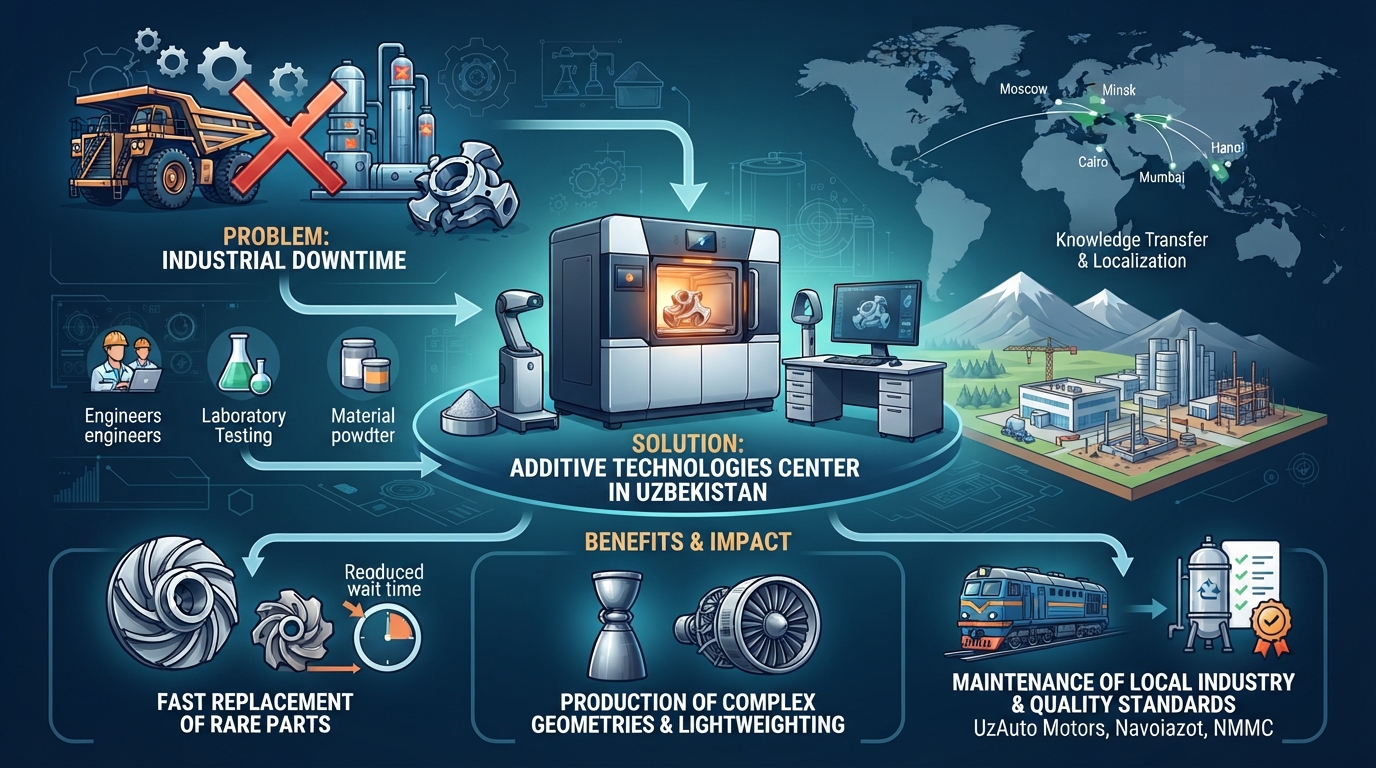
When a rare imported part breaks down at an enterprise, waiting for a replacement sometimes stretches on for months. Industrial 3D printing, or additive technologies, makes it possible to manufacture such a part using a digital model without long logistics and high costs. In Uzbekistan, a center where such parts will be printed for local factories may also emerge.
The idea of creating an Additive Technologies Center in the country became one of the main topics of a special seminar on 3D printing for industrial enterprises, which took place at the Uzatom Agency jointly with experts from Rosatom's Fuel Division. About 30 companies from the automotive, chemical, and mining industries participated in the event, including NMMC, Navoiyazot, and UzAuto Motors. The project involves creating working groups, auditing the manufacturing capabilities of enterprises, preparing a list of products and services, and developing support measures for the center.
This technology is used for prototypes, spare parts, tooling, and pilot samples to quickly make a rare part, restore a worn element, or obtain a complex-shaped product that is difficult to cast or machine on a lathe. At the same time, material is used more economically, and unused powder can be reused.
For a long time, 3D printing was used mainly for prototypes. Aviation became one of the first examples of serial industrial use. In 2015, GE Aviation launched the production of printed fuel nozzle tips for the LEAP engine at a plant in Auburn (USA). The part, which used to be assembled from 20 elements, became single-piece, a quarter lighter, and, according to the company, five times more durable.
The German company Deutsche Bahn has been using 3D printing in rolling stock maintenance since 2015 and has manufactured over 100,000 parts this way. The 100,000th part in 2023 was a gear casing for a shunting locomotive weighing 570 kg and with a volume of almost 1 cubic meter. At that moment, it was the company's largest part created using 3D printing. They printed not the casing itself, but the casting mold into which it was then cast. With standard procurement, such a part would be expected for an average of nine months, but with the new technology — two. The company stores digital models in a database, a "digital warehouse," where a rare spare part is not kept on a shelf, but printed as needed.
In Russia, the introduction of additive technologies into nuclear power engineering, where requirements for parts are particularly strict, became a noticeable step. In February 2026, specialists from OKBM Africantov (part of Rosatom) together with materials scientists completed a comprehensive set of studies and tests and prepared regulatory documentation for a 3D-printed pump part of the RITM-200 reactor unit, the so-called "impeller." According to calculations by the state corporation's specialists, the product's manufacturing cycle was reduced by approximately 20%. Among the advantages of the technology, the developers also name lower material consumption, high repeatability, and the ability to manufacture parts with complex geometry.
Mass-produced simple parts are still more profitable to make by casting, stamping, or machining. Therefore, the decision to print is made for each item separately. At the same time, for the industrial application of additive technologies, it is not enough to simply print a part of the required shape. It is necessary to confirm the properties of the material, the absence of critical defects, and the repeatability of the result from batch to batch. Mandatory tests are conducted for this purpose.
What this looks like in practice is shown by the example of the "impeller" for RITM-200. In the nuclear industry, material requirements are particularly strict, and work on the part included a set of tests and the development of regulatory documentation. In other industries, requirements may be milder, but the set of tasks remains the same: materials science, testing, refining print modes, subsequent processing, and quality control. Therefore, printers alone are not enough for an additive technologies center. Laboratories, engineers, and a regulatory framework are needed.
Rosatom's first overseas additive technologies center opened in September 2025 in Minsk jointly with the Belarusian company Horizont. The launch was preceded by an audit of several interested enterprises. Two metal 3D printers of Rosatom's RusMelt series, an industrial printer for engineering plastics, a 3D scanner, and a unit for printing sand-polymer molds operate at the center. The center's production capacity is up to 1.5 tons of products from various metals, up to 3 tons of sand-polymer molds, and up to 100 kg of products from engineering plastics per year.
Rosatom considers the Minsk project a reference model for other countries. According to the state corporation's press service, the next step will be the phased localization of Rosatom 3D printer production by 2027. Groundwork has already been laid. In October, the company presented the first small-sized RusMelt 150M 3D printer, manufactured using Russian and Belarusian components.
Using the same model, Rosatom is working on turnkey additive technology center projects in other countries. To date, projects to create similar centers are being developed in Egypt. In Vietnam, a memorandum and an agreement on the development of a project for constructing an additive technologies center were signed in 2026. At the same time, cooperation with foreign partners is not limited to equipment supplies. One of the important directions is production localization. Thus, this year, production of Russian-designed 3D scanners began in India. Localization is expected to reduce equipment costs for end consumers. In addition, it will make it possible to obtain the "Made in India" status, which will facilitate product sales in the local market. In April, following a tender, Rosatom delivered a RusBeam 2800 unit to India for printing large metal parts for the aerospace industry. This is the state corporation's first delivery of a 3D printer to a non-CIS country.
In parallel, equipment production is growing in Russia. In 2023, the state corporation's Moscow Additive Technologies Center manufactured three metal 3D printers, and in 2025 as many as 13. In early September 2026, the 30th machine was assembled here. In addition to equipment, Rosatom produces metal powders and software for 3D printing, and also trains personnel.
Interest in additive technologies in the country coincides with the course toward the technological transformation of industry. At the August seminar, industries were represented for which equipment downtime is particularly expensive.
For mining and metallurgical plants, chemical plants, and machine-building enterprises, it makes sense to consider additive manufacturing not as a replacement for traditional manufacturing, but as a tool for solving specific production tasks where it may prove more effective than traditional technologies. This may concern rare parts and small batches, products with complex geometry, restoration of equipment or components whose delivery from abroad takes months.
Which parts and operations at Uzbekistan's enterprises fit these scenarios should be shown by the audit provided for by the project. The set of equipment, the scale of the future center, and the economics of its operation will depend on its results. Minsk has already passed this stage. The experience of other countries also suggests questions that the project will have to answer: who will become the center's customers, who will train engineers and certify printed parts, and whether local production will emerge. Whether 3D printing becomes a working industrial tool in the country and what practical effect it can yield depend on the answers.