

Spanish intelligence warned of Ceuta mass crossing plans before surge
Declassified documents show Spanish and Moroccan authorities were alerted to social media calls for a mass migrant crossing the day before tens of thousands entered Ceuta.
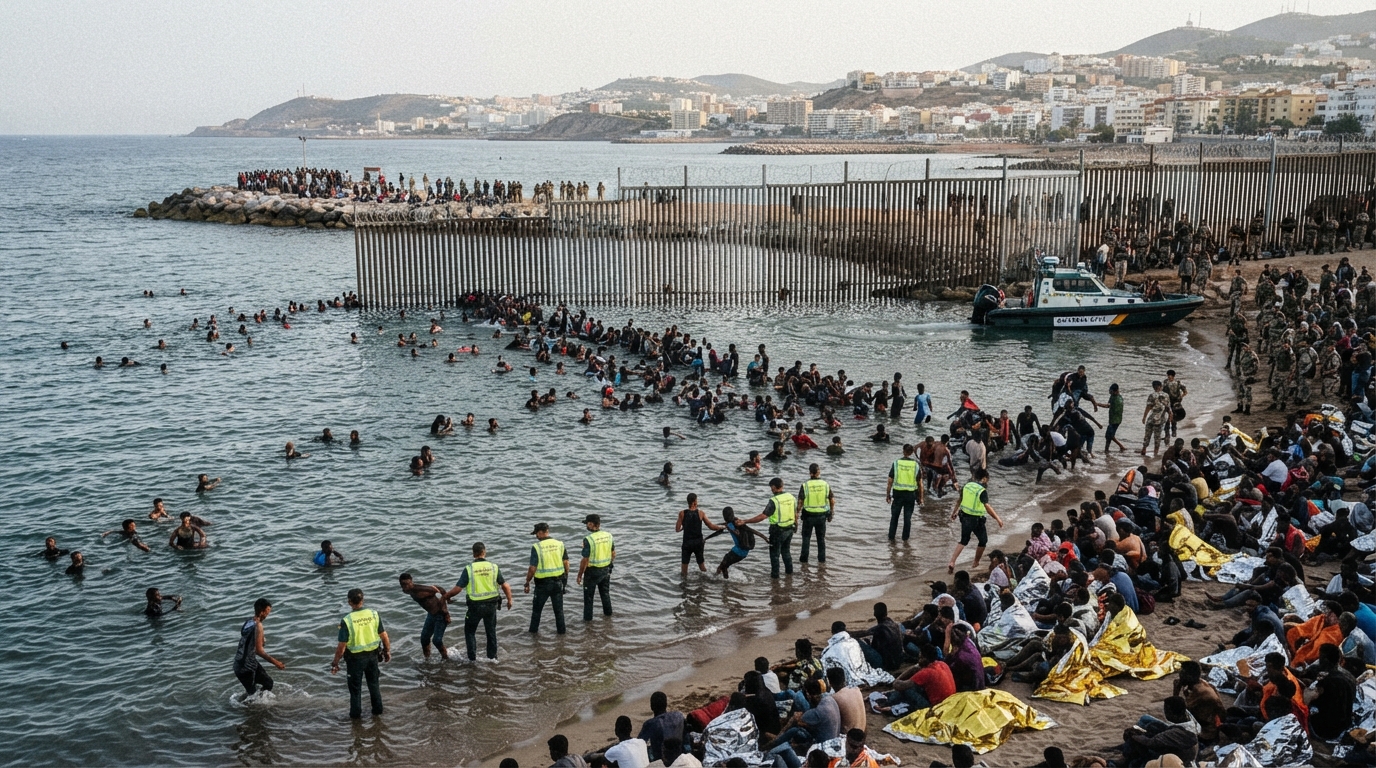
Spanish intelligence had warned about plans for a mass crossing into Ceuta before the surge
Newly released government documents show that Spanish intelligence services alerted authorities to social media calls for a mass migrant crossing into Ceuta the day before tens of thousands of people entered the city.
The disclosures came from papers declassified by the Spanish government amid accusations that it had not told the full story of the migrant influx.
On 29 July, Spain's National Intelligence Service (CNI) informed Moroccan and Ceuta authorities that social media groups were urging migrants to cross the next day.
Prime Minister Pedro Sánchez has said the events of 30 July could not have been foreseen, but opposition parties argue the documents prove the government misled Spaniards.
Sánchez had earlier told parliament that there was "no information that conveyed the magnitude" of the "crisis we were going to suffer" on the last two days of July.
At least 72,000 migrants crossed from Morocco into Ceuta on 30 and 31 July. Most swam around a border fence, and at least 100 people died during the crossing, according to figures from Ceuta's mayor.
While most went back, as many as 5,000 are still in makeshift camps or sleeping on the city's streets and beaches, fueling unrest in the autonomous city in North Africa. Residents have voiced safety fears, and some have torn down shelters and blocked aid being delivered to migrants.
In a note dated 29 July, the CNI told Moroccan intelligence that it had identified WhatsApp and Facebook groups promoting an attempt by migrants to reach the Spanish exclave the following day, "both swimming and via the [border] fence".
The CNI said about 180,000 people were receiving the messages, including one that said: "Whoever wants to cross has the last chance on Throne Day [30 July] at 8 the authorities will be distracted with the celebrations and parades".
It also alerted, by text message, the central government's representation in Ceuta and the civil guard to the social media activity.
The messages are among more than 40 security documents tied to the Ceuta crossing that the government declassified after growing pressure on Sánchez over his handling of the crisis and widespread claims in Spain that Morocco had helped facilitate the crossings.
Earlier this month, a leaked Spanish police report appeared to implicate Moroccan police in the incident.
Even so, Sánchez has insisted there is no evidence of Moroccan complicity.
Just before the documents were published on Wednesday, he told Spanish television that "the mass arrival of migrants was not expected".
But opposition politicians said the newly released material contradicts that assertion.ed
"They had the information, they are directly responsible for the invasion of Ceuta and for those who died," said Ester Muñoz of the conservative People's Party.
Jorge Buxadé, of the far-right Vox, said on social media that the documents showed Sánchez "and his band of criminals should be brought before the Supreme Court for treason and security crimes".
The government has kept insisting that it acted on the information it had.
Foreign Minister José Manuel Albares said he was "not aware of any report that might have forseen the magnitude of what happened on July 30".
A government source said the released documents "showed that the information available before the mass crossing did not make it possible to anticipate the scale that the crisis would reach or prepare with enough time the necessary response".
Miguel Ángel Pérez Triano, the central government's delegate in Ceuta, responded to the revelations about the text messages the CNI had sent to his office the day before the mass crossing.
"The Whatsapps from [July] 29 do not constitute an alert or a report," he said. "It is nothing more than an exchange of information."