

Spain battles climate change on several fronts
A summer of wildfires and heatwaves underlines the threats to the country's economy.
**Spain battles climate change on several fronts**
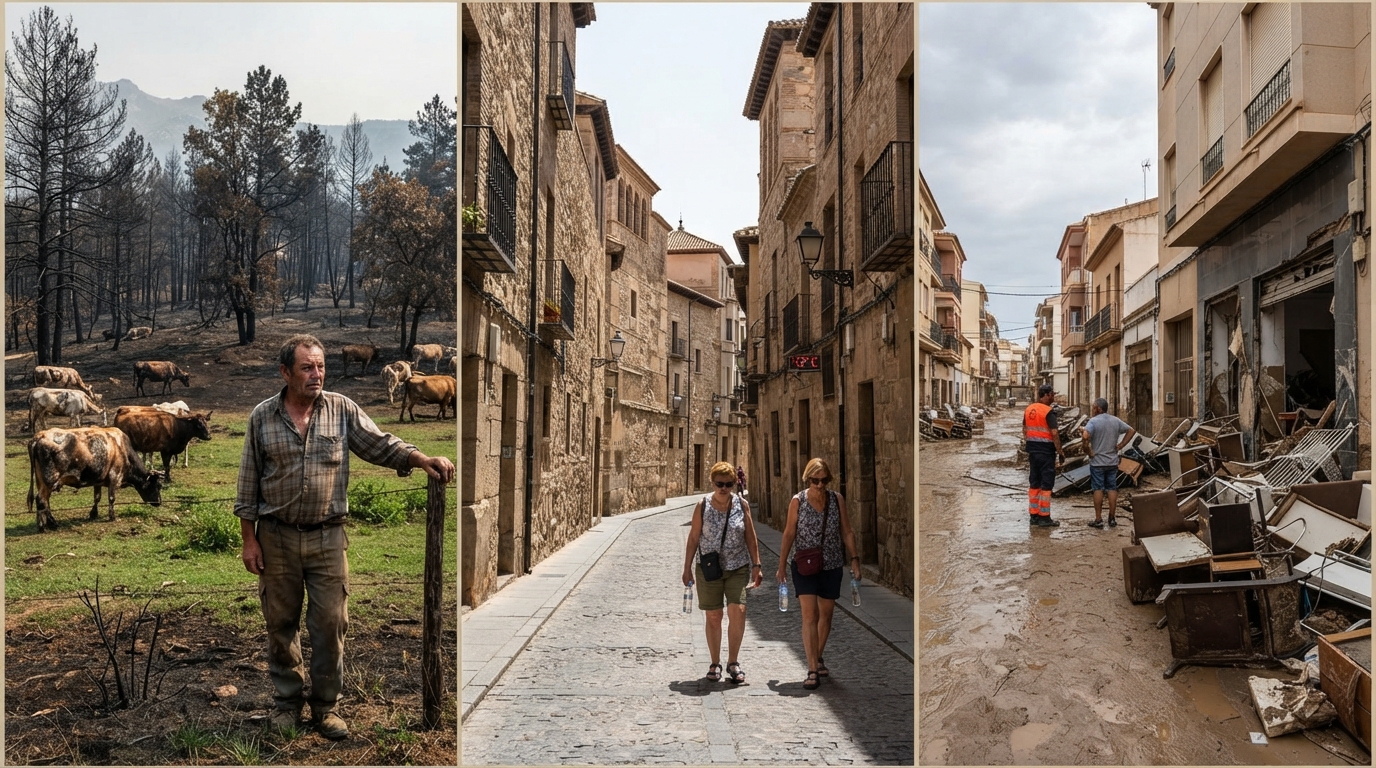
Farmer Juan Ángel Izquierdo says it is hard not to worry about wildfires
In a small green meadow in the Gredos mountains, west of Madrid, a few dozen cows owned by Juan Ángel Izquierdo and his family are grazing. The only sound is the soft ringing of the bells hanging around the animals’ necks.
The scene might seem idyllic if not for the blackened pine and oak trees surrounding it, the aftermath of a devastating wildfire that recently swept through the area.
"It was immense, I've never seen anything like it," says Izquierdo, whose family have farmed there for 200 years.
In late July, the fire joined with two others and burned about 80,000 hectares (200,000 acres) in total, becoming the largest blaze Spain has ever recorded.
It destroyed more than two-thirds of Izquierdo’s land, killed 12 of his 85 cows, and forced another eight animals to be put down because of their injuries. All the hay he had collected to feed the cows through winter also went up in flames.
"For us farmers, the summers are becoming more and more worrying, because they are getting hotter," he says. "It rains less, the wet season ends earlier and the autumn starts much later."
For farmers, those conditions are closely linked with fires.
"If you don't think about the wildfires too much, you feel okay," Izquierdo says. "But when a fire starts in a nearby village you start wondering – 'and what if we're next?'."
Wildfires are among several signs of climate change that have had a major effect on Spain’s economy in recent years, while also contributing to shocking human tragedies.
World Weather Attribution, an international research organisation, found that the extreme conditions behind the record fires in Spain and Portugal in 2025 were
40 times more likely
, external to occur because of the warming climate.
"The ultimate reason for the greater frequency and intensity of these kinds of fires has to be attributed to the increase in greenhouse gases caused mainly by the generalised use of fossil fuels," said Ernesto Rodríguez Camino, president of the Spanish Meteorology Association.
Socialist Prime Minister Pedro Sánchez has spoken of the fires in stark terms, putting Spain at the forefront of an environmental crisis.
"The climate emergency kills," he said in July during a visit to the southern province of Almería, where a wildfire killed 15 people.
Research found that extreme heat and the fires it causes in Spain were now 40 times more likely
So far this year, about 300,000 hectares of land have burned in Spain, according to the European Forest Fire Information System (EFFIS), roughly half of the total affected across the entire European Union.
Over the past 40 years, Spanish fires have caused damage exceeding 200,000 hectares in a year on eight occasions, including three since 2022.
Agroseguro, the farming insurance association, estimated that 16,000 hectares of crops had been destroyed by mid-August this year, a serious blow to Spain’s agri-food sector, which accounts for 9% of GDP.
Authorities in Castilla y León, the region hardest hit by this year’s huge fire near Madrid, are offering compensation of between €5,500 ($6,300; £4,700) and €25,000 ($29,000; £21,000) to each farmer, depending on the damage. But Izquierdo says that would cover less than half of his losses.
For decades, Spain’s warm climate has benefited one of its other major industries: tourism. Sun-soaked resorts on the Mediterranean coast, as well as in the Balearic and Canary Islands, have helped drive the country’s rise as a tourist destination.
This year, nearly 100 million foreign visitors are expected to travel to Spain, making it the world’s second most-visited country after France.
But there are signs that the heat is becoming too much for some tourists. A study by researchers at Madrid’s Rey Juan Carlos University found that it can deter potential visitors.
"When there is a heatwave, the number of overnight stays drops in the destinations that we've studied, and there is also a drop in arrivals from some of Spain's biggest markets," says María Dolores Sánchez, an economist who co-authored the report.
"Tourism represents 13% of Spain's GDP, so this could have repercussions in the medium term when it comes to Spain's competitivity."
The city of Toledo, near Madrid, saw temperatures soar above 40C on numerous days this summer
The medieval city of Toledo sits on the plains of Castilla-La Mancha, far from Spain’s coast, but its rich history and narrow streets have made it a favourite for visitors looking for an alternative to the country’s beaches and nightlife.
This summer, however, tested people’s tolerance for heat, as Spain recorded a record 61 days of heatwaves that lasted into early September. Toledo repeatedly experienced temperatures above 40C.
"It's quite difficult to do the tours in the summer," says Diego Esteban, a guide with Visit Toledo. "We need to adapt, whether it is those of us who work in the tourism industry or the locals."
When leading tours in summer, Esteban makes sure there are frequent breaks, drinking water is available and the routes include plenty of shade. Even so, he would like to see more shade and more drinking fountains.
He says the heat has begun to shift the timing of the tourist season, bringing many more visitors in the cooler spring and autumn months.
Warmer summers have also fuelled the so-called "coolcation" trend, in which Spanish travellers head to cooler places for their holidays, usually in the north of the country.
Another effect of Spain’s warming climate has been drought. In 2024, after three years of very low rainfall, the north-eastern region of Catalonia temporarily imposed strict water-use limits, including a 25% cut for industry and an 80% cut for crop farming.
Heavy rain since then has ended the restrictions, but the drought still had a significant impact on the local economy.
The most dramatic and tragic natural event Spain has experienced in recent years was the flash flooding that killed 237 people in the east of the country in October 2024, centred on the Valencia region.
Spanish meteorological research group Climatoc-Lab called it "a manifestation of how global warming alters the hydrological cycle".
The Valencia Chamber of Commerce estimated the floods caused €4.5bn in direct damage. Thousands of businesses were affected, some literally swept away by floodwater, while others managed to reopen only after a long recovery.
"It was a disaster, both in terms of the lives lost and the impact on businesses, on workers, employers and ordinary people," says Laura Llácer Álvarez, manager of the Fepeval federation of industrial parks in the Valencia region.
Spain’s location, climate and terrain make it especially vulnerable as global temperatures rise. Germanwatch, an independent environmental organisation, ranked Spain as the world’s 20th most affected country in its climate risk index for 2024, just behind Nigeria and Mali.
Still, some see an economic upside.
"Climate change affects how we produce, how we invest and how we consume," says Julián Cubero, head of economics of climate change at economic think tank BBVA Research. He points to the way heat can slow economic activity.
"We all work worse when it's hot," he says. But he adds that a greener economy can generate new jobs with higher productivity.
"The key is to realise that if we don't act, growth will slow down, and if it's handled right it can become an opportunity," he says.