

"South Korea is perceived as a neutral and pragmatic partner. This is its main advantage." Expert opinions on the past summit
Following the first "Central Asia — Republic of Korea" summit, Gazeta spoke with experts about what the new format can offer Central Asia, which summit initiatives have the greatest chance of being implemented, and what advantages South Korea holds over the region's other external partners.
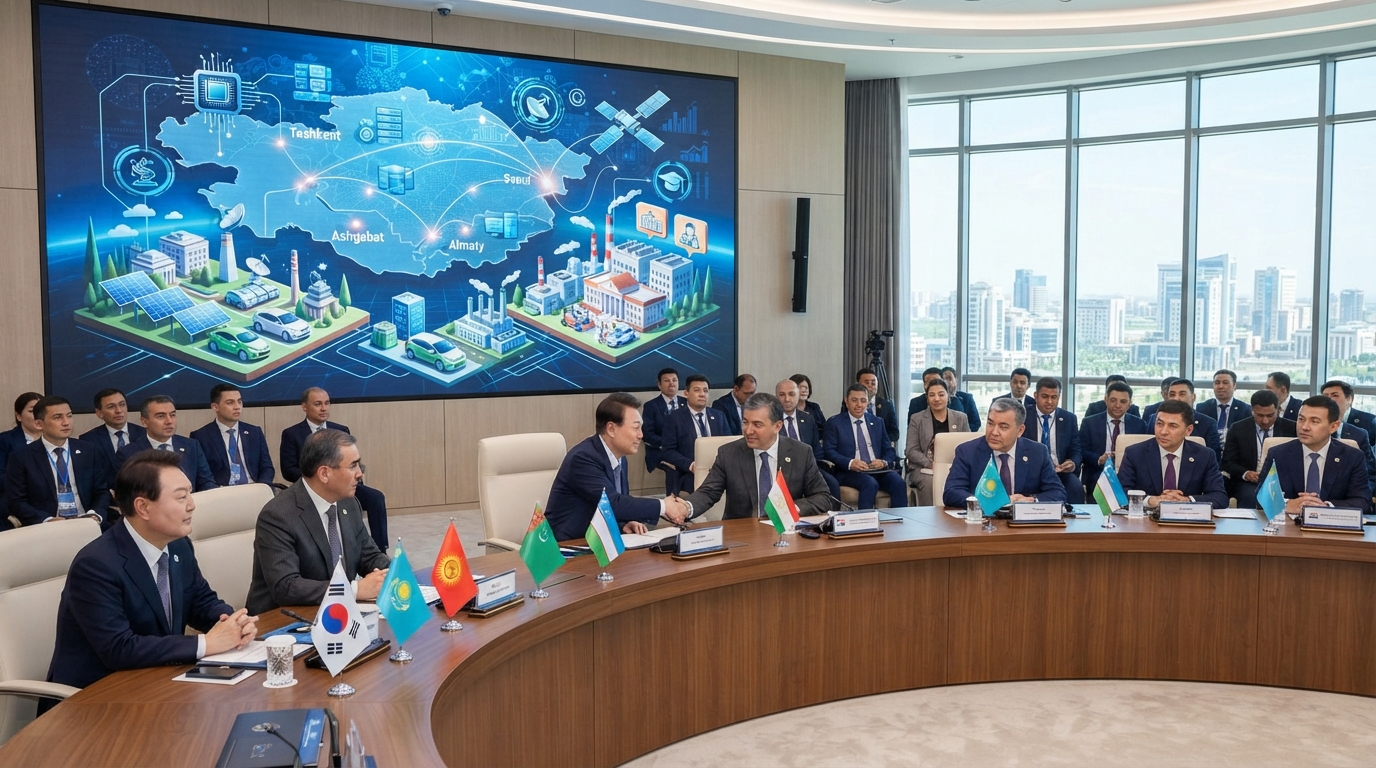
"South Korea is perceived as a neutral and pragmatic partner. This is its main advantage." Expert opinions on the past summit
Today, South Korea's main asset is its combination of technological expertise, investment potential, and practical experience in modernization. Unlike many external players, the Republic of Korea itself has traveled the path from a developing economy to a high-tech industrial power. This is precisely why its experience is in high demand in Central Asian countries that seek to diversify their economies, develop industry, digitalization, and human capital.
Another important factor is South Korea's ability to work with long-term projects and tailor solutions to the specific demands of its partners. This is particularly noticeable in areas such as e-government, digital infrastructure, healthcare, education, energy, transport, and industrial manufacturing.
Finally, a significant advantage remains the perception of South Korea as a relatively neutral and pragmatic partner. Central Asian states are interested in expanding their circle of external relations and avoiding dependence on a single economic or political center.
Against this backdrop, the Korean model of interaction, which relies primarily on economics, technology, education, and human capital development, aligns well with the multi-vector strategy of the region's countries.
Therefore, the competitive advantage of the Republic of Korea today lies not in any single sector, but in its ability to combine technology, investment, knowledge, and long-term partnership.
I would highlight the following factors. By launching the "Central Asia – Republic of Korea" Cooperation Forum in 2007, Seoul was one of the first to recognize the region as a single, cohesive space. The creation of the forum's secretariat and the launch of the K-Silk Road Cooperation Initiative ensured a systematic, practical, and flexible approach to interaction in the fields of industry, energy, logistics, and digital technologies.
In addition, from the very first days of independence, South Korea has acted as a reliable investor and donor to the countries of the region, implementing projects to modernize transport infrastructure, water supply systems, healthcare, and agriculture through the KOICA agency and the Economic Development Cooperation Fund (EDCF).
Possessing one of the world's leading scientific and technological bases, South Korea contributes to the innovative modernization of Central Asian economies. Branches of Korean universities successfully operate in the region (for example, Inha, Bucheon, Ajou, and the Korea International University in Uzbekistan), joint IT centers are being established, Korean "e-government" standards are being introduced, and joint research projects in the field of artificial intelligence and digitalization are being launched.
It is also important that Seoul builds its dialogue with the countries of the region on the principles of equality, recognition of sovereignty, mutual respect, and consideration of partners' interests, without putting forward geopolitical demands or political conditions. This approach eliminates the risks of dominance and builds high trust in South Korea as a predictable and reliable partner.
Finally, one cannot fail to mention the Korean diaspora of Central Asia — more than 300,000 people living predominantly in Uzbekistan and Kazakhstan. It has become an organic part of the region's multinational society and fosters a deep level of mutual trust and spiritual and moral closeness between our peoples.
The main advantage of the regional format is the opportunity to view Central Asia not as five separate markets, but as a single economic space. This allows for the implementation of projects that are difficult to realize in a bilateral format: cross-border transport and energy projects, production chains, and digital solutions.
This is also important for the exchange of experience among the countries of the region themselves. South Korea gets the opportunity to work with Central Asia more systematically, while the countries of the region can jointly utilize Korean technologies in areas such as digitalization, artificial intelligence, energy, and education.
In other words, the regional format does not replace bilateral relations but adds economies of scale and coordination to them. Five separate tracks primarily address national tasks, whereas the "Central Asia + Korea" format allows for the formation of a common regional agenda and projects.
The regional format creates something that is fundamentally impossible to achieve through five separate bilateral tracks — the effect of macro-regional scale and complementarity. It establishes common institutional rules of the game, unified transit corridors, and resilient macro-regional supply chains.
Industrial cooperation can serve as an example. Since an individual state does not always possess a full cycle of resources and production capacities, the "Central Asia – Republic of Korea" format allows for the building of deep industrial cooperation. For instance, the extraction and primary processing of raw materials can be carried out in one country, the production of technological components in a second, and final assembly in a third. This transforms the region from a source of raw materials into a single industrial hub.
Along with this, the multilateral format opens up additional opportunities for joint research, technology transfer, and the formation of sustainable scientific and production ties between Korean and Central Asian companies and research centers.
In parallel, multilateral interaction addresses the task of removing internal barriers and ensuring "seamless" transit. Seoul's bilateral agreements with individual states are unable to eliminate customs delays at the borders between the Central Asian countries themselves, whereas the regional format allows Korean technologies to be scaled across the entire region at once — through the introduction of unified digital customs platforms, smart logistics systems, and common power grid management standards.
Moreover, the joint positioning of a combined market with a population of over 80 million people creates the necessary volume of demand to attract major South Korean investors, such as Hyundai, POSCO, SK, or Samsung, whose scale requires significant market capacity for localizing production.
Finally, by acting as a single bloc, the Central Asian states strengthen their agency and negotiating positions, avoid internal competition for investment, and significantly accelerate the launch of cross-border environmental, energy, and logistics projects.
I would highlight the creation of the "Central Asia – Korea" Industrial and Technological Park in Uzbekistan. In my view, this initiative looks the most realistic because it builds on the existing interest of Korean business in the region and can be filled with concrete industrial projects — from electrical engineering and automotive components to robotics and new materials.
The regional effect is also important here. Uzbekistan proposes using such a park not only for national production but also as an innovative and production base for the entire Central Asian market. This aligns well with the overall logic of the first summit — to move from trading individual goods to creating production chains and deeper technological cooperation.
Therefore, I would say that this is one of those initiatives where a political agreement can quickly translate into concrete investment projects. And in my opinion, the presence of such projects will be the main indicator of whether the summit has truly given a new impetus to relations between Central Asia and the Republic of Korea.
I would also highlight the idea of creating the "Central Asia – Korea" Industrial and Technological Park — a platform that should turn into a single innovative and production base for the entire macro-region.
The implementation of this initiative will be facilitated by its link to another key decision of the summit — the creation of a Consultation Mechanism at the level of ministers of industry and trade.
Thus, the industrial and technological park acts as the physical platform for an industrial breakthrough, while the ministerial dialogue serves as its regulatory engine. Regular work by the ministers will allow for the synchronization of customs procedures, the elimination of trade barriers, the simplification of certification, and the formation of end-to-end interstate value chains.
Within the framework of such cooperation, raw materials and critical minerals from neighboring countries in the region will be able to flow into the park for deep processing and assembly of high-tech products, with their subsequent export to global markets.
It is precisely the interconnectedness of the industrial park and the institutional ministerial mechanism that creates real conditions for achieving the main goal — increasing the trade turnover of Central Asian countries with South Korea to 20 billion dollars by 2030.
I would say that competition primarily expands the room for Central Asian countries to choose the most effective and quickly implementable option. Currently, interest in the region indeed goes far beyond a single partner. South Korea offers cooperation across the entire chain — from geological exploration and processing to the production of materials, while the countries of the region are simultaneously developing ties with other external players.
For Central Asia, this presents an opportunity not just to export raw materials, but to choose partners for specific technologies and create competitive advantages. The more potential investors and technological partners there are, the more opportunities there are to secure processing within the region, technology transfer, and personnel training.
This approach provides Central Asia with additional resources for industrial and technological development.
In my view, high competition among external partners does not create risks if Central Asia uses it to expand its own opportunities.
The optimal strategy for Central Asia is not to bet on a single global player, but to build a smart division of labor, effectively utilizing the strengths of each partner. For example, adopting technologies for deep processing of raw materials, launching joint scientific and technological laboratories, and implementing solutions for the production of microchips and batteries from South Korea; adapting strict environmental standards, green energy solutions, and circular economy practices from the European Union; and attracting innovative methods of digital geological exploration and high-precision equipment from the US and Japan.
Today, Seoul offers the region a model of cooperation that involves not just the extraction of ore, but the institutionalization of a full production cycle. The practical foundation for this interaction has already been laid: in Uzbekistan, the Uzbek-Korean Scientific and Technological Center for the Deep Processing of Refractory Metals (tungsten and molybdenum) operates at the Almalyk Mining and Metallurgical Combine in cooperation with the Korea Institute of Rare Metals (KIRAM); and in Kazakhstan, the Center for Rare and Rare Earth Metals, focusing on geological exploration and lithium extraction technologies, has been established at Satbayev University in cooperation with the Korea Institute of Industrial Technology (KITECH).
The Seoul Declaration, meanwhile, recorded the transition to comprehensive cooperation: from joint geological exploration and primary processing to the creation of research infrastructure and the training of local engineering personnel.
I would highlight three points: concrete projects, clear financing mechanisms, and constant coordination.
If joint projects with specific deadlines, responsible parties, and clear sources of funding are launched after the summits, the format will gradually transition from declarations to practical cooperation.
It is especially important to focus on several areas where the interests of South Korea and the Central Asian countries align: critical minerals, digitalization, energy, transport, education, and personnel training. Here, it is possible to quickly move from political agreements to measurable results.
And finally, a permanent mechanism for monitoring the implementation of the reached agreements is needed. Then, each subsequent summit will not start the discussion anew but will show what has already been done and which projects are moving to the next stage.
I believe that a transition from declarations to systematic project work is necessary. To achieve this goal, fulfilling five basic conditions is of key importance.
First of all, a consolidated position of Central Asia itself plays a decisive role. The countries of the region need to enter negotiations with Seoul not with fragmented national initiatives, but with a single package of agreed cross-border projects. A rigorous project specification must be built on this basis: the results of each summit must be recorded in the form of a clear registry of priority initiatives with fixed deadlines, sources of funding, and clear performance criteria.
No less important is the operational work of institutional bodies. The established consultation mechanism at the level of ministers of industry and trade must function as a permanent project office.
In parallel, it is necessary to build a stable financial and guarantee infrastructure. Industrial and infrastructure projects require long-term financing, so it is important to combine the state resources of Central Asian countries with the capacities of Korean financial institutions, international development banks, and the private capital of South Korean chaebols.
Finally, a key condition is human resource, scientific, and technological support. Any investment must be accompanied by a transfer of competencies: the training of engineers, IT specialists, and personnel for deep processing of raw materials must be conducted within the region through the launch of joint research centers and applied laboratories at leading Central Asian universities.
Ultimately, the defining indicator of the effectiveness of this work will be the portfolio of implemented projects with which the parties will approach the next "Central Asia + Korea" format summit, scheduled to take place in Kazakhstan in 2028.