

"Smart" gas meters: a closed contract, trillions in costs, and now a criminal case
It is alleged that Technopark and Hududgaztaminot officials committed a robbery under the pretext of servicing gas meters. This criminal case will also bring to light other issues related to meters under the Austen brand - it is not surprising that during the investigation, attention will also be paid to questions that have previously arisen in the public. So, when was Technopark established, by whom, and how did it obtain a contract worth 5.3 trillion soums?
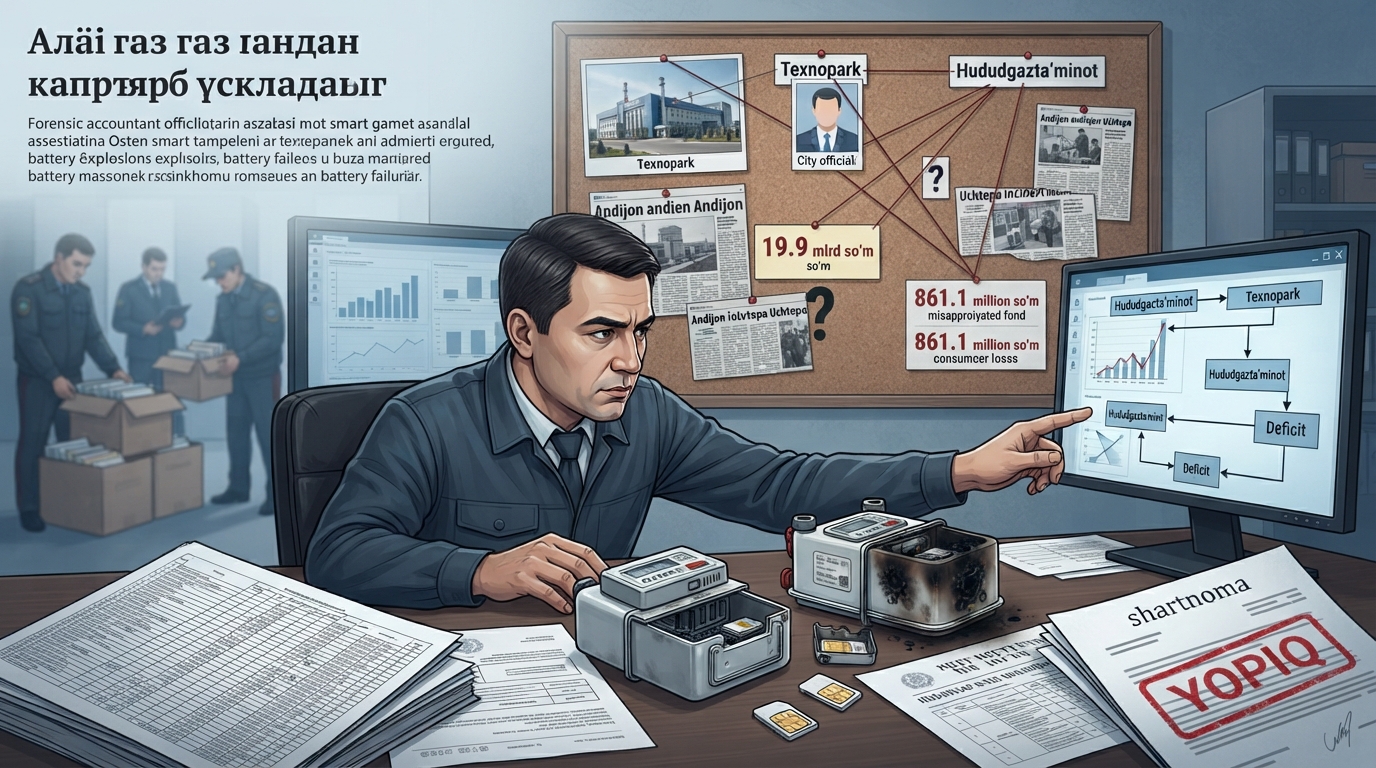
A closed contract, trillions of dollars in expenses related to “smart” gas meters, and now a criminal case has been launched.
According to the Department under the Prosecutor General’s Office, officials of “Hududgaztaminot” JSC and “Technopark” LLC, in collusion with other individuals, embezzled about 19.9 billion soums of budget funds under the guise of technical maintenance of electronic gas meters. In addition, as a result of underestimating the readings of 273 gas meters installed at consumers, 861.1 million soums of damage was caused to the interests of the state and society.
It should be noted that since the introduction of “smart” gas meters, various questions have been regularly raised around this issue.
**Project launch and adverse events**
When the plan to localize “smart” gas meters in Uzbekistan was announced in 2019, the project was presented as an important milestone in the digitalization of the country’s energy system. At that time, it was reported that negotiations were underway with the Artel company to produce modern electronic gas meters, but in the end, Technopark LLC, a subsidiary of the Tashkent city administration, was chosen as the manufacturer and supplier of the product.
In 2020, a $50 million factory was launched in the Technopark area of Tashkent. It began producing Austen-branded meters with a SIM card installed and automatically transmitting the amount of gas consumed to a central server. Official reports stated that 3 million meters would be produced per year.
Several situations were widely discussed on the networks as the devices began to be installed. In particular, in 2020 alone, there were reports that more than 40 “smart” gas meters in Andijan failed to work, and in some apartments the devices exploded. Technopark, however, stated that the quality of the meters was guaranteed, and these problems were the result of errors in the installation process.
A year later, another Osten meter burned out in the Uchtepa district - “Hududgazta’minot” stated that this incident was not a defect in the meter, but an external influence.
By 2024, another systemic problem emerged. It turned out that the battery capacity of some meters had run out in a few years, and the devices stopped transmitting information to the central system.
By July 2026, the head of state himself criticized the fact that 300 thousand gas and 234 thousand electricity meters installed in residential premises were not transmitting information to the network.
**Questions on prices, tenders and transparency**
Along with the technical aspects of the meters, the cost of the project has also been a subject of debate. The state company's costs for installing the new meters have not been made public.
According to media reports, based on the agreement between Technopark and Hududgaztaminot signed on April 23, 2020, the state order placed with Technopark included: a total of 3,546,148 gas meters of various models, 2,455,176 boxes for meters and gas pressure regulators, and 1,292,969 regulators. The company is expected to deliver these devices in full by July 1, 2021.
Anhor.uz writes that the cost of the project to install 3.54 million "smart" gas meters across the republic is set at 5.28 trillion soums, which indicates that the average price of one meter is 1.49 million soums.
The publication, noting that the retail prices of similar meters abroad are much lower, criticized the fact that the manufacturer's competition was held only among local companies, some privileges granted to Technopark, and insufficient transparency in the procurement of a state-owned company.
The analysis emphasizes the need to ensure full transparency in terms of purchase prices and tender processes in such projects implemented at the expense of state funds. Indeed, the above-mentioned contract of April 23, 2020, although it concerns a large state procurement, was not disclosed to the public, unlike many other contracts for state procurement.
**What kind of company is Technopark?**
“Technopark” LLC is an industrial cluster established under the Tashkent city administration, which is engaged in the production of household appliances, electronics, building materials, elevators and escalators, energy equipment and other products. In recent years, the enterprise has been presented as one of the largest industrial sites producing import-substituting products.
At the same time, the company has not escaped public attention due to its establishment and receipt of some large state orders. In particular, since it was established during the time of the former Tashkent city governor Jahongir Ortiqhojayev, allegations have been made repeatedly about its connection to the company.
Kun.uz, while investigating this connection, drew attention to the fact that Sarvar Ahadov, who was the director of Technopark at that time, previously worked at the Dream Production joint venture, which is located at the same address as Artel Group. However, at that time, Artel officials stated that they had no connection with the “smart” gas meter project and the “Technopark”.
The ongoing criminal investigation may be an important stage in the legal assessment of the questions that have accumulated over the years regarding this project.