

Six smugglers jailed for manslaughter over worst Channel small boats disaster
Thirty-one migrants died when their boat went down in November 2021. The trial found that the guilty men were part of two smuggling networks.
Six smugglers jailed for manslaughter over worst Channel small boats disaster
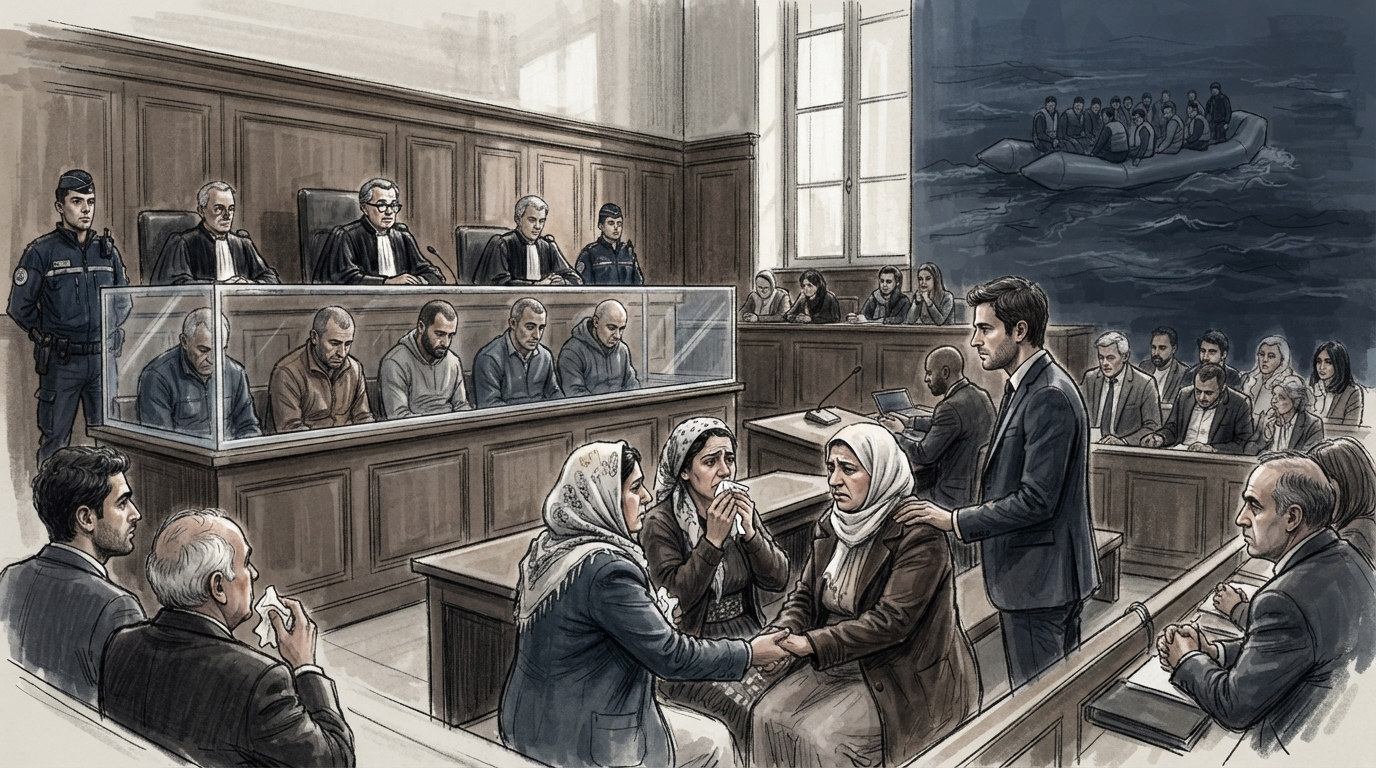
Six people traffickers have been convicted in France over the deaths of 31 migrants in the deadliest small-boat tragedy ever in the Channel.
After a four-week trial in Paris, the six were found guilty of "involuntary homicide" and handed prison sentences ranging from six to 10 years.
Seven others received lighter sentences of up to four years, while one person was acquitted.
The boat sank in the early hours of 24 November 2021 after sending distress calls to French and British coastguards. The dead, including a seven-year-old child, were mostly Iraqi Kurds, but also included Afghans, Egyptians and Iranian Kurds. Only two men survived.
According to the charge sheet, the migrants had been launched from the French coast in a boat "that was of poor quality, uncertified, unsuitable for navigation at sea, overloaded, and without correct life jackets".
The trial showed that the convicted men belonged to two different networks – one Iraqi Kurd, the other Afghan – which worked together to arrange the Channel crossing and transport migrants to the rendezvous point.
Unusually, several family members attended the opening of the court proceedings, travelling from Iraqi Kurdistan to France and giving emotional testimony about how the victims ended up on the boat.
After the verdict, their lawyer Matthieu Chirez said the ruling "comes as a relief for all the civil plaintiffs because it confirms the penal responsibility of the traffickers". He added that the trial had "humanised the families of victims".
One relative, Zana Marmand Muhammed, told the court that his younger brother Twana had "wanted to go to England to find a job and because the geopolitical situation with us is dangerous. No-one in the family wanted him to leave, but we could not dissuade him."
Nabi Mustafa Mina, the father of Zanyar, who was 19 when he died, described how he had tried to stop his son from leaving.
"I said I would help him to get married, I would give him my house, I would divide my salary in two. But no, he said he wanted a better life, that he would get by somehow. I ran out of arguments," he said.
The family members said they had paid a deposit at a bank in Iraqi Kurdistan and then tracked their loved ones’ journey through Turkey, Italy and then France. In one of Twana’s final messages, he posted a photo of himself at the Eiffel Tower.
The court also heard a statement from one of the two survivors, Issa Omar, which was read out by his lawyer. Omar said that he "would have liked to appear before the judge but I do not have the strength. Since the wreck I have the impression that part of me disappeared beneath the waves."
His lawyer Matthieu Chirez said Omar had "clung to floating bodies, to a life-jacket. He survived by keeping his eyes open so as not to go to sleep, and swimming to keep his heart beating".
Police investigating the disaster used phone tracking to identify members of the two networks.
The lower-level defendants were accused of sheltering migrants, moving them across France to the so-called "jungle" camp outside Calais, and assisting on the night of the departure.
The alleged head of the Iraqi Kurd network – named as Bashdar – was not on trial. He is being held in Iraq. His close aide – Harem Ahmed Abawaker – received an eight-year prison sentence.
The longest sentence, 10 years, was given to Obaidullah Maroofkhel, who led the Afghan network. He was tried in his absence, along with one other defendant.
Most of the 14 were Afghans or Iraqi Kurds. All but one of the defendants appeared in court as free men, so after the verdict the court issued six arrest warrants.
A separate police inquiry is under way into seven members of the French armed forces for allegedly failing to help the migrants on the night of the disaster.
The seven were at the regional sea rescue centre or aboard a navy ship, and are accused of ignoring distress calls from the boat. A decision on whether to recommend them for trial will be made in the coming months.
The trial concluded as France and the UK announced the end of the so-called one-in one-out scheme, under which the British government sent irregular cross-Channel migrants back to France and, in return, accepted people likely to be granted asylum.
France had already indicated that the year-long programme, which has seen just over 1,000 migrants move between countries, was not delivering the expected results in disrupting the traffickers' business model.