

Sharpeville massacre survivors start legal fight for justice in South Africa
At least 69 people were shot dead in 1960 but no-one has been prosecuted and victims want restitution.
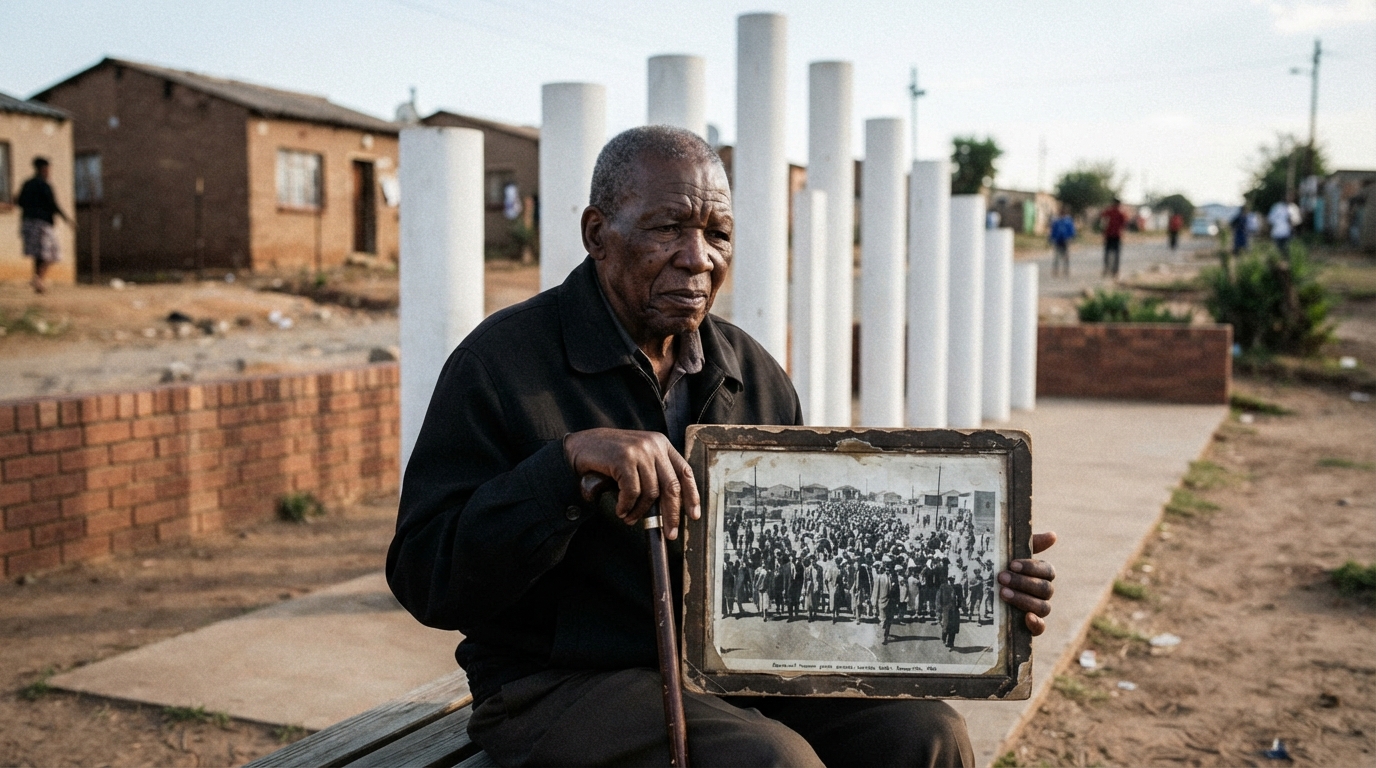
Survivors of the Sharpeville massacre in South Africa are initiating a legal battle for justice. Abraham Mofokeng, who was 20 when he participated in a peaceful protest in Sharpeville, still bears the physical scars from the brutal suppression of the demonstration 66 years ago. During what became known as the Sharpeville massacre, police notoriously opened fire on thousands of unarmed protesters.
Mofokeng, now 86, has a bullet lodged in his spine and a slight limp from a gunshot wound to his leg. He told the BBC that he joined the protest on March 21, 1960, against the oppressive laws of the white-minority government because "We weren't seen as people." He added, "All you were good for was working. You couldn't question them, you were supposed to just do as you're told."
The massacre, which Mofokeng survived, exposed the violent nature of the racist apartheid system to the world. However, due to an indemnity law passed a year after the killings, none of the perpetrators were ever prosecuted. Mofokeng is now part of a legal case, to be announced on Thursday, that aims to overturn this law.
At least 69 protesters were shot dead by police on that day in 1960, marking a pivotal moment in the anti-apartheid movement's history. Despite its historical significance, Sharpeville, a township south of Johannesburg, shows signs of decay. Its once-paved roads are reverting to dirt, many houses are still the small, brown-brick homes built during the apartheid era, and the dry, barren earth is accumulating piles of rubbish.
While the legalized system of racism ended in 1994 with the country's first democratic election and Nelson Mandela's presidency, its scars persist. Efforts at redress, including the Truth and Reconciliation Commission (TRC) established by Mandela's government to investigate apartheid-era crimes, have been made. However, Sharpeville survivors feel that justice has not been served.
The Human Rights Precinct, Sharpeville's local memorial park, recounts how the township's streets became a bloodbath. Inside the park, 69 white pillars stand, each representing a life lost. The victims were protesting against the racist pass laws, which forced Black people to carry a "dompas" (passbook in Afrikaans) that restricted their movement. Being caught without it, or in a "whites-only" area without permission, could lead to beatings and imprisonment.
In March 1960, many, including Mofokeng, then 20, responded to the Pan Africanist Congress's call to march against the dompas. Mofokeng recalled, "The life we were living under apartheid was a life of oppression. We could not move around freely. We ended up planning to march to the police station against these passbooks that were being used to oppress us."
Thousands gathered for what they expected to be a peaceful protest. Mofokeng described the scene: "[The police] had rifles, machetes, even shields. We explained to the police that we didn't want the passes anymore and we were prepared to go to prison. There was a commotion, then all hell broke loose when the police started shooting."
Mofokeng was among the more than 200 injured, and recent estimates by South African researchers have revised the death toll upwards to as many as 91.
Larazus Magotsi, another survivor now 90, walks among the graves in the cemetery where most of the victims are buried, including a 12-year-old. With tears in his eyes, Magotsi recounted, "We heard gunshots and ran and hid inside a store, peeping to see what was happening outside. People were lying on the ground. When we looked out again, we saw that some were trying to get up, but the police were just shooting at them. Others were using machetes to strike the heads of people who were still moving."
It is believed that over 1,300 bullets were fired into the crowd. Archival photos show policemen walking among the fallen bodies immediately after the massacre. The only legal action that followed was an unsuccessful attempt to charge the protesters with affray. Now, survivors and victims' relatives hope to overturn the law they believe obstructs justice.
The 1961 Indemnity Act, passed by the apartheid government after the massacre, shielded the police and government from criminal charges or civil claims related to the events at Sharpeville. This law remains in effect despite over 30 years of democratic rule.
However, the South African non-governmental organization Lawyers for Human Rights, in collaboration with UK-based law firm Leigh Day, has filed a case in the High Court, arguing that the Indemnity Act is unconstitutional under the new constitution enacted in 1994.
Charne Tracey, one of the lawyers on the case, stated, "Apart from the individual damages, what the community's looking for is basically reparations to enable their healing. They feel as though Sharpeville is a forgotten community." Their court application includes seeking class action certification, which, if approved, would allow dozens of victims and relatives to collectively sue the state for the first time. This could also potentially lead to criminal charges against alleged perpetrators, if any are still alive.
Tracey added that "Nothing has been done that assists with their healing and improvement of their quality of life, or remedy the long-term effects of what they've suffered," noting that 70 people could be involved in the class action.
Constitutional law expert Prof Frans Viljoen believes repealing the old law is crucial to "clean up" legislation and "close a chapter on the past." He explained that while South Africa has a transformative constitution, the principle of statehood continuity allows cases to be brought against the current state. "So if there were laws in our statute book in 1994, the constitution explicitly says they remain in force until parliament repeals them, abolishes them or changes them," he said, supporting efforts to declare the Indemnity Act unconstitutional to "cleanse us of that past."
The TRC, chaired by Archbishop Desmond Tutu, was largely praised for uniting victims and perpetrators, who received amnesty if they fully disclosed their actions, among other conditions. However, a major criticism was that it did not deliver justice for some, as no one was jailed for their acts, and no police officers applied for amnesty for the Sharpeville shootings.
The government informed the BBC that it has supported apartheid victims over the years and will continue to do so, and does not oppose survivors and families pursuing legal remedies. Regarding reparations, the justice department stated that 560 TRC-recognized victims of apartheid-era violence have received individual grants totaling approximately $31 million (£23 million). While not all Sharpeville survivors and relatives have been identified, they are encouraged to come forward.
For many in the Sharpeville community, there is hope that restitution will help heal decades of lingering trauma. Mofokeng expressed this hope: "Apartheid is dead and buried. A win would bring complete healing, not just for us, but for future generations as well. Considering how people died, many have not completely healed."