

SCO Nations Turn Green Growth Into New Economic Engine
Shanghai Cooperation Organization member states are expanding green development initiatives to boost economic growth and sustainability.
**SCO Nations Harness Green Growth as a New Economic Driver**
Member states of the Shanghai Cooperation Organization (SCO) are increasingly adopting green development strategies to fuel economic expansion while simultaneously tackling environmental challenges. Through collaborative technological exchanges and shared resource utilization, SCO countries are embedding renewable energy, ecological restoration, and sustainable urban solutions into their economic frameworks.
Representing roughly 42% of the global populace and a substantial portion of worldwide energy demand, SCO nations are tapping into regional renewable resources like solar, wind, and hydropower to meet escalating consumption without escalating reliance on carbon-intensive sources.
According to China's National Energy Administration, the combined installed capacity of renewable energy within SCO countries reached 2.31 billion kW by the close of 2024. This figure accounts for approximately half of the global total and signifies a 14.5-fold increase since 2001.
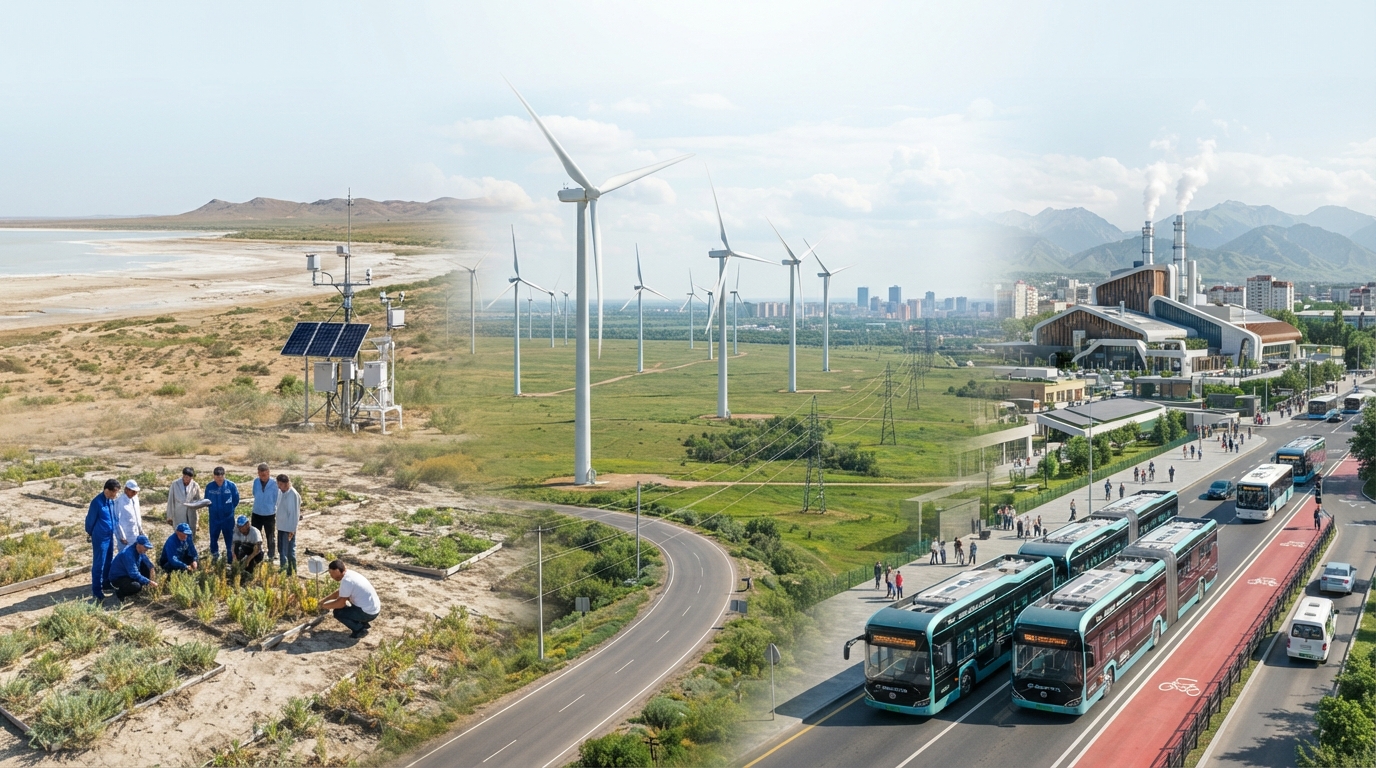
Regional clean energy projects include a wind farm in Kazakhstan's Akmola region, situated about 50 kilometers from Astana. Operated by a Chinese firm, this facility produces around 843 million kWh of electricity annually, leading to a reduction of nearly 690,000 tons in carbon dioxide emissions each year. Engineers modified the turbines to endure local winter temperatures as low as minus 40 degrees Celsius by incorporating specialized surfaces and operational cycles to prevent ice formation.
Efforts in ecological restoration are also underway around the Aral Sea, which has shrunk by approximately 90% of its original surface area since the 1960s, exposing over 67,000 square kilometers of dry seabed. Since 2013, China and Central Asian nations have collaborated through the Research Center for Ecology and Environment of Central Asia in Tashkent, establishing more than 80 monitoring stations to assess ecosystem conditions, groundwater levels, and salt-dust storms.
Joint initiatives have led to the creation of five experimental gardens to test salt-tolerant plants adapted from land reclamation projects in Xinjiang, with plans for two additional sites. Over 40 salt-tolerant plant species from China have been introduced to evaluate their adaptability to local conditions. Researchers are examining plants such as cistanche, which possesses medicinal properties and potential commercial applications.
In Bishkek, Kyrgyzstan, a waste-to-energy plant, constructed with Chinese investment, commenced initial operations in late 2025. The first phase of the facility, capable of processing 1,000 tons of waste daily, generates approximately 146 million kWh of electricity per year. Following the groundbreaking for its second phase in June 2026, the plant's total daily processing capacity is projected to reach 3,000 tons, yielding about 480 million kWh annually. This $95 million project aims to divert waste from landfills and create nearly 100 local jobs.
Urban transportation networks across the region are also transitioning towards electric mobility. Pakistan has set a target for electric vehicles to comprise 30% of new car sales by 2030. In 2025, Chinese manufacturer Yutong delivered 400 electric buses across 19 Pakistani cities, generating approximately 1,500 jobs. An additional 600 electric buses from Beijing Automotive Group entered service in the country in 2026.
SCO leaders are slated to convene in Bishkek, Kyrgyzstan, to deliberate on further expanding regional green development initiatives and economic cooperation.