

SCO countries are turning green development into a new driver of economic growth.
The member countries of the Shanghai Cooperation Organization (SCO) face a common challenge: how to continue economic development and improve living standards while protecting the environment.
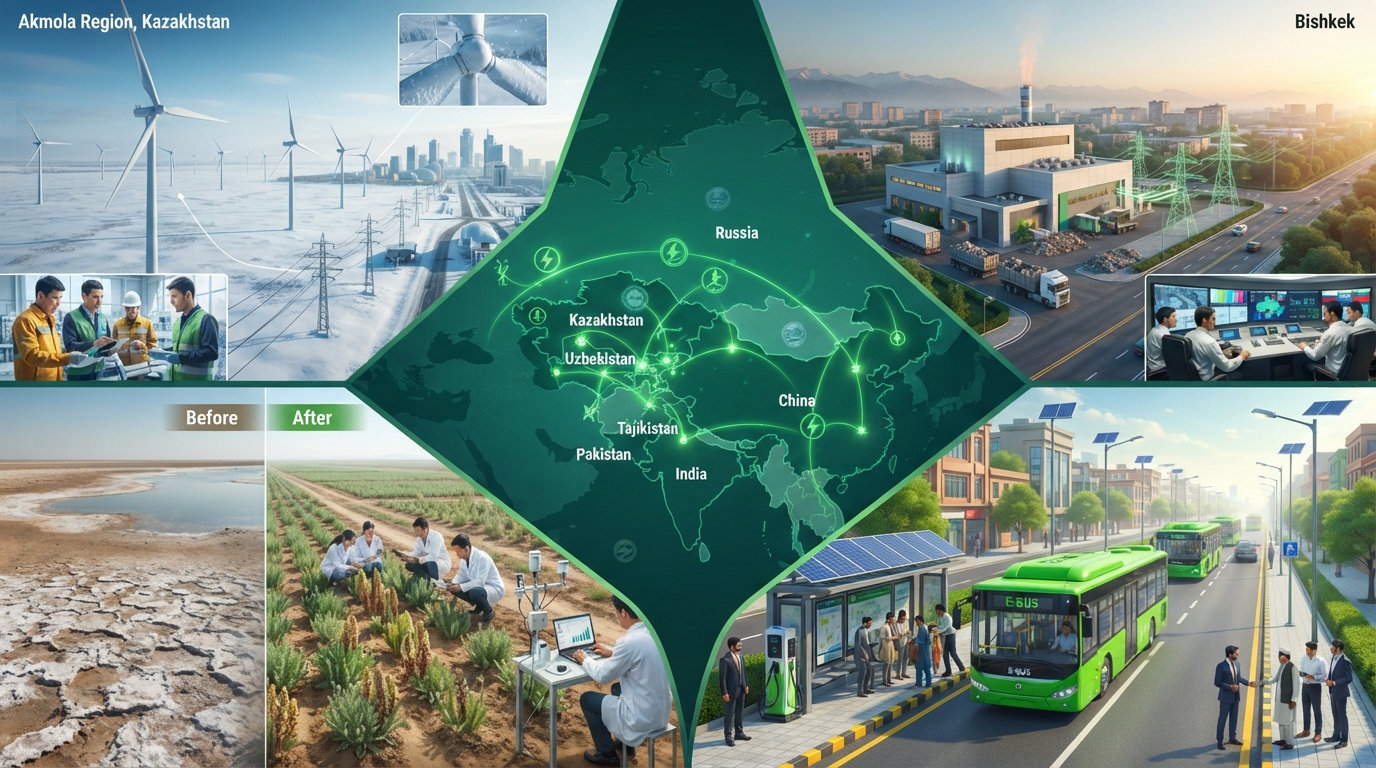
The countries of the Shanghai Cooperation Organization (SCO) are actively integrating "green" approaches into their economic growth strategies, seeking to reconcile development and improved living standards with environmental protection. This cooperation is manifested in the exchange of technologies and the use of complementary resources.
Examples of such collaboration include wind farms in Kazakhstan, the development of salt-tolerant plants in the Aral Sea region, the use of electric buses in Pakistan, and waste-to-energy in Kyrgyzstan. This experience demonstrates that "green" development can not only contribute to environmental conservation but also accelerate the energy transition, create new sources of income, and attract investment, jobs, and innovation in the region.
**Future Energy: The SCO's Transition to Clean Energy**
The SCO countries, which account for approximately 42% of the world's population, are facing growing demand for energy. The challenge is to meet this demand without increasing dependence on carbon-intensive sources. The region has significant renewable energy potential, including solar, wind, and hydropower, which are being actively exploited to create new energy sources.
A large-scale energy transition requires technology and regional cooperation. SCO Deputy Secretary-General Sohail Khan noted that high-tech products, particularly from China, can help member countries implement energy projects and strengthen regional energy connectivity.
By the end of 2024, the total installed capacity of renewable energy sources in the SCO countries reached 2.31 billion kW, approximately 14.5 times the 2001 figure and approximately half the global total, according to the National Energy Administration of China.
Kazakhstan is an example of successful cooperation. In the Akmola region, 50 km from Astana, one of the country's largest wind energy projects, built and operated by a Chinese company, annually produces approximately 843 million kWh of electricity. This helps meet the needs of local residents and reduces dependence on traditional sources.
Chief Engineer Zhang Liang reported that annual renewable electricity generation prevents the emission of nearly 690,000 tons of carbon dioxide, equivalent to removing more than 200,000 gasoline-powered cars from the road for a year.
Operating the turbines in the harsh winter conditions of the Akmola region, where temperatures can drop to minus 40 degrees Celsius, requires equipment adaptations. Engineers are using smoother surfaces to reduce icing and periodically restarting the turbines to remove ice.
**Ecosystem Restoration as a Source of New Opportunities**
The SCO's "green" agenda encompasses not only energy but also environmental issues. The Aral Sea, once the fourth-largest lake in the world, has become a symbol of environmental disaster. Since the 1960s, intensive use of water for agriculture has reduced its area to 10% of its original size. The exposed seabed, covering an area of over 67,000 square kilometers, has turned into a desert, where salt causes soil salinization and salt-dust storms.
Since 2013, China and Central Asian countries have been collaborating through the Central Asian Research Center for Ecology and Environment (CAS) in Tashkent. More than 80 monitoring stations have been established to track the state of ecosystems, water resources, and salt-dust storms. Based on the collected data, the region has been divided into seven ecological types for restoration efforts.
One area of cooperation is the application of Chinese experience in combating saline soils, developed through land restoration projects in Xinjiang. Researchers from China and Uzbekistan are testing plants that can survive in high salinity conditions and reduce salt content in the soil. Five experimental gardens have been established by 2026, with two more planned. More than 40 salt-tolerant plant species from China have been imported for adaptation testing.
Some of these plants can not only restore soil but also create economic opportunities. Bakhitzhan Khabibullaev, Director of the Aral Sea International Innovation Center, cited the example of cistanche, a plant with medicinal properties whose potential has not yet been fully explored. China has systematic scientific knowledge and practical experience in using this plant, which could be useful for Central Asian countries.
**"Green" Solutions for Growing Cities**
The "green" transition is also changing the SCO countries' approaches to urban development, including waste management and public transportation.
In Bishkek, the capital of Kyrgyzstan, a new waste-to-energy plant, built with the support of Chinese investment and technology, began operations late last year. The first phase of the plant is capable of processing approximately 1,000 tons of waste per day and generating approximately 146 million kWh of electricity annually.
In June of this year, groundbreaking for the second phase of the project took place. Once completed, the complex will be able to process up to 3,000 tons of waste per day and generate approximately 480 million kWh of electricity annually, making it the first such facility in Central Asia. The project addresses a long-standing problem in the city, where most of the waste was sent to landfills, emitting methane and creating a fire risk.
The project is costing approximately $95 million and is expected to create nearly 100 jobs for local residents, linking improved waste management with economic activity.
A similar principle is being applied to urban transportation. In Pakistan, with a population of over 240 million and high demand for transportation services, cities are faced with the need to expand infrastructure without degrading air quality. The government is seeking to accelerate the transition to electric transport, aiming for electric vehicles to account for 30% of new sales by 2030.
Chinese companies are actively participating in this transition. In 2025, 400 electric buses from the Chinese manufacturer Yutong were delivered to 19 cities in Pakistan, creating approximately 1,500 jobs. This year, another 600 electric buses from Beijing Automotive Group also entered service.
Dr. Naveed Arshad of the Lahore University of Management Sciences believes new energy transport is a promising area for cities. He stated that as Pakistan's energy infrastructure improves, electric vehicles will provide greater energy efficiency, reduce operating and maintenance costs. He added that Chinese companies possess the technological expertise and experience that can facilitate the development of new energy transport in Pakistan.
The SCO's "green" transition is becoming an independent development strategy aimed not only at reducing carbon emissions but also at creating a more environmentally friendly development model that will strengthen energy supply, create sources of income, improve the urban environment, and open up new economic opportunities.
In the coming days, SCO leaders will gather in Bishkek, Kyrgyzstan, to discuss how to transform these opportunities into deeper cooperation to create a greener and more sustainable region.
Chen Ziqi, CGTN correspondent