

Scientifically based concepts and "roadmaps" have been developed for the development of the territories of the Khorezm region
The Center for Economic Research and Reforms has prepared a separate development concept and "roadmap" for each city and district of the Khorezm region.
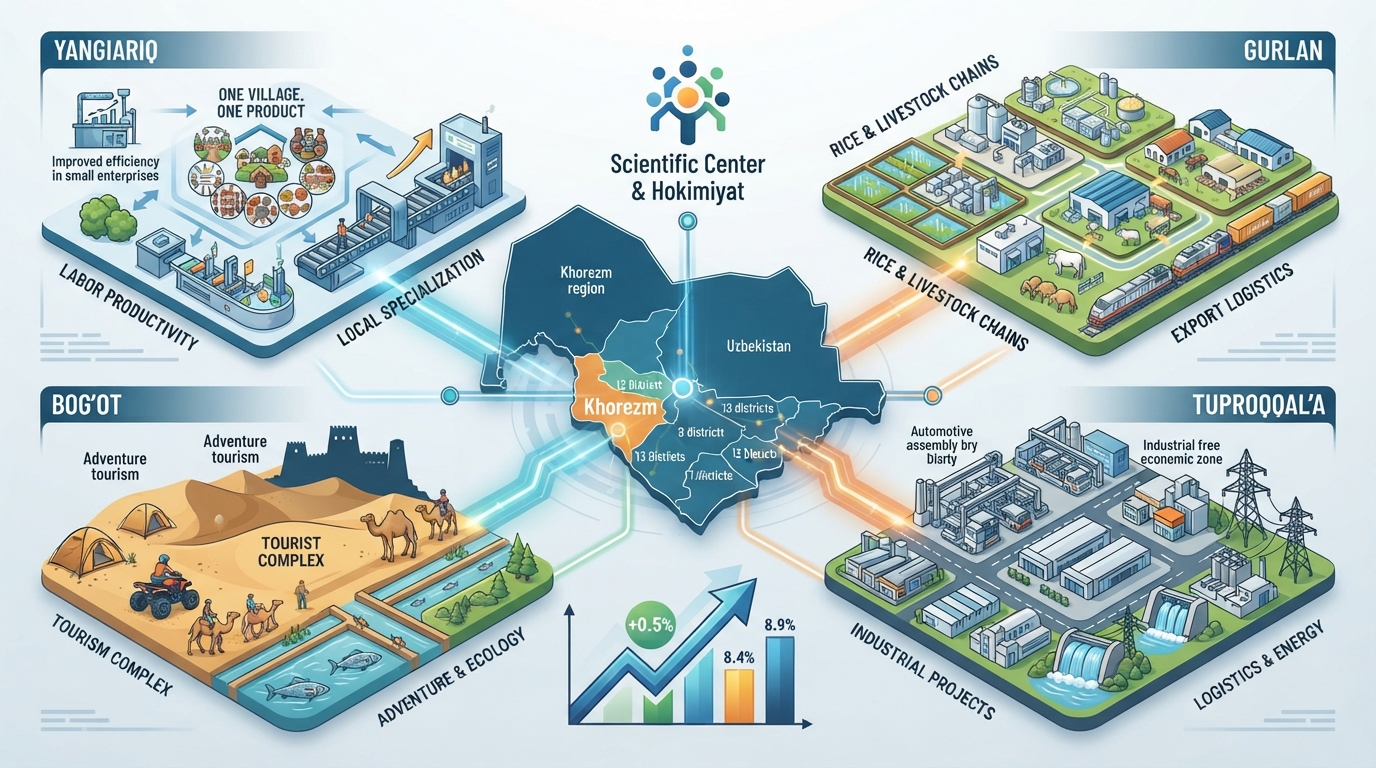
Scientifically based concepts and "road maps" for the development of the regions of Khorezm region have been developed.
On August 11, at the twenty-fifth session of the Khorezm regional Council of People's Deputies, the Center for Economic Research and Reforms discussed scientifically based concepts and "road maps" aimed at the development of 13 cities and districts of the region. These documents identified the economic potential and internal reserves of the regions, identified promising growth directions and about 150 practical measures.
These works were carried out within the framework of the tasks set at the videoconference meeting held on June 25 of this year under the leadership of the Head of State. The meeting was tasked with the widespread use of scientific approaches in the development of regions, identifying economic potential and internal reserves.
In accordance with the instructions of the President, the principle of "Center of Reason - Khokimiyat - Council of People's Deputies" was introduced. Based on this approach, the Center for Economic Research and Reforms has prepared a separate development concept and "roadmap" for each city and district of the Khorezm region.
**A new system of working with regions is being introduced based on the "Namangan experience"**
**Each region was studied based on a scientific approach**
To organize research, 13 researchers from the Center were permanently assigned to each city and district of the region. In order to coordinate work in the field, a Headquarters was established in the Khorezm regional administration.
The Center's specialists studied the state of industries and sectors, natural raw material potential, geographical location and environmental conditions, and infrastructure capabilities in each region. The analyzes were carried out based on more than 20 scientific methods and questionnaires.
Based on the opportunities and promising directions identified as a result of the studies, scientifically based concepts and "roadmaps" for the development of cities and districts were developed based on a single methodological approach.
About 150 practical measures have been included in the "roadmaps" for the development directions identified in 13 regions of the Khorezm region. In addition, 10 promising growth directions have been formed for each region, which will be studied in depth by the end of the year.
**Labor productivity and local specialization opportunities will be studied in Yangiaryk**
It is planned to identify internal reserves for increasing labor productivity in industrial and service enterprises operating at low capacity in the Yangiaryk district.
At the same time, studies will be conducted on the development of economic specialization of neighborhoods and villages based on the "One Village One Product" (OVOP) model, expanding the system of industrial cooperation and localization (Local Supplier Development).
This approach is aimed at the effective use of local resources and the existing production base, increasing the capacity of enterprises, and expanding the opportunities for regional cooperation.
**Rice and livestock value chains to be developed in Gurlan**
In Gurlan district, opportunities for full use of existing export potential have been explored by developing deep processing chains in the rice and livestock sectors.
Based on the district's comparative advantages, it is planned to complete the livestock and rice value chains, develop the stages from raw materials to the production of high-value-added products.
Work is also being carried out to improve production and export logistics by fully utilizing the capabilities of the Gurlan-Karaozak railway network.
**There is an opportunity to create a new tourist complex in Bogat**
In Bogat district, opportunities for deep processing of fruits and vegetables, development of tourism, and increasing fish farming through the effective use of water, including collector water, have been identified.
The geographical location of the district and the sandy-desert landscape around the "Qal'ajiq Qal'a" make it possible to combine camel riding, quad biking, fishing and gastronomic tourism into a single tourist product.
Currently, these resources are not combined into a single route. There is an opportunity to create a new tourist complex by launching eco-safari and adventure tourism and attract up to 10 thousand foreign tourists per year.
**Automotive, logistics and high-energy industrial projects in Tuproqqal'a**
Khorezm region, along with its rich historical and cultural heritage, also has significant opportunities for industrial development.
Measures have been identified in the Tuproqqal'a district to increase the efficiency of industrial zones using the Pitnak automotive base, introduce a dual education system, and expand cross-border logistics and export potential.
Also, the possibilities of organizing services along the international highway, using the capabilities of the Tuyamoyin HPP, main electricity and gas networks, and placing industrial projects with high energy capacity were studied.
The effective use of the territory of the branch of the Hazorasp free economic zone in the district was also identified as one of the directions for increasing the industrial potential of Tuproqqala.
**The "Roadmaps" are expected to add an additional 0.5 percentage points to the regional economic growth**
According to calculations, the implementation of the measures set out in the "roadmaps" developed for 13 regions of the Khorezm region is expected to produce more than 400 billion soums of additional products and services this year alone.
As a result, the economic basis will be created for accelerating the growth rate of the regional gross regional product by an additional 0.5 percentage points this year, i.e. from 8.4% to 8.9%.
The developed concepts and "road maps" will serve to direct the existing resources, comparative advantages and internal reserves of the regions to specific economic results. At the next stage, the implementation of the specified measures and in-depth study of the promising growth directions formed for each region will continue until the end of the year.
Center for Economic Research and Reforms
Public Relations Department