

School at age 4, sleeping on desks, lessons on a boat: how do children study in different countries of the world?
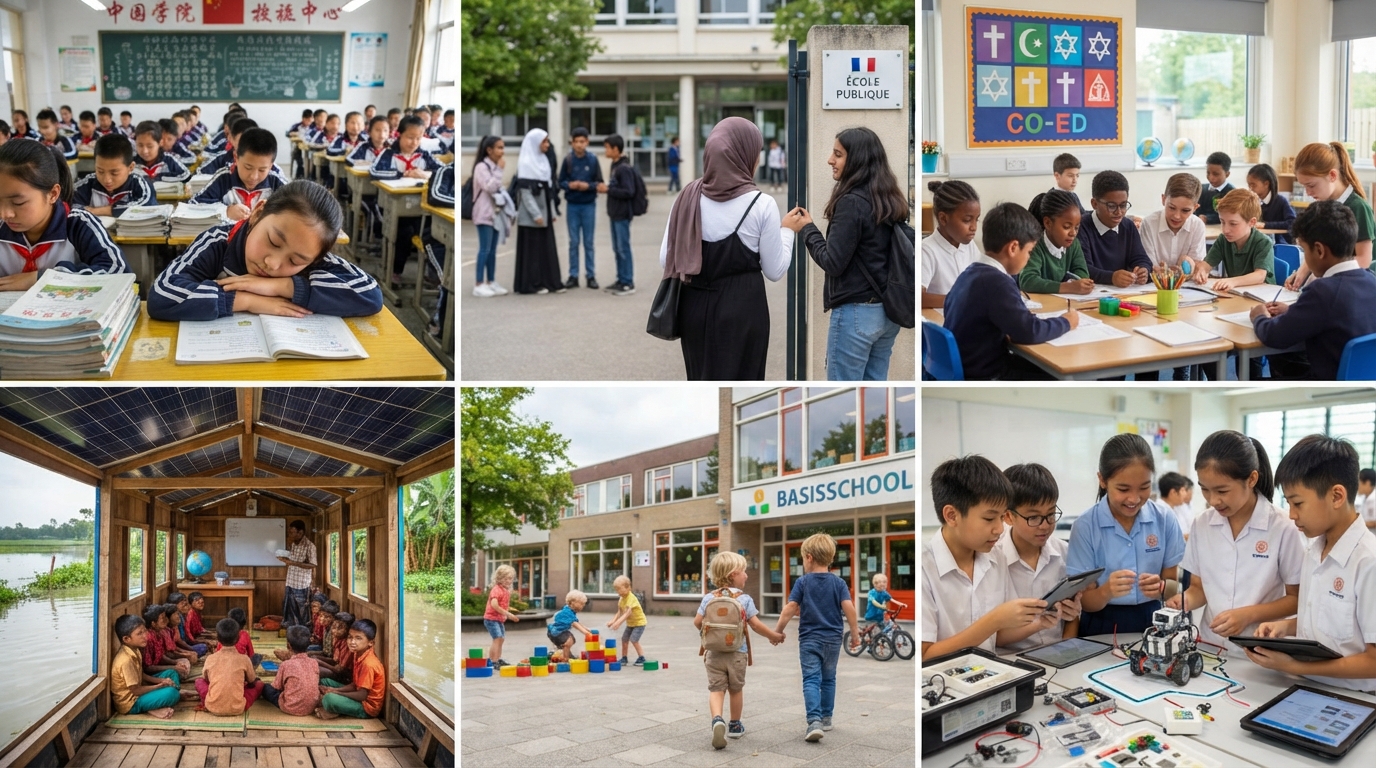
School at age 4, sleeping on desks, lessons on a boat: how do children study in different countries of the world?
There is no single, identical, and perfect model of education for everyone in the world. While in one country a child sees hard work and high results as the path to success, in another, their independence and mental well-being are prioritized. Yet another country views school not just as a place that provides knowledge, but as an institution that raises a good person.
These differences raise a question: what is actually more important in providing a child with a quality education — strict discipline, freedom, upbringing, or practical knowledge?
**China: education is the most important thing**
"As long as we live, we learn. We study until we die" — there is no exaggeration in the Chinese student's motto. In China, entering a higher education institution is considered almost the only way to climb the social ladder and escape poverty, and competition among applicants is extremely fierce. In some universities, there can be up to 200 applicants for a single place. For this reason, studying hard from morning till night has become a unique value in Chinese schools. A student studies independently at home in the morning before classes start, then goes to school, and after 16:00 heads to extra classes.
During the day, each child attends an average of 7 classes of 40 minutes each. A one-hour break is given for lunch between classes. In some schools, sleeping is also allowed at this time, because students often cannot sleep well at night due to the heavy workload. A half-hour nap after lunch is both a habit and a physiological need.
To keep up with the school curriculum and get high scores, children memorize material in large volumes rather than analyzing it deeply. Memorization does not aim to develop critical thinking, but it helps to successfully pass the next test. The main exam in the lives of Chinese people — the "gaokao" taken to enter higher education — tests how well they have memorized and can reproduce the school curriculum. Here, the ability to memorize is particularly useful.
**France: wearing religious clothing to school is not allowed**
One of the main principles of French society enshrined in the Constitution is laïcité, which translates as secularism. According to this concept, religion and public life, especially politics, must not interfere with each other in any way. This is not opposition to religion — the country's population can freely practice any religion. However, this is a centuries-old view that religion should not influence state affairs and public order. For example, in 2011, covering the face in public places was made illegal in France. This in practice banned Muslim women from wearing the burqa or niqab.
Also, wearing religious clothing in schools is prohibited in France. This restriction applies not only to Muslim men and women, who cannot wear the abaya, qamis, and hijab, but to others as well. In particular, Sikhs are banned from wearing turbans, Jews from wearing the kippah, and Christians from wearing crosses in school. Although the law was passed in 2004, it still causes controversy, and violations are regularly recorded in schools.
**Ireland: from religious discrimination to multi-denominationalism**
Although France and Ireland are countries where the majority of the population is Catholic, their attitudes toward religion in schools differ sharply from each other. In Ireland, 93 percent of primary schools are Catholic schools. Until recently, they had the right to refuse to hire non-Catholic teachers and to deny admission to representatives of other religions, especially atheist children. Many parents baptized their children solely to get them an education. It was only in 2018 that Ireland passed a law abolishing selection on religious grounds in Catholic primary schools. By 2022, a significant decrease in the number of registered baptisms was observed.
Multi-denominational schools are a new type of educational institution in Ireland, the purpose of which is to promote pluralism. Currently, there are 166 (5%) multi-denominational primary schools in the republic.
**Bangladesh: lessons on a boat**
70 percent of Bangladesh's territory lies less than one meter above sea level. The country suffers simultaneously from floods during the rainy season and rainfall coming from the Himalayas. Because of this, one-fifth of the country's total area is flooded every year.
During floods, schools have to close, as a result of which millions of children are deprived of the opportunity to receive an education. Therefore, the government of Bangladesh was forced to introduce an innovative solution: establishing schools on boats. Most of them run on solar panels. Thanks to such floating schools, children do not get disconnected from the educational process even during extreme weather conditions that usually last for weeks and months.
School-boats pick up students from coastal villages, anchor at the final destination, and conduct lessons in small groups on board. After classes, the boats take the students back to their homes and gather the next groups. Each such school has a classroom designed for 30 students, a laptop connected to the internet, and a library, providing primary education up to the 4th grade.
**Japan: how to be a good person?**
The main goal of the Japanese school is to raise a decent citizen. Regardless of the direction of education and the student's age, moral education is included in every curriculum along with subjects like mathematics and the Japanese language. This subject is taught throughout the entire educational process. In grades 1–2, children are taught the basic rules of etiquette, while in grades 3–4, this program is called "Observing social behavior norms in daily life." Students in grades 5–6 learn how to benefit society, and in middle school, a block called "Understanding the need to live a decent life" is introduced. Among Japanese teachers, the journal Dotoku kyoiku ("Moral Education"), published by the Ministry of Education, Culture, Sports, Science and Technology of Japan, is quite popular. It publishes methodological developments and recommendations on teaching morality.
The qualities of a polite person are instilled in the minds of Japanese school children, and the basic principles of morality — empathy, kindness, willpower, tolerance, justice, love for one's culture, and loyalty to the homeland — are taught. At the same time, special emphasis is placed on diligence, endurance, and the priority of public interest over everything else.
**Netherlands: to the first grade at age four**
In the Netherlands, children go to school on the day they turn four, which is why new students are constantly joining the class throughout the year. The purpose of this approach is to ensure that all students start classes having reached the same level of development. True, older students, for example, have more time to adapt to the class and make friends than those born at the end of the year. Nevertheless, a Dutch child can step into their first grade precisely on their fourth birthday.
From the age of five, attending school becomes compulsory for children. And this is a very pleasant obligation — according to UNICEF research, students in the Kingdom of the Netherlands are the happiest children in the world. The reason Dutch students are happy is that great respect is shown here to children's independence and freedom. The country's school system is less focused on performance than those of other countries: children are given choices, allowed to spend their time playing, developing social skills, and setting their own priorities. At the same time, children in the Netherlands do not study poorly — the country is among the top ten countries in the world in terms of education level.
**Singapore: a young and effective school education system**
Singapore has repeatedly taken leading positions in international education rankings. One of the keys to success is a play-based approach to education.
Before performing operations with numbers, Singaporean children draw pictures of fruits, sweets, or students on paper or a board, and work with bar and block diagrams. Every calculation, whether it is addition, division, or fractions, is explained through a concrete real-life example before being translated into mathematical language. Until the 6th grade, children learn to systematize and model not only examples and equations, but also real-life problems, because they realize the practical importance of mathematics from an early age. Play methods are also used in other subjects: for example, to better understand the principles of electricity, students build robots. However, each stage of education is accompanied by rigorous tests, and this gradually prepares students for the PSLE (Primary School Leaving Examination) — the primary school graduation exam.
In secondary school, children study for another 4–5 years, i.e., until about 17 years of age. During this period, they deeply study 5 core subjects (English and an additional language, mathematics, one humanities, and one science subject), and also choose from 5 to 10 elective subjects.
In Singapore, grades are given on a hundred-point system. In this country, teachers do not openly discuss students' performance, so students do not know their classmates' grades.
Based on the results of tests at the end of each semester, the accumulated points are entered into a document called a report card. Also, the teacher writes a brief characterization of the student in the diary. For example, they get along well with people, speak English or Chinese fluently, answer in class, but have difficulties in mathematics.
**What about Uzbekistan?**
One of the unique aspects of the education system of Uzbekistan is that great importance is attached to upbringing alongside academic knowledge. In schools, students are instilled not only with subject mastery, but also with values such as love for the Motherland, respect for elders, and behavior in a team. In this respect, the approach in Uzbekistan's schools can be compared to some extent with the traditions of moral education in Japan.
However, there are also problems in the education system. The gap in education quality between regions, the large number of students and teachers in some schools, and the issue of implementing modern educational methods equally in all regions remain relevant. In addition, rather than evaluating a student solely based on test and exam results, developing their independent thinking, problem-solving ability, creativity, and practical skills is becoming increasingly important.
Looking at the education systems in different countries of the world, none of them can be called absolutely ideal. Each model has emerged from the needs, culture, and historical conditions of the society. Nevertheless, useful aspects for improving the quality of education can be found in each of them.
Therefore, the best path for Uzbekistan is not to completely copy the education system of another country. On the contrary, the most effective aspects of different countries should be combined: from China — discipline and diligence, from Japan — upbringing, from the Netherlands — student independence, from Singapore — practical and systematic thinking, and from Bangladesh — adaptability to conditions can be learned.
For this, the main question in education needs to be changed: the question should not be "How much information did the student memorize?", but rather "How well did they understand the knowledge they received and can they apply it in life?" should be more important.