

Saudi Arabia urged to spare man sentenced to death over Facebook post
Anojan Sivarasa faces execution after he was found guilty of blasphemy over a Facebook comment.
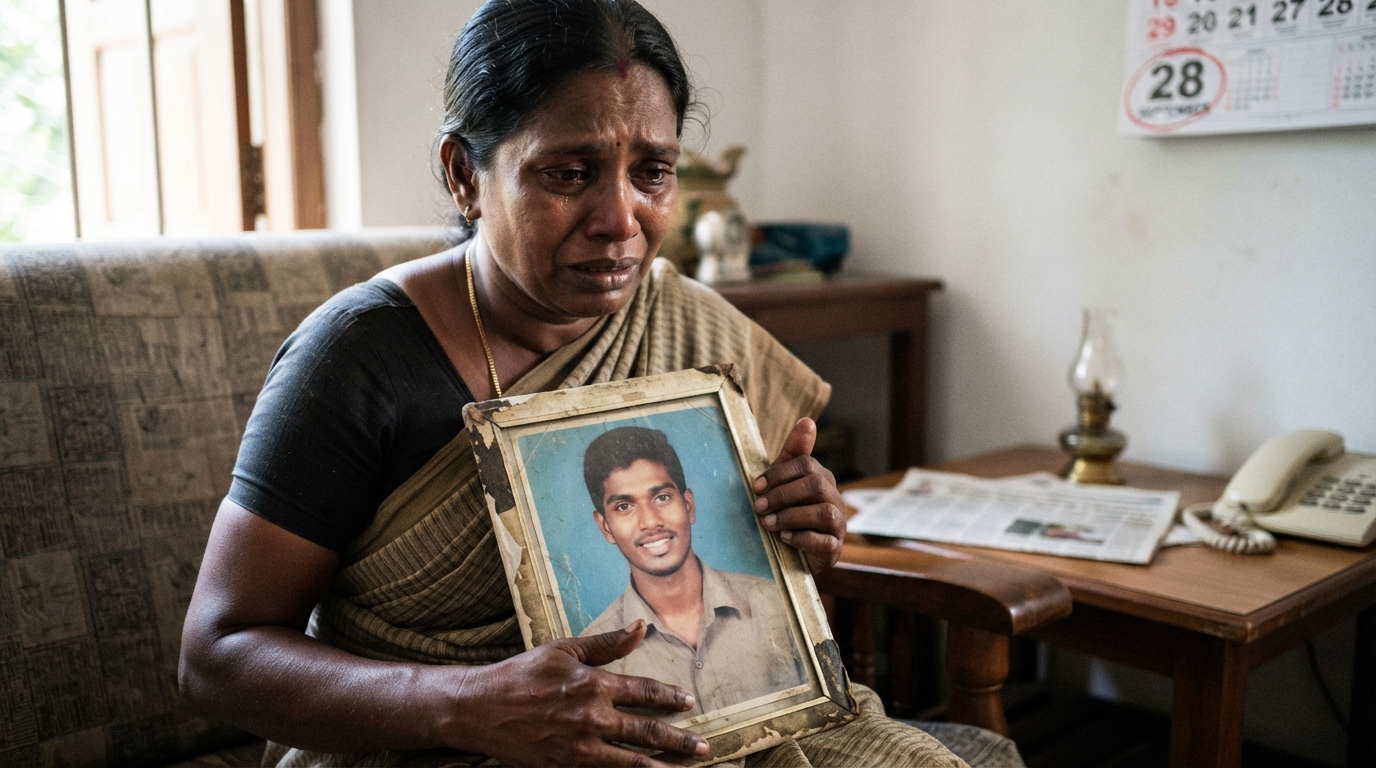
Saudi Arabia urged to spare man sentenced to death over Facebook post
Anojan Sivarasa's family have not heard from him for more than a week
"I plead for mercy for the wrongs committed by my son. Please forgive him and send him back to us."
Through tears, Rasamanickam Yogalakshmi made a desperate appeal for the life of her eldest son, Anojan Sivarasa. The 24-year-old migrant worker is now facing the death penalty in Saudi Arabia after an appellate court found him guilty of blasphemy against Islam and the Prophet Muhammad over a Facebook comment.
The case has caused shock across Sri Lanka, prompting widespread concern and civil society petitions nationwide. Several political parties and government agencies have coordinated diplomatic efforts to seek clemency.
But the family has received no information about his condition since 28 September. The Sri Lankan government has told the family not to make any further public statements while diplomatic efforts continue.
Saudi authorities have not announced any official execution date, and it is still unclear when the sentence may be carried out. Saudi Arabia has a record of carrying out executions without warning families or foreign embassies, informing relatives only after the sentence has been carried out.
Anojan was charged after a social media dispute that followed an incident during a Hindu pilgrimage in Sri Lanka. In late June, video of a young Muslim man kicking a dog after Hindu pilgrims circulated widely online, sparking religious arguments on social media.
During the exchange, one user posted insulting comments about a Hindu deity, prompting Anojan to reply in Tamil with an insult directed at the Prophet Muhammad.
Although Anojan quickly deleted the comment and posted an apology video, it was screenshotted and brought to the attention of his employer and Saudi officials, leading to his arrest in July.
His personal devices were later confiscated, and Saudi officials deleted his social media accounts.
"People in Saudi Arabia knew nothing about this matter. It was individuals in Sri Lanka who sent emails to the company where my brother worked.
The company employing Anojan informed the authorities in Saudi Arabia, who registered a case against him, according to Hamsidan.
Anojan was first sentenced by the Al-Ahsa Criminal Court to five years in prison and a fine of 3m Saudi riyals (about $0.8m; £0.6m). An appeal filed on his behalf to reduce the sentence was rejected, according to Sri Lankan Foreign Minister Vijitha Herath.
The case took a dramatic turn on 17 September, when Saudi prosecutors appealed for Anojan to be tried under Sharia law rather than the country's cybercrime law. The appellate court accepted the prosecution's request, raising the sentence to death.
Sri Lanka's Ministry of Foreign Affairs said it is taking every possible step to help Anojan.
His family met President Anura Kumara Dissanayake at the Presidential Secretariat on 21 September. The president assured them that the government would make every effort to secure a general pardon for him, and instructed diplomatic channels to engage with Saudi authorities.
The case has drawn support across religious lines. Senior Buddhist leaders, the Mahanayake Theros of the Ramanna Nikaya and the Amarapura Maha Nikaya, along with Hindu religious leaders, submitted a memorandum to the Presidential Secretariat calling for urgent state intervention.
In addition, a four-member Sri Lankan legal delegation is travelling to Saudi Arabia this week to meet Anojan's local defence lawyers.
"There are two law firms in Saudi Arabia handling Anojan's case. We are going there to meet the lawyers from these two firms, discuss the case and plan what can be done next," one member of the team, MP Upul Kumarapperuma, told BBC Sinhala.
Back in Sri Lanka, contact between Anojan and his family has stopped completely.
"My brother hasn't called for two days." Hamsidan said on 28 September. "We informed the embassy and asked officials to look into the matter and update us. They said they would check. We are still waiting, as we have not yet received a response."
In Saudi prisons, inmates on death row usually lose access to personal mobile phones, with official calls handled strictly through prison authorities.
Human rights groups have repeatedly voiced concern over harsh punishments for online speech in Saudi Arabia.
In July 2023, Mohammed Al Ghamdi, a retired Saudi schoolteacher, was sentenced to death over comments he made on several social media platforms, according to the United Nations.
"The death sentence against Mohammad bin Nasser al-Ghamdi, who has a total of just 10 followers on both of his anonymous Twitter accounts and is accused of nothing other than expressing his opinions on social media, is ludicrous," Philip Luther, Amnesty International's Research and Advocacy Director for the Middle East and North Africa, said at the time.
Al Ghamdi's sentence was later overturned, and he was given 30 years in prison, according to ALQST for human rights, an independent non-governmental organisation that defends and promotes human rights in Saudi Arabia.
There are more than 10 million foreign workers in Saudi Arabia, according to the International Organisation for Migration (IOM). Rights groups say low-wage migrant workers are especially vulnerable in the Saudi legal system because of language barriers and a lack of proper legal representation.
Executions for blasphemy are relatively uncommon compared with those for drug offences or murder handed down by Saudi courts.