

"Safe Childhood". In Uzbekistan, teenagers are developing a platform that will help children report violence
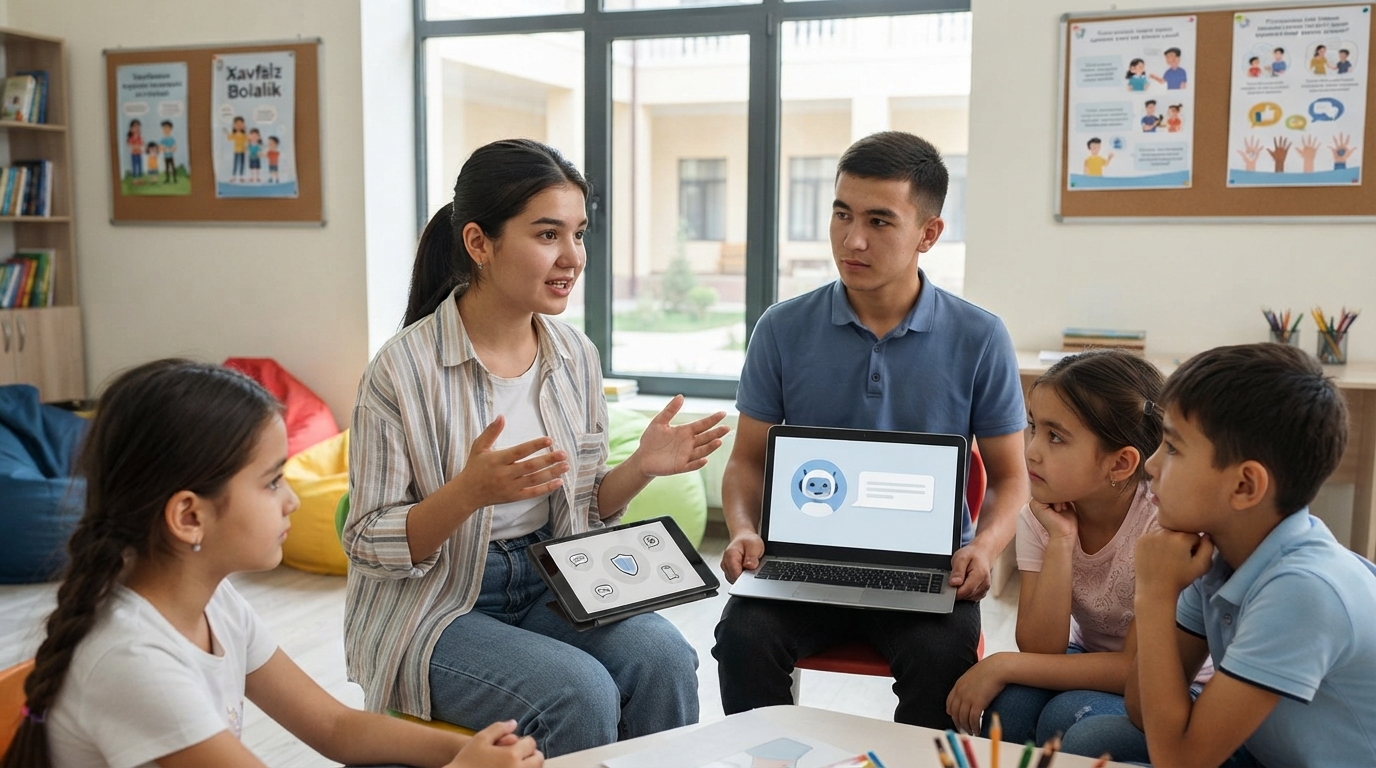
"Safe Childhood". In Uzbekistan, teenagers are creating a platform that will help children report violence
For children who have experienced violence, it is often difficult to tell adults about it and ask for support. Participants in the Uzbekistani project Xavfsiz Bolalik ("Safe Childhood") are helping their peers recognize violence and understand where to turn in a dangerous situation. Now, the team is also working on an AI-powered platform for anonymous reports. A Podrobno.uz correspondent met with the project at the World Summit on Children's Wellbeing in Samarkand and learned how teenagers are helping their peers and what role new technologies can play in this.
How teenagers are helping their peers
The Xavfsiz Bolalik project was launched in 2025. Its participants are teenagers seeking to make information about protection from violence more accessible to children.
As team representatives Azambek Urmonbekov and Lailo Khasanova explained, about 50 volunteers are currently involved in the project. They hold meetings with schoolchildren and residents of children's institutions, talk about various forms of violence, and explain where to apply if a child finds themselves in a dangerous situation or witnesses such an instance.
According to the team, the project has already reached more than three thousand children across five schools and five institutions. During the meetings, volunteers also find out how children themselves perceive the problem of violence and whether they are ready to seek help.
According to survey results presented by the team, about half of the participants consider violence to be a family matter. At the same time, only 1–3% of respondents said that in such a situation they would contact social services or law enforcement agencies.
Among the reasons why children may hesitate to speak about what happened, the project participants cite the fear that they will not be believed or taken seriously, as well as not knowing where to turn.
Why it is difficult for children to ask for help
The problem is not limited to a child being afraid of an adult's reaction. Children do not always understand which actions are considered violence, how to behave in a dangerous situation, and whom they can contact.
"For many children, the topic of violence remains unfamiliar. At first, they are reluctant to talk about it and often do not know how to react in dangerous situations," said Azambek Urmonbekov.
According to the project participants, it is sometimes easier for a child to open up to a peer than to an adult. Therefore, teenagers try not only to pass on information, but also to create a space where children can discuss difficult situations and learn about available ways to get help.
This issue does not only concern physical violence. Topics that worry children in various countries also include internet bullying, cyberbullying, peer pressure, and safety at home.
According to the presentation participants, about 1,700 children from 110 countries, including Uzbekistan, took part in international consultations conducted with the participation of the UN. Among their wishes were the ability to report problems online and the readiness of adults to take children's words seriously.
How the AI platform will work
The next stage of the project is the creation of a platform through which children will be able to anonymously report cases of violence and seek help. The team is considering the possibility of using artificial intelligence for this.
It is assumed that a child will be able to send a message via a chatbot. The system will preliminarily evaluate the request, after which a social worker will step in to determine further action.
For now, the platform is under development. Its practical effectiveness will depend not only on technical capabilities, but also on how the processing of reports, the protection of personal data, and the transfer of information to specialists are organized.
Artificial intelligence should not replace professional help. In such situations, it is important that a report does not go unnoticed and that the child receives support from a person who can assess the circumstances and take the necessary measures.
"Artificial intelligence can be a useful tool for protecting children, but the most important thing is for adults to know how to listen to them," noted Lailo Khasanova.
During the presentation, data on the work of the Children's Ombudsman in Uzbekistan were also cited. According to the speakers, in 2024 the agency received 1,064 appeals, of which only 24 came directly from children. The source of these figures was not specified in the presentation.
Why technology alone is not enough
An anonymous platform can become an additional way to report a problem; however, by itself, it does not guarantee that a child will receive the necessary help. This requires specialists, a clear response procedure for appeals, and children's confidence that their words will not go unheeded.
Prevention is no less important. Children need to be explained how to recognize violence, where to look for support, and why they should not be left alone with a dangerous situation. Adults, in turn, need to know how to listen to a child and not trivialize their experiences.
Possible areas of work include peer support groups, accessible reporting channels, training for teachers and other adults, and the participation of children themselves in developing solutions related to their safety.
Xavfsiz Bolalik combines the educational work of teenagers with the idea of a digital tool for reporting violence. Currently, the team is developing volunteer activities and creating the platform. The next important step is to show how these initiatives will work in practice and how children will be able to receive real help after making a report.