

Saddam also hoped
Wall Street heads to the steppe: why Central Asia has piqued the interest of BlackRock and Trump's children
**Saddam also hoped**
Recently, Central Asia, primarily Kazakhstan and Uzbekistan, has increasingly been receiving signs of favor from major American businesses and economists.
Against the backdrop of conflicts flaring up around the world, slowing economies in developed countries and China, as well as growing fears of global inflation, the key states of Central Asia are demonstrating rapid growth and attracting investors with reforms. Among those interested were even the children of US President Donald Trump, who decided to invest in a metallurgical project in Kazakhstan.
The growing interest in the region is noticeable at least from the headlines about summits in the "Central Asia + 1" format. The first meeting in this format at the level of country leaders, albeit online, was held by India in January 2022. Later that year, the "CA + Russia" summit took place in person for the first time. The following year, the baton was taken up by China, the US, Germany, and the Gulf Cooperation Council, and in 2025 by the European Union, Japan, and Italy. Most recently, in mid-September, a summit was held with the President of South Korea.
All of these major world economies discussed joint investment projects with Central Asia. Russian media often write about China's "Belt and Road" infrastructure and logistics strategy, which stimulates, among other things, investments in the region. But other countries have similar initiatives as well. For instance, the last country to meet with Central Asian leaders—South Korea—has had a development strategy with the region called "K-Silk Road" in place since 2024.
**The metal of war**
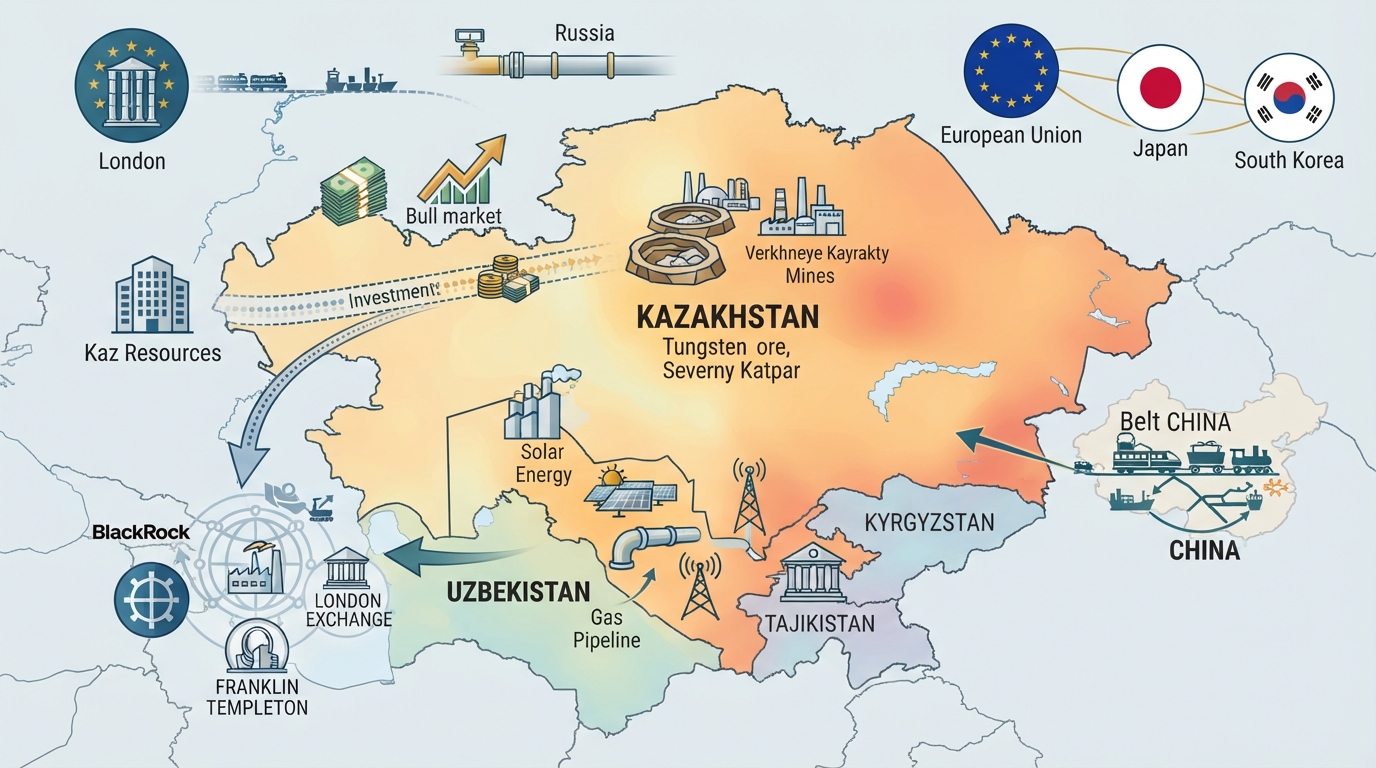
The family of US President Donald Trump also has a personal interest in the region. As the Financial Times found out in the spring of 2026, Kaz Resources, a company partially owned by his children Donald Jr. and Eric, acquired a 70% stake in an enterprise that will develop some of the planet's largest tungsten deposits—Severny Katpar and Verkhneye Kairakty in Kazakhstan. These two deposits will be able to produce about 15% of all global tungsten output.
According to financial reports, access to them was sold to the American businessmen for $114.8 million. However, the development itself will require huge investments—around $1.1 billion, Rabbi Pini Althaus noted in an interview with the New York Times. The US government, which has already approved federal funding for the project, is expected to help with this.
Eric and Donald Jr. told the NYT that they participate in Kaz Resources as "passive investors" and do not make management decisions. The White House emphasized that all decisions are made solely in the "interests of the American people."
The US needs Kazakh tungsten not only for the well-being of the president's children. As the NYT writes, tungsten is the "metal of war," used for the production of ammunition, aviation, and weaponry. At the same time, this market is dominated by China, which restricts exports of tungsten and other critical minerals, causing the price of the metal outside the PRC to increase sixfold over the year.
It is against this backdrop that American officials turned their attention to Central Asia. As a representative of the Ministry of Industry and Construction of Kazakhstan noted in a conversation with the NYT, the country is capable of mining and processing 25 of the 60 types of raw materials included in the US critical minerals list.
China also laid claim to the deposits, but, as the NYT writes, Trump personally convinced the President of Kazakhstan, Kassym-Jomart Tokayev, to hand over the critical deposits to the American company.
**BlackRock sees opportunities**
However, foreign investors are privatizing more than just mines. In the spring, the government of Uzbekistan sold a 35% stake in its national investment fund, UzNIF, in an initial public offering conducted primarily on the London Stock Exchange, for $603.6 million. The national fund owns blocking stakes in 13 companies in the utilities, energy, telecommunications, banking, and transport sectors.
Half of the entire placement went to major global institutional investors—BlackRock, Franklin Templeton, Redwheel, and the Allan & Gill Gray Foundation. And they do not intend to stop there. "It appears that we will have more opportunities in Uzbekistan in the future," Ben Powell, chief investment strategist for the Middle East and Asia-Pacific region at the institute of BlackRock, the world's largest asset management company, stated without providing details.
Such optimism from the world's largest fund management company may also be linked to its contacts with the President of Uzbekistan, Shavkat Mirziyoyev, and the head of his administration. In July, he met with BlackRock's Senior Managing Director Adebayo Ogunlesi. According to a press release, they discussed, in particular, "expanding partnership in the field of privatization."
A privatization campaign has begun in Uzbekistan that did not happen in the 1990s, which is why the main attention of major international investment funds is focused here, said Stanislav Pritchin, head of the Central Asia Sector at the IMEMO RAS. According to him, among institutional investors, BlackRock and Franklin Templeton are the most active in the country and are helping to bring local companies to IPOs.
At the same time, Powell did not overlook Kazakhstan. In a conversation with Bloomberg, he welcomed the ongoing reform of the pension system and capital market there. "Kazakhstan is becoming more capital-friendly, and as the country feels the benefits, it is becoming even friendlier. If we see more opportunities, we will readily deploy additional funds here," the BlackRock representative noted.
**A heated region**
In a recent survey of economists and officials by the World Economic Forum (WEF), Central Asia emerged as one of the most promising regions in the world in terms of economic growth rates, second only to India and Southeast Asia. Almost half—44%—of the surveyed economists expected "strong" or "very strong" economic growth over the next 12 months, while 50% expected moderate growth. According to their forecasts, the region's GDP will grow by 5.6% in 2026 and by 5.3% in 2027, following a growth rate of 6.9% in 2025. Despite the slowdown, the WEF considers Central Asia's prospects favorable due to domestic consumption and investment.
The main constraint there is considered to be inflation. In Kazakhstan, it fell to 9.8% in August, but still remains quite high. However, compared to May, chief economists have improved their inflation forecast for the region.
Investors are still primarily attracted by raw materials, but also by "transit and neutrality, critical metals, energy, and even a consumer market inhabited by 80 million people," lists Freedom Global analyst Daniyar Orazbayev. To develop more high-tech industries, the region lacks a technological base and qualified specialists, Pritchin believes. "In reality, the investment flow is very selective, very limited," he notes.
Investors also show selectivity when choosing countries in the region, whose attractiveness to them varies significantly. Kazakhstan remains the leader in accumulated foreign direct investment (FDI), but Uzbekistan has recently become the fastest-growing country, all experts surveyed by Frank Media noted.
"While institutional players usually come to Kazakhstan, with interest drawn to sovereign papers and quasi-state Eurobonds, in Uzbekistan investors are aimed at participating in the privatization program and buying corporate sector bonds," explains Zhannur Ashigali, director of the sovereign and regional ratings group at ACRA. In Kazakhstan, the carry trade has become popular in recent years. Yields on local government bonds in tenge are higher than those in base currencies, including dollar papers, which gives investors the opportunity to earn on the difference between them, Ashigali notes. At the same time, compared to its neighbors, the country has a more developed financial infrastructure, which makes Kazakh papers particularly attractive.
Meanwhile, Tajikistan and Kyrgyzstan are still lagging behind. In both countries, China had the highest share of FDI in 2025: 60% and 47% respectively, pointed out Kirill Lysenko, leading analyst for sovereign and regional ratings at the Expert RA agency. Although overall it grew in all countries of the region—the PRC remains the largest investor in Central Asia, he noted.