

Russian strikes destroy 12 million books ahead of Ukraine's first week back at school
Ukraine says Russia is deliberately attacking its culture, after strikes on publishers and churches.
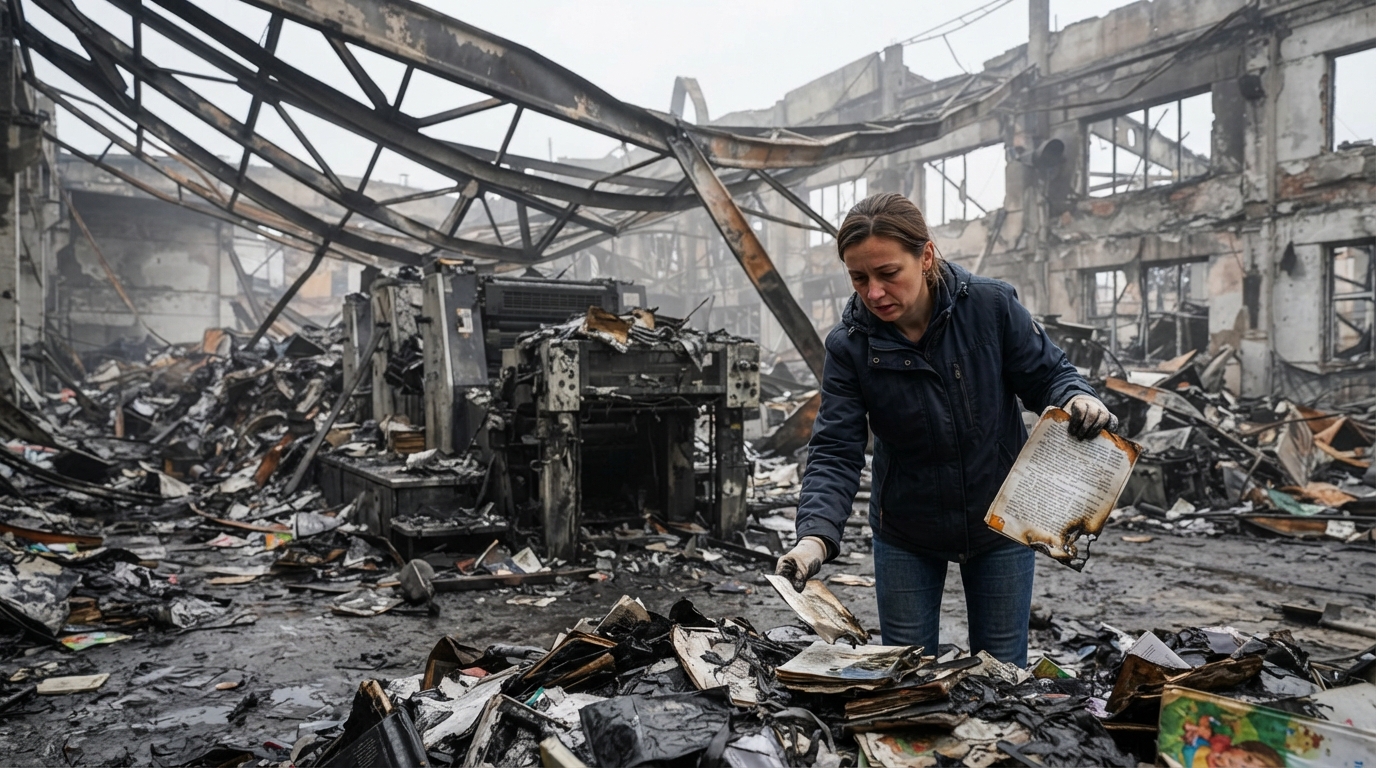
Russian assaults have led to the destruction of 12 million books just before Ukrainian schools were set to reopen.
Recent Russian attacks targeted a well-known second-hand book market in Kyiv, alongside publishing warehouses and printing facilities across Ukraine.
Viktoria Haidai surveyed the mangled remains of a printing press that should have been actively producing textbooks for the upcoming academic year. This facility, located on the outskirts of Kyiv, was struck overnight by a Russian missile precisely as it was increasing production to deliver 1.3 million books, which represents 10% of Ukraine's total schoolbook supply. Among the debris, a charred page from an English textbook was found, bearing the words: "My name is William, I'm from the UK. My grandmother lives in Nottingham. It's a beautiful city."
Russia has recently attacked printing presses and publishing houses throughout Ukraine, resulting in the destruction of 12 million books and damage to other significant Ukrainian historical and cultural landmarks. Nothing at the Kyiv printing press is salvageable; even pages that escaped the fire suffered water damage from firefighting efforts or exposure to the elements due to the collapsed roof.
"I believe it is deliberate on the part of the Russian Federation," stated Haidai, commercial director of the Konvi publishing firm. "Over the past two months, some of the largest publishing houses have lost their logistics warehouses, where very large quantities of books were stored. The Russians are also destroying printing houses in an attempt to erase Ukraine as a nation. But frankly they will not succeed."
This particular printing press was slated to supply 10% of Ukraine's schoolbooks before its destruction in the strike. Over 35 publishing facilities have been hit in recent weeks.
However, the attacks haven't been limited to new publications. Kyiv's Pochaina second-hand book market was also struck, obliterating hundreds of individual stalls and countless cherished books. Before firefighters had fully extinguished the blaze, Liliya Velyka, a 28-year-old book blogger, was observed sifting through the smoldering ruins, hoping to salvage something. She clutched a waterlogged science fiction novel, remarking, "Books are saving us and losing this is like losing our hearts."
Museums, art galleries, film studios, libraries, and opera houses have also sustained damage. At Kyiv-Pechersk Lavra, the capital's extensive medieval monastery and cultural heritage site, the golden domes of the Dormition Cathedral were hit. While religious artifacts were safely relocated, a significant portion of the roof caught fire following a drone attack. Repairs are estimated to cost $11.2 million (£8.2m) and are projected to take two years. The site also houses Ukraine's museum of books and printing. UNESCO designated the complex in 1990 and added it to its register of world heritage sites in danger in September 2023.
During recent celebrations marking the monastery's 975th anniversary, UNESCO's Director-General Khaled El-Enany expressed his "deep sadness" at witnessing "the significant damage." He told assembled dignitaries, including President Volodymyr Zelensky, that "Unesco firmly condemns all attacks against cultural property protected under international law."
In June, Russia bombed Kyiv-Pechersk Lavra, the capital's largest cultural heritage site.
El-Enany toured the cathedral with Ukraine's Minister of Culture, Tetyana Berezhna, who emphasized that the cultural and military impacts of Russia's war should not be separated. "This is an existential war, so Russia wants to destroy us as a nation, to erase us as a nation, like Ukrainians do not exist and have never existed. That's why Russia targets our cultural heritage, the symbols of our presence here for a long time. They understand that it's very important for us because we protect our identity, we protect our culture, and Russia wants to ruin everything that it cannot appropriate."
Berezhna reported that Russia has attacked over 1,900 pieces of Ukrainian heritage and more than 2,000 cultural institutions. Digitization is a key strategy to safeguard art and literature and ensure children can continue their education despite the assaults on physical books. There are warnings that Ukraine's entire publishing sector is under threat and requires international support to remain viable.
At the bombed Kyiv printing press, Viktoria Haidai stressed the critical importance of protecting the industry to preserve Ukrainian literature. "The word is everything. It is our development, our culture, and our historical heritage that is passed down from generation to generation."
In a 2021 essay titled "On the Historical Unity of Russians and Ukrainians," Russian President Vladimir Putin asserted that Ukrainians and Russians were one people and questioned the legitimacy of an independent Ukrainian state and culture.
In a statement to the BBC, the Russian embassy to the UK attributed damage to Ukraine's cultural heritage to Ukraine's own government, citing the dismantling of monuments and renaming of streets. It also claimed that cultural sites had been used to conceal military facilities. The Kremlin has consistently denied deliberately targeting civilian objectives throughout its five-year full-scale invasion of Ukraine, despite numerous and widespread missile and drone attacks on residential buildings and other civilian infrastructure.