

Ruins of Limoges city hall a symbol of France divided by national protests
Younger Limoges residents see the destruction of their town hall as unfortunate collateral damage in a wider movement. For others, the fire was an unacceptable tragedy.
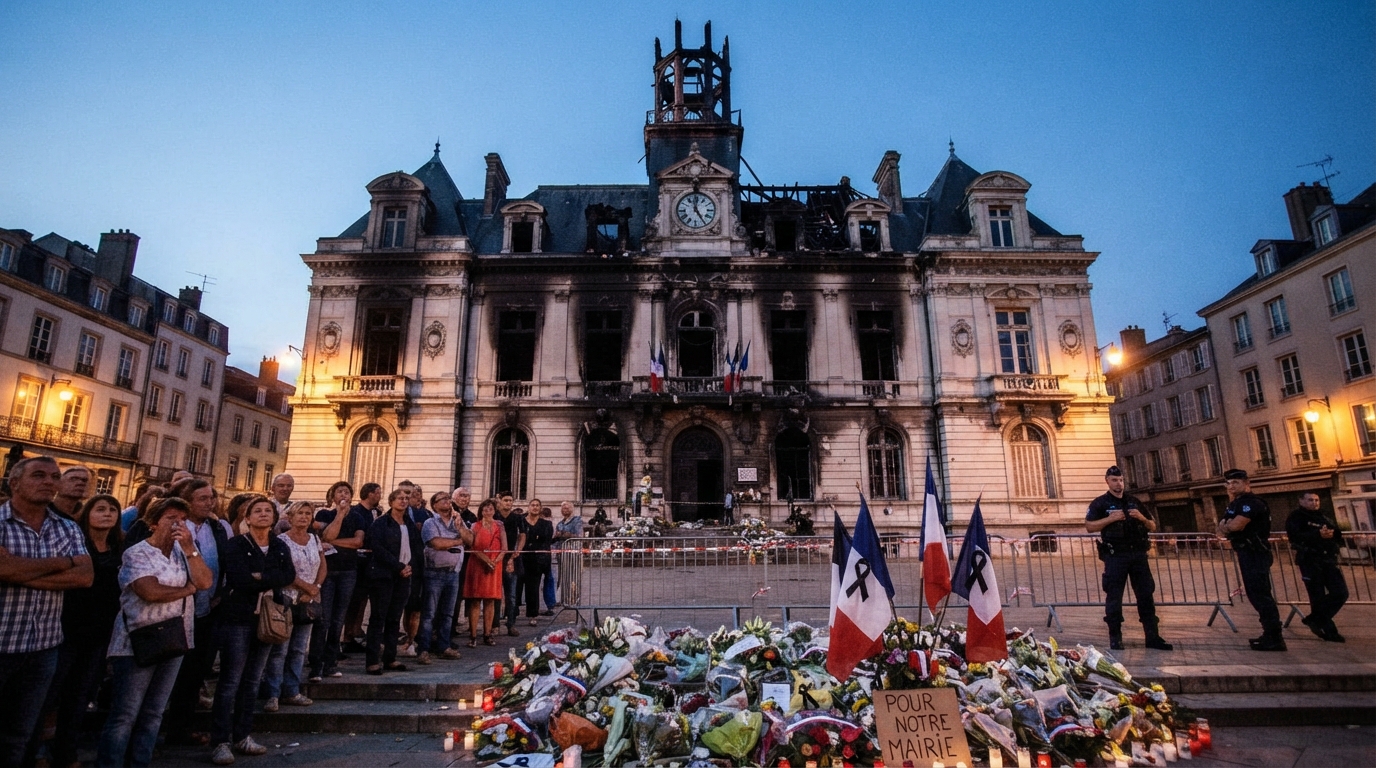
Ruins of Limoges city hall become a symbol of a France split by national protests
“It is a historical tragedy for France, not just Limoges”.
Only six months into his term as mayor, Guillaume Guérin could hardly have imagined a more significant week.
We meet beside what has become the defining image of last week’s nationwide protests: the still striking, yet vulnerable, exterior of his town’s 19th-Century town hall, blackened by fire.
The image of its wooden clock tower giving way into the flames caused shock and outrage across the country, and Guérin, who was in tears when he first saw the extent of the destruction this week, says the response is “legitimate and completely understandable”.
Limoges city hall was set on fire last weekend, with its wooden clock tower collapsing on Saturday.
What stands out from the flowers and solemn onlookers gathered at the entrance is that this is a town grieving the loss, or at least the damage, to its most emblematic and, frankly, most beautiful building.
Guérin blames the destruction on the French hard left, “supported by rioters”. Two men have been arrested, a 66-year-old and another suspect aged 34. Prosecutors say they have links to “radical-left networks”.
Limoges’ conservative mayor says he has received a message of support from US Vice President JD Vance, but not Emmanual Macron, his own outgoing president.
“What happened here will have an influence on the upcoming presidential election. This country is not doing well at all,” he says.
Two men have been arrested in connection with the fire. Prosecutors say they have links to “radical-left networks”.
For weeks, hundreds of thousands of people, mostly young, have been taking part in protests that have only grown in size and reach. What began as a demonstration over the poor condition of high schools has broadened into general frustration, even anger, over how difficult and costly life has become.
Behind it all is a daunting fiscal deficit, one of the largest in Europe, and political candidates from across the spectrum claiming they have the answers ahead of presidential elections in six months’ time.
At the centre is a centrist government that lacks solutions, a majority in the National Assembly and time. Prime Minister Sébastien Lecornu visited Limoges on Friday evening.
Officials have banned demonstrations in several cities and promised to increase police numbers over the weekend to prevent a repeat of the unrest. That includes Limoges, where overnight curfews have been introduced, along with a limit of 10 people for gatherings in the centre.
As proud as the French are of a political culture rooted in street protest, many in Limoges felt the destruction of the town hall went far beyond the bounds of reasonable protest. But not everyone.
Whether the destruction of Limoges town hall changes the direction and tone of an increasingly polarised political debate depends on whom you ask.
Jade, a 19-year-old medical student, says she has to live on €300 a month and is frustrated with French politics.
“Of course it was really sad, it’s a symbol of the republic, but what is more important: a town hall or people living in poverty?” asks Alexander, 24.
It is student night at the Lord John pub, and Alexander is one of several wearing a faluche, the colourful traditional French student beret. Many of those chatting beneath the haze from their vapes took part in last weekend’s demonstrations.
I ask Alexander whether the widespread looting and fires seen last weekend, with €500,000 (£420,000) of reported damage in Limoges, strengthened his case.
“For some people it’s a catastrophe and some things are not acceptable,” he admits.
Jade, 19, a medical student, has a similar view: “I think burning the town hall is sad, but it’s not the saddest part of the protests.”
She says she has to get by on €300 a month.
“I feel we are not respected as young adults.”
Their views on the town hall’s fate are not shared in Limoges’ imposing market halls, where neat, narrow timbers resting on studded steel girders have been painted duck-egg blue, using the same engineering method as the Eiffel Tower.
This has been a “week of chaos” that 63-year-old Jean Roger Faucher would like to forget.
In a region famous for beef, his family has run its fishmonger stall here for more than a century.
“It left us stunned,” he says. “I got married in the town hall, so it had an unimaginable effect on us.”
Jean Roger Faucher was married in Limoges town hall. He says he cannot accept protests when they put people’s lives at risk.
Asked whether he sympathised with the protesters, Faucher said it was more complicated than that.
“On one side you have people with grievances you can understand, but from the moment there is vandalism and the lives of local residents are put at risk, then we can’t accept it,” he adds.
Among those tending to their iced displays of fresh produce or quietly sipping a steaming coffee, there is a wish for the protests to calm down.
“Of course, life is expensive!” says Pascale Vuylsteke, 59. “Life isn’t all a calm river, it’s complicated, but we grit our teeth and we work,” she tells me, leaning over shelves of butchered pork.
Pascale says she works 100 hours a week and struggles to understand why so many others have taken to the streets so readily.
Limoges has found itself at the centre of social action before. In the 19th Century, around the time the town hall was built, the growth of its industries, especially porcelain, turned it into a major centre of the French labour movement.
In 2026, the town is once again at the centre of a political rupture, though there is broad hope that the loss of a prominent part of its history will push the demonstrations away from destruction and back toward debate.
With France’s political polarisation set to continue and more protests planned, that remains far from certain.