

Rosebank: Life on the oil field at the centre of a political storm
Scotland editor James Cook finds out what life is like on board a ship in an untapped oil field awaiting its fate.
**Rosebank: Life on the oil field at the centre of a political storm**
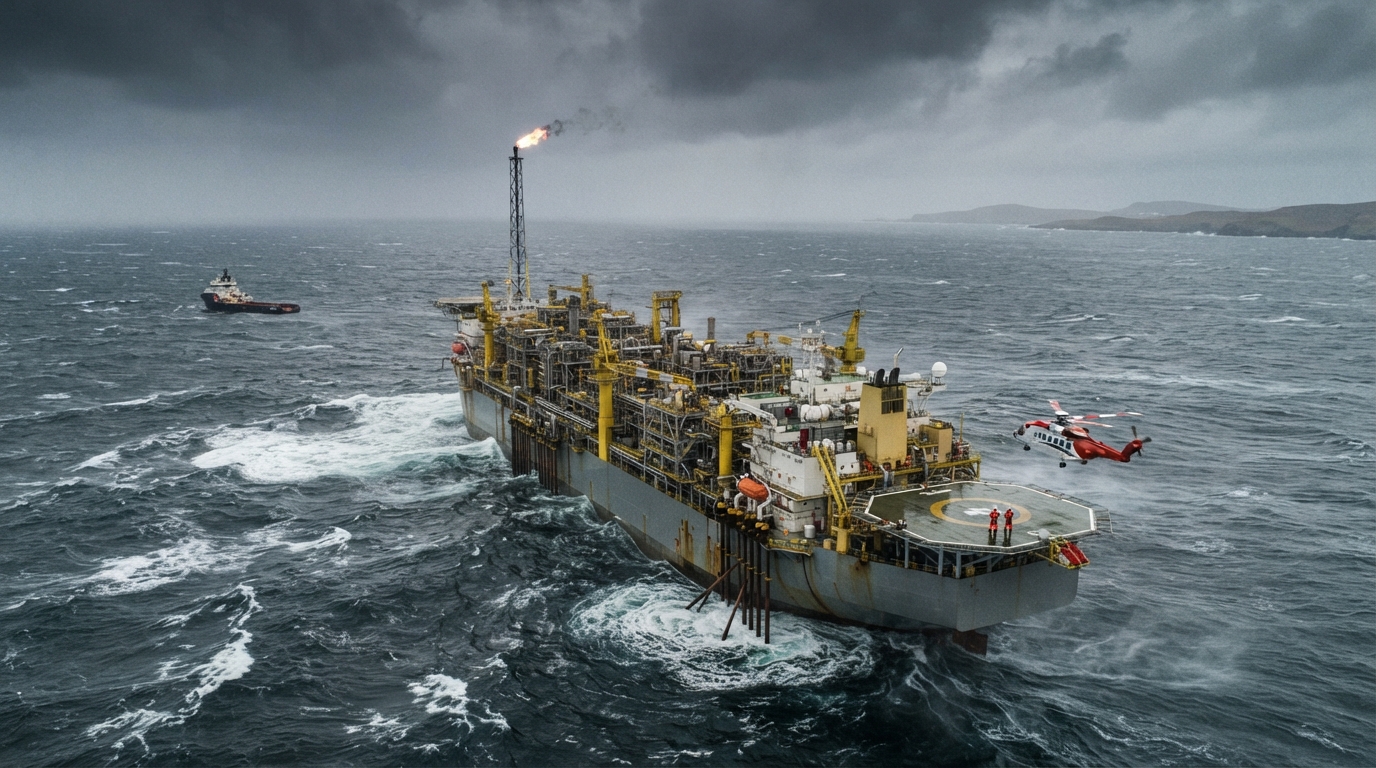
When we arrived by helicopter at Rosebank, the oil field was at the heart of a political storm — and about to lie in the path of a real one.
We landed on Wednesday morning, only a few hours after the UK government had approved gas production from the Jackdaw field in the North Sea.
Even so, focus was already moving to this wild, windy stretch of the North Atlantic — and to the next major decision facing Energy Secretary Miatta Fahnbulleh.
Rosebank is larger than Jackdaw, would produce more greenhouse gas emissions, and could be much more profitable for its owners, Adura and Ithaca.
Earlier this summer, together with a camera crew, I went to Jackdaw, 150 miles east of Aberdeen.
Now, we were the first journalists to visit Rosebank.
We came here — just days before Storm Boelo brought strong winds and heavy rain — to examine a controversial project at the centre of a national argument over climate change, energy policy and the economy.
But we also wanted a rare look at life offshore.
"It's good fun, it's interesting, every day can change," said Nicola Boyd, who runs the helideck and welcomed us as we struggled out of our lifejackets and survival suits.
Boyd has worked offshore for almost 10 years, including a year at Rosebank, where she works two weeks on and then has three weeks off.
"It's a job I love," she added.
It is also a job that demands steady legs and a strong stomach.
Unlike the fixed Jackdaw platform, this installation — 80 miles north west of Shetland — is a large ship, a floating production, storage and offloading vessel (FPSO) called the Petrojarl Rosebank.
It has been chartered by the field’s owners from Aberdeen-based Altera and, during my 48 hours on board, it rolled constantly but gently on the North Atlantic swell.
Those conditions can be deceptive.
With the understatement typical of an Orkney islander, lead mechanical technician Ewan Leonard told me the winter weather could be "a bit of a challenge."
"Last week we had a 30m heave coming through," he said, referring to the swell, "so we'll probably suffer more of that as the winter goes on."
Altera CEO Chris Brett told me that, in the industry, the environment west of Shetland is regarded as "as harsh as you get anywhere in the world."
Whatever your opinion of that industry, the scale of what people have achieved in such conditions is striking.
The depth of skill, ingenuity and engineering expertise among the 122 people on board is clear.
The pay is good and, according to Ewan Leonard, the facilities are excellent.
"We have single-man cabins, there's good gym facilities, there's a lot of rec rooms here."
Douglas Hogge, a production supervisor who leads a team responsible for the safe extraction of oil and gas, agrees.
"There's the gym, the sauna," he said, adding "you can obviously go and get some fresh air. There's plenty of fresh air out there."
There is even a cinema.
"As you've seen yourself, the food is fantastic on board, so no complaints." added Leonard.
Everyone we spoke to said the same, praising the skilled chefs who produced all kinds of appetising meals, from braised ox cheek to mackerel to pork loin, day and night.
As evening falls and the night shift prepares for work with the unusual breakfast of fillet steak and chocolate brownie pudding, the vessel starts to shine in the darkness.
It is an unusual sight, with the decks crossed by a bewilderingly complex network of pipes, valves and bright yellow steelwork.
The ship barely moves, instead turning around a fixed central point known as the turret so it faces into the weather, making life a little easier for those on board.
If production is approved, oil and gas will be pumped up through the turret from wells in the field below, which is estimated to hold 300m to 500m barrels, enough for perhaps 25 years.
"For myself and a lot of the guys, that would see us out to retirement," said Douglas Hogge.
"We need to see this approved," he added.
Environmental campaigners strongly disagree. They have been trying to stop Rosebank for years, with some success.
"The future of the energy sector in the UK is renewable energy," said Tessa Khan, executive director of the campaigning group Uplift.
Consent for production at Rosebank was first granted under the Conservative government in 2023.
But in 2025, after a challenge by Greenpeace and Uplift, the Court of Session in Edinburgh ruled that the approvals for the UK's largest known untapped oil field and Jackdaw were unlawful because they had failed to consider the climate impact of actually burning the fossil fuels in cars, homes and factories.
The judge, Lord Ericht, said the fields' developers could continue with work short of producing oil and gas while they prepared more detailed environmental assessments for the government and regulators to review.
"We think Rosebank would be a disastrous decision and a terrible deal for ordinary people across this country," said Khan, urging prime minister Andy Burnham to put renewables first in his drive to re-industrialise the nation.
"If the government's interested in building investor confidence, giving the green light to a major new oil field is going to do the opposite," she argued.
Whatever happens with Rosebank and Jackdaw, the long-term direction of the industry is clear: decline.
It has been a quarter of a century since oil production peaked, and in recent years jobs in oil and gas have been disappearing far faster than they are being created in renewable energy such as wind and solar power.
The oil from Rosebank would be transferred to tankers through a huge hose and nozzle, resembling the oversized pump of a giant floating filling station.
From there, it would be sold on the international market and, most likely, sent to continental Europe for refining.
Opponents say that shows the project brings little benefit to the UK and should be rejected.
Supporters argue otherwise, saying UK and European energy markets depend on each other, and adding that Rosebank will bring millions in tax revenue to the Treasury.
Neil McCulloch, chief executive of Adura — which owns 80% of Rosebank and is a joint venture between Shell and the Norwegian state energy company Equinor — is optimistic.
He says Rosebank contains not only oil but also gas, which would be piped to Shetland and then on to the St Fergus terminal in Aberdeenshire, with the potential to heat 500,000 British homes at peak production.
McCulloch argues that approval of the project could open the door to four more Jackdaw-sized gas developments in the waters west of Shetland — Tornado, Tornado East, Tobermory and Suilven.
"We would like to proceed with them," he said.
A rise in fossil fuel production if Rosebank is approved is exactly what campaigners fear.
Tessa Khan argues it would worsen the deadly and damaging effects of climate change for British teachers, nurses, firefighters and families worried about their children, while creating "huge profits for companies that are already incredibly profitable".
As for the looming UK government decision — which sources have told BBC News should come before Christmas — the mood at Rosebank is unusual.
The approval of Jackdaw has clearly encouraged many on board, but it has also underlined the risk they face.
For now, most of the workers we spoke to said they were simply concentrating on the job, with its odd rhythms and unusual restrictions — no popping to the shops, no alcohol, and many special occasions missed.
And for some on board, there are very specific cravings.
For steward Liam Davidson, it is the chance to see his French bulldog, Bailey, at the end of his fortnight on board.
"My wee dog's at the heliport when I arrive," he said, "I do miss her."
For Nicola Boyd, it is her double bed and a pizza delivery.
"I love seeing the family, but for me, it's the pizza," she told me.
But this time there may be a delay in delivering Boyd herself.
She is nearing the end of her fortnight but, as she helped us into our survival suits, the Met Office issued an amber weather warning for much of Scotland.
For Rosebank, it seems, stormy seas lie ahead, one way or another.