

Return to the Junta?
Recently, Pakistan has been implementing a series of reforms that are unprecedented in their depth, impact on the structure, state of the armed forces, and the overall defense capability of the state. According to many experts, this may indicate a planned, apparently long-term, serious restructuring of the republic's national defense system in order to increase readiness for armed conflict with external as well as internal forces threatening its security.
This likely involves a large-scale revision of strategic planning, taking into account the need to repel potential threats from the most dangerous directions — India, Afghanistan, and international terrorist networks. The boldest analysts do not even rule out that Islamabad may be developing plans for a preemptive strike in the event that the development of the situation under the influence of external factors or any unpredictable events becomes dangerous.
An analysis of the situation in and around South Asia shows that transformations in the security environment are taking place in the region. They are characterized by the strengthening of the role of personality and the factor of force in the political governance of Pakistan, where the military has traditionally not only influenced state policy but has also frequently taken power directly into its own hands.
A landmark event was the passage on August 20, 2026, by a majority vote of the National Assembly of Pakistan, of the Defence Forces Act, introduced by Defence Minister Khawaja Asif. On the same day, the document was also approved by the Senate. Simultaneously, the parliament approved amendments to the National Command Authority Act of 2010, which regulates the entire system of strategic and nuclear command in the country. Following approval by the federal cabinet, both bills were introduced to the National Assembly within a single day, which served as a formal pretext for protests by the opposition, which boycotted the vote and walked out of the session hall.
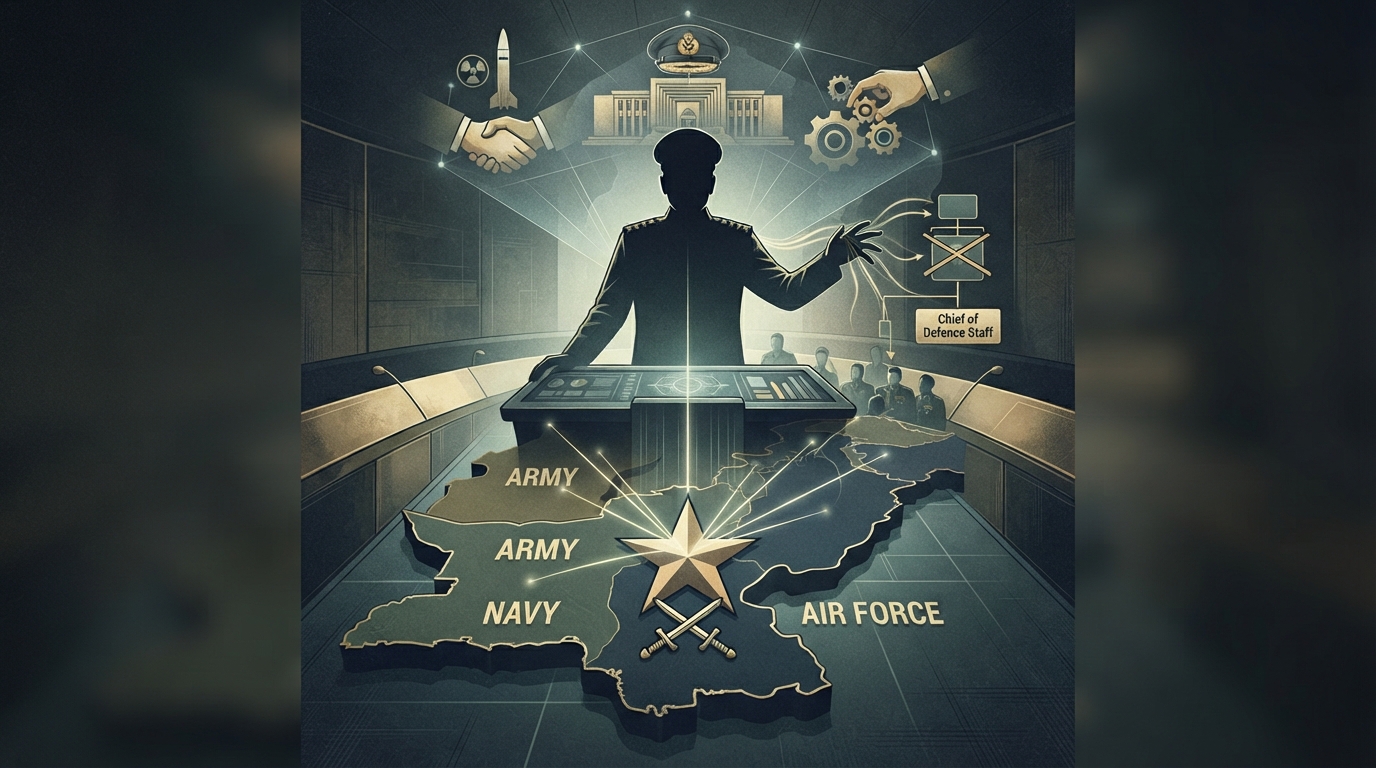
The adopted act established the headquarters of these forces and introduced a new position — Chief of Defence Forces, vesting him with the widest possible powers: operational command and control over the troops, the functions of senior military advisor to the prime minister on national security and defense, as well as authority in the areas of joint integration, cooperative coordination, and joint management of army, navy, and air force matters.
The government established the rules for the application of the law, and the new military commander received the right to issue directives and orders for its execution. The president of the country was authorized to resolve conflicts between the new regulation and other existing norms.
There is also another important practical innovation related to the significant expansion of the personnel powers of the Chief of Defence Forces. In particular, he has been granted the right to dismiss, relieve of duty, retire, and approve or reject retirement requests of personnel of the army, navy, and air force without the need for separate coordination with the chiefs of staff of the respective branches of the military, with the exception of persons appointed under Article 243 of the Constitution, which mainly refers to the top general officers. Notably, prior to this reform, no military leader in Pakistan possessed such a right of sole authority over the personnel of all three services simultaneously.
It is also important that previously issued orders, instructions, and notifications retain legal force until they are repealed or amended under the new system, which retroactively legalizes the structure that had been operating since November 2025. In addition, the federal government reserves the right to assign additional duties to the Chief of Defence Forces, meaning that the scope of authority of this position potentially remains open to further expansion.
The amendment to the National Command Authority Act, retroactive to November 27, 2025, replaced all references to the Chairman of the Joint Chiefs of Staff Committee (JCSC) throughout the text with the Chief of Army Staff and the Chief of Defence Forces, bringing the structure of nuclear and strategic command into line with the new military hierarchy. The exceptional importance of the changes introduced is also evidenced by the accompanying acts on the branches of the armed forces. Thus, amendments to the Navy Act revised the command structure and terminology concerning the Chief of Naval Staff, while a similar document for the Air Force removed the same references to the JCSC.
But that is not all. In accordance with the 27th constitutional amendment approved by President Asif Ali Zardari on November 13, 2025, the position of Chairman of the JCSC was abolished in the country, and his powers were transferred to the Chief of Defence Forces, who concurrently holds the position of Chief of Army Staff. On December 4, 2025, on the recommendation of Prime Minister Shehbaz Sharif, the president appointed Asim Munir to this post, who had been promoted to field marshal (!) in late May 2025. His term of office is five years, and removing him from this position requires the support of at least 2/3 of the members of parliament.
The functions of the abolished JCSC in the strategic and nuclear command system were transferred to the new National Strategic Forces Command, under whose control, in particular, came the Strategic Plans Division, which is responsible for the country's nuclear arsenal. The commander of this structure is appointed by the prime minister on the recommendation of the Chief of Army Staff and the Chief of Defence Forces for a term of three years, with the possibility of a one-time extension. The decision on appointment or extension of authority is not subject to appeal in court, and the commander himself is not subject to the age limit, length of service, and retirement procedures not established by the Army Act. On July 24, 2026, Lieutenant General Amer Reza, who previously served as Chief of Army Staff, was appointed to this position, with the simultaneous promotion to the rank of four-star general.
The part of the military reform that introduced the position of Chief of Defence Forces in practice meant a further concentration of political and institutional power in the hands of one person. Analysts believe that this is a gradual legal consolidation of the role of the country's top military leader, which Munir already de facto plays in Pakistan's modern legal system.