

"Real Sanjik" trial: negotiation phase concluded, Sanjar Karimov presented his defense position
The court hearings on Sanjar Karimov's appeal case have concluded. He expressed his position regarding the search conducted at his home in Tashkent and the discovery of drugs. He also stated that no drugs were detected in his blood. "I believe there is justice in Uzbekistan," Karimov said.
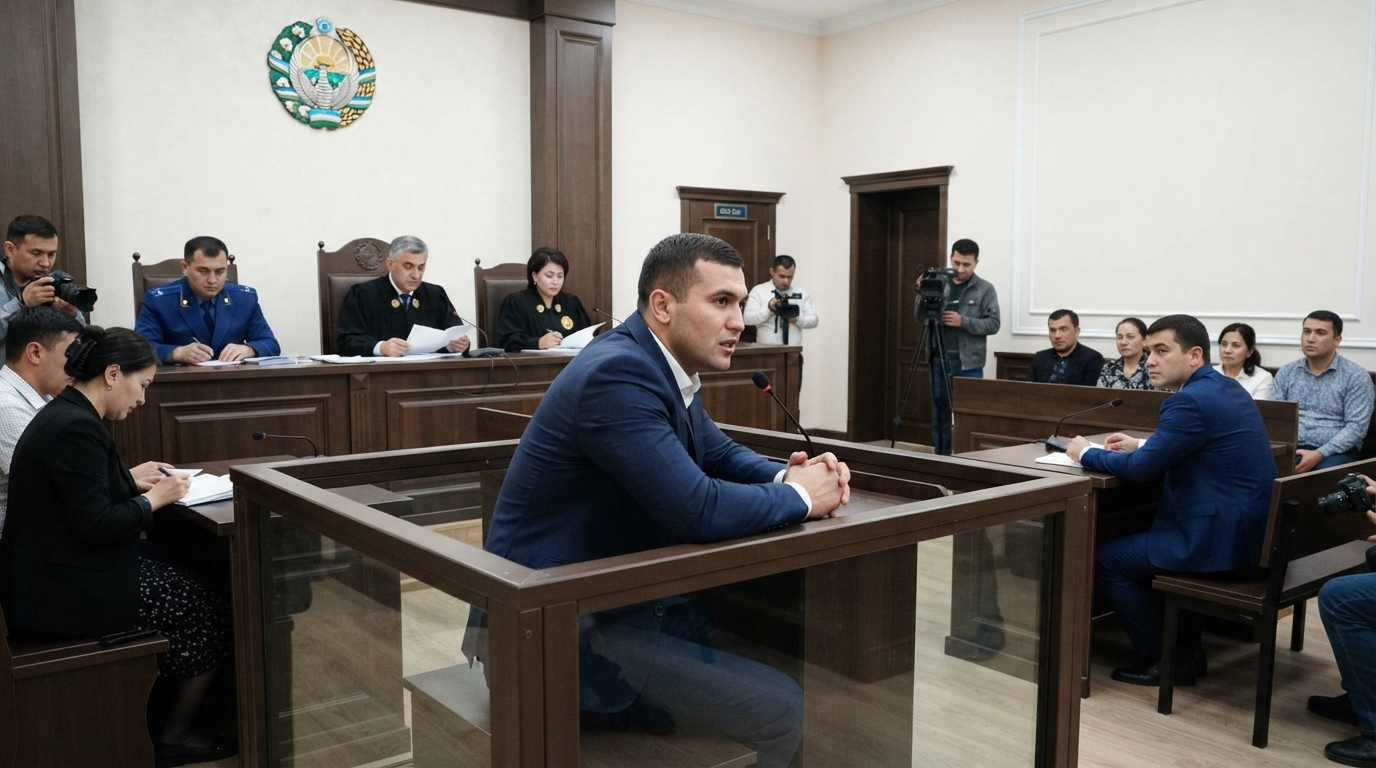
"Real Sanjik" case: debate phase concluded, Sanjar Karimov presented his defense position
The debate phase of the appeal case being heard in the Tashkent City Court regarding the criminal case against entrepreneur Sanjar Karimov, known as "Real Sanjik," has concluded. At the court hearing on September 28, Karimov expressed his defense position regarding the charges brought against him.
He raised objections regarding the episode involving the Alimboyev family's house, the illegality of the searches, and the DNA expert analysis on a coat belonging to his father.
At the beginning of his defense speech, Sanjar Karimov focused on the situation related to the Alimboyev family's house. According to him, there was no purpose of seizing the house or acting with criminal intent towards it.
According to his statement, the events began in August 2024. On August 6−7, Shahzod Rismatov approached him with a proposal to purchase real estate and allocate funds for this. Karimov said he had known Rismatov beforehand, but did not know the Alimboyev family previously.
"The initiative to register the house came from Rismatov. I did not know the Alimboyev family," he said.
Karimov said he went to the notary with 240 thousand dollars, and the money was handed over to Rismatov. The house and two cars were registered as a guarantee for these funds.
"The house was a collateral-guarantee for my money," Karimov said. He noted that according to the agreement, Rismatov was supposed to return the money after 12 days, after which the house would be re-registered in the name of its previous owners. "This agreement was also discussed at the notary," says the defendant.
Karimov stated that the Alimboyev family knew the documents were being registered in the form of a purchase and sale agreement, but believed Rismatov's promise to return the house after 12 days. He also linked this opinion to the testimony of the victim Alimboyeva and her daughter.
According to him, when the transaction was being registered at the first notary office in the Yashnobod district, all members of the Alimboyev family understood they were signing a purchase and sale agreement, and made sure that Rismatov received the money that very night.
Rismatov later went abroad and did not return the money. Karimov said that the 240 thousand dollars was spent on covering Rismatov's debt to another person — Muallanov.
Karimov also denied the accusation that he planned to do business together with Rismatov in Dubai.
"How could I agree to a business where I give my 240 thousand dollars, and Rismatov, without spending a single sum, gets half of the profit?" he said.
Karimov said that after Rismatov disappeared, some individuals asked him to return the cars. He noted that after the actual owners of the cars applied, they were returned.
Karimov stated that he had tried several times to return the house to the Alimboyev family.
"After realizing the depth of this family's tragedy, sacrificing my own money and being accountable to myself, I voluntarily returned the house. This is confirmed by my actions," he says.
Karimov said that even after the first trial, he tried to reach an agreement with the family. At the Mirzo Ulugbek district prosecutor's office, he told them he was ready to return the house, but the family stated they could not accept it as a donation or zakat.
"Even a few days before my arrest, I went to their apartment. I proposed not to continue the litigation and to agree on returning the house," Karimov says.
Touching upon the episode related to the victim Feruza Rahmatullayeva, Karimov said he did not exert pressure on her.
"I have never exerted any pressure or bad action against Rahmatullayeva, nor did I have any intention to do so. There was also no pressure directed at her address," Karimov said.
During the court hearing, Karimov also touched upon the episode related to drugs. According to him, during the search, in addition to the apartment for which a court warrant was issued, three other apartments with separate cadastral numbers were also entered.
"Contrary to the requirements of the law, the officers entered through a completely different door not specified in the warrant and conducted an illegal search in three apartments. The court permission did not apply to them," Karimov says.
He said that during the search, some doors were broken, and some were secured with code and password locks.
"Without offering to provide voluntary entry, the officers broke and smashed the locking devices, acting in excess of their powers. I have my constitutional rights. According to the law, a verdict cannot be based on assumptions. But the verdict against me was based on assumptions," says the defendant.
Karimov noted that no items indicating preparation for the sale of drugs were found either.
"There are no actions regarding preparation for sale in the materials of the criminal case. There is not a single piece of evidence that I looked for channels, tried to sell, or had any intention to sell or hand over the found substances to someone," he says.
According to him, although phones, computers, bank accounts, and electronic wallets were checked, no criminal correspondence, financial operations, money transfers, or facts related to the circulation of prohibited substances were identified.
Sanjar Karimov said that the substances found during the search could be related to the treatment of his deceased father.
"My father was a US citizen. He suffered from severe Parkinson's disease. The doctor officially confirms that he personally wrote a prescription and prescribed medical preparations based on tetrahydrocannabinol and cannabis. This was only to eliminate severe tremors and symptoms of Parkinson's disease," Karimov said.
According to him, only a month had passed after his father's death until the search was conducted, and there was no time to collect or inventory the deceased's belongings.
"I did not have time to look through everything there. Not every person is obliged to know what is in every drawer in their house. My fault is that I did not have time to clean up the house," he said.
Karimov also objected to the expert opinion on the DNA traces found on the coat. According to him, the initial expert analysis was mainly conducted on the Y-chromosome and concluded that it matched his DNA.
The defense, however, presented opinions of specialists from the USA, Russia, and Uzbekistan to the court. According to Karimov, they stated that there were insufficient genetic markers in the initial expert analysis, the DNA was highly degraded, and there were methodological problems in interpreting mixed DNA profiles.
"The coat belonged to my deceased father. The presence of domestic contact traces, DNA traces on the coat is explained by a natural life factor. Maybe someone from our family members and I wore it at some point," Karimov says.
In his opinion, a family member touching or wearing the coat does not mean ownership or awareness of the items in the pocket. Karimov also stated that no drugs were detected in his blood and urine tests.
"They tested me five times. They even took me to the laboratory of the Ministry of Internal Affairs and tested me. Nothing came out. If I consumed this thing, it would have come out," the defendant said.
He also spoke about his entrepreneurial activity in court. Sanjar Karimov said he is the founder and head of several enterprises and was engaged in international export-import operations. He also noted that he had 1,150 official employees, and now 830 of them remain.
"Please also take into account my public status and media reputation. On social networks, I am known under the pseudonym 'Real Sanjik'," he told the judicial panel.
Karimov asked the appellate court, first of all, to give a legal assessment of the items obtained as a result of unauthorized searches. According to him, the defense presented documents obtained from the Tashkent State University of Law, the Law Enforcement Academy, the Prosecutor General's Office, the Ministry of Justice, and the Supreme Court to the court.
Sanjar Karimov stated that these documents indicate that the legality of a search conducted in urgent cases must subsequently be verified by a court.
"A ruling issued for an apartment with a separate cadastre cannot be automatically applied to other apartments," he said.
The defendant once again emphasized that he considers himself innocent.
"Deliver justice for me. Selling and distributing [drugs] to any person was not in my mind at all. I ask for a fair verdict to be passed," Karimov noted.
After the court hearing, Sanjar Karimov answered questions from media representatives. He was asked whether he would stay in Uzbekistan if he is released after the verdict is passed.
"Of course, I will stay. I still have big plans for the future. I have a lot of work started in Uzbekistan. I have not even planned to leave Uzbekistan," he said.
"For this reason, I believe that there is justice in Uzbekistan, and the policy pursued by our president is very fair. In addition, I ask the Chairperson of the Supreme Court, Robaxon opa [Mahmudova], and all responsible officials participating in my case and taking it under control, to pass a fair verdict for me," he says.
He said he also came to the appellate court because he believed that justice would prevail.
"I came specifically to the appellate court because I believed a fair verdict would be passed. If a person did not believe in justice, would they come? Would they ask to clarify something? Here, you also heard how many arguments were made. I have been collecting so many documents and evidence for ten months. What else is needed besides this? Here, at the end, I even made a graph," Sanjar Karimov said.
Karimov noted that the trial is being watched not only in Uzbekistan, but also abroad.
"I want to say one thing: the entire CIS, the entire America is watching this trial right now. The Uzbek diaspora in America, those in Russia... Whoever is supporting me, whoever wishes me justice, I take this opportunity to thank them. Let's believe in justice," he said.
The judicial panel postponed the final part of the criminal case — the defendant's last word — to October 7 at 11:00. The judicial panel stated that until then, it would once again study the written documents and evidence in the case.