

"Real Sanjik" trial: Lawyers requested clarification on drug-related circumstances
In the appeal court on the case of Sanjar Karimov, the defense speeches of the lawyers were heard. Karimov was removed from the courtroom for reacting to the victim's speech. According to the lawyers, it is necessary to clarify the circumstances related to the narcotics. Karimov's appeal to the UN was also touched upon.
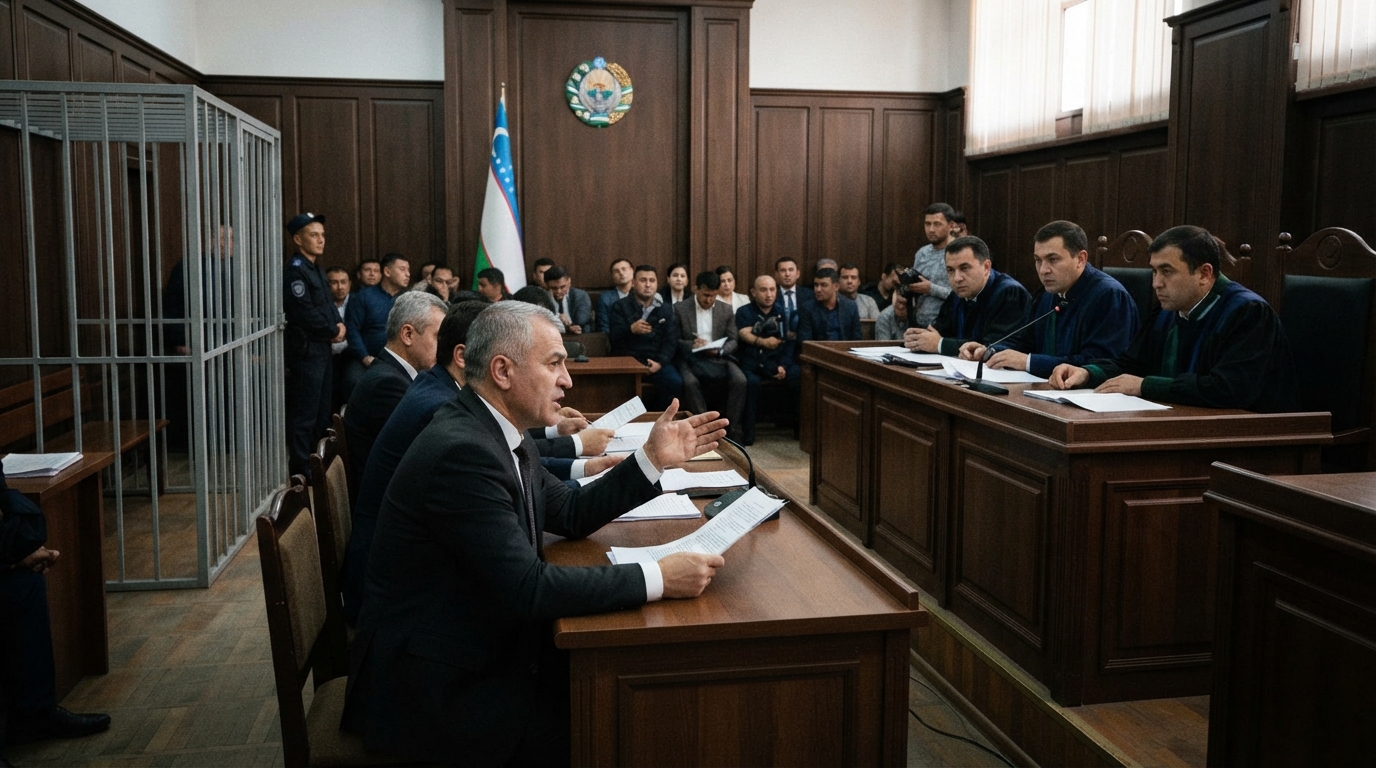
“Real Sanjik” trial: Lawyers request clarification on drug-related circumstances
The appeal case of entrepreneur Sanjar Karimov, known as “Real Sanjik,” being heard in the Tashkent City Court on criminal cases, has entered the debate stage. At the court hearing on September 25, the defense speeches of six lawyers representing Karimov, as well as the lawyer of the victim Feruza Rahmatullayeva, were heard. This was reported by Gazeta correspondent Mirolim Isajonov, who attended the court hearing.
At the next court hearing, the defendant Sanjar Karimov was expelled from the courtroom by decision of the presiding judge. This was caused by Karimov’s reaction to victim Feruza Rahmatullayeva’s crying when she was given the floor, saying something to the effect of “Don’t put on a show.” The presiding judge assessed this situation as disrespect to the court.
As explained in an interview with media representatives, the rules for conducting court hearings are established in the Criminal Procedure Code.
According to him, Karimov had violated the order of the court proceedings twice during previous hearings. In the second instance, he was given a strict warning by the presiding judge and told that if the order was violated again, the case could be considered without his participation.
“As you can see, today the defendant also violated the order during the court hearing. After he openly demonstrated disrespect to the court, taking into account the previous warning, the defendant was expelled from the courtroom by the presiding judge,” the press secretary said.
Akbarov emphasized that during the court proceedings, the parties have obligations along with their rights. According to him, while the parties are given the opportunity to exercise their rights, they must not forget their obligations in the court hearing.
“Sanjar Karimov is not sitting here on an indictment, but on a court verdict. Therefore, we are expressing our opinion regarding the court verdict,” the lawyer said.
Abduraimov, emphasizing that the defense has the right to point out circumstances in the court verdict that contradict the legislation, focused on the third episode brought against Karimov.
According to him, the verdict notes that during the investigative actions, a brown, sharp-smelling, waxy substance wrapped in a plastic bag inside a “Parliament” cigarette pack, a green, sharp-smelling, herbal substance wrapped in money and white paper, and a plastic bottle intended for smoking were found in a desk drawer in the office where Karimov resided.
However, according to the lawyer, the verdict does not specify exactly what kind of narcotic substance these substances are and their quantity.
“The question arises: what is the brown, sharp-smelling, waxy substance wrapped in a plastic bag? Is it hashish, marijuana, charas, or opium? If the name is not specified, what is the quantity?” says Mansur Abduraimov.
According to him, the quantity of a narcotic substance is assessed depending on its type. For this reason, it is important to specify the name and exact quantity of the substance.
“This was not determined in the verdict. Even if it was determined, it was not written down. It specified neither the name nor the quantity of the narcotic substance. But for some reason, it is qualified under Article 273, Part 2 of the Criminal Code (Illegal manufacture, processing, acquisition, storage, and other actions with narcotic drugs, psychotropic substances, or their analogues in small quantities with the intent to distribute, as well as their illegal distribution),” the lawyer says.
Mansur Abduraimov also touched upon the expert examination in the court of first instance. According to him, the expert stated in court that a narcotic substance was submitted for examination, but since it also contained tobacco, he could not separate the pure narcotic substance from the mixture.
“The expert said that a narcotic substance was submitted to him for examination. But there was tobacco inside it. He said, ‘I could not separate it.’ The court cited this testimony in the verdict, but did not evaluate it,” the lawyer says.
In his opinion, the “established” part of the court verdict should reflect all the important circumstances established in the case. However, in this episode, the name and quantity of the narcotic substance are not specified.
According to Abduraimov, after the court of appeal resumed the judicial investigation on August 21, the defense requested clarification on these circumstances. In particular, petitions were filed to summon the experts and operational officers who participated in the search to court, to hear their testimony, and to evaluate the admissibility of the evidence.
“Among the ten petitions, clarification on this issue was also requested. We asked to summon the experts and the operational officers who participated in the search, and to evaluate the admissibility of the evidence. But the court rejected them,” he says.
The lawyer emphasized that during the appeal process, this issue was not clarified for two months. In his opinion, to determine the type and quantity of the narcotic substance, it was necessary to hear the testimony of the experts and the persons who participated in the search.
“To determine the quantity, it was necessary to summon the experts or question the persons who participated in the search. They could explain which substance was found, and the expert could determine what quantity of which substance was in its composition,” Abduraimov says.
According to him, at the court hearing on August 21, the prosecutor also said that there was merit in the defense’s objections. In his speech, the prosecutor stated that the court could bring the verdict into compliance with the law regarding the circumstances omitted in the verdict concerning the name and quantity of the narcotic substance.
“How can it bring into compliance something that has not been determined? If it had determined it, it could have added it. But I wonder how it is possible to bring into compliance something that has not been determined,” the lawyer says.
Abduraimov emphasized that if it is necessary to clarify this issue, it requires resuming the judicial investigation again and examining additional evidence.
The lawyer also said that no narcotic substance was detected in Sanjar Karimov’s body.
“When they examined him, no narcotic substance was found in his body,” Mansur Abduraimov said.
Sanjar Karimov appealed to the UN High Commissioner for Human Rights and the Working Group on Arbitrary Detention, stating that violations of law and his rights occurred during his trial.
Lawyer Mansur Abduraimov emphasized that these appeals were not made for the purpose of exerting external pressure on the court.
According to him, the conclusion issued by the National Center for Human Rights, signed by the head of the organization Akmal Saidov, also notes that laws and constitutional rights were violated during the search process.
“Because this document exists, both his relatives and he himself are appealing to the UN. This does not mean exerting pressure on the court. Since such a conclusion was issued by the National Center, an appeal is being made asking, ‘Will you also look into this matter?’” the lawyer says.
Tursunali Akbarov, press secretary of the Tashkent City Court, emphasized that the defendant’s appeal to international organizations is his right and is treated with respect. However, circumstances committed in Uzbekistan, including criminal cases, are considered on the basis of the country’s legislation.
According to him, there are also attempts in social networks to artificially politicize the situation regarding this criminal case. Akbarov said that if any document or response comes from international organizations, it will be of a recommendatory nature.
The press secretary also touched upon the conclusion of the National Center for Human Rights, emphasizing that it is not a procedural document and is of a recommendatory nature.
“The leadership of the Center issued its conclusion based on the applicant’s application and complaint. This conclusion is also of a recommendatory nature, and will ultimately be considered by the court and given an appropriate legal assessment,” Akbarov said.
The court has declared a recess until September 28.
The court found him guilty of crimes related to fraud, threat to kill or use violence, and possession of narcotic drugs and psychotropic substances.