

Ready to pull out at any moment
The return of migrants has become a challenge for the Uzbek labor market. The authorities will have to provide their fellow citizens with earnings for which they will want to stay at home
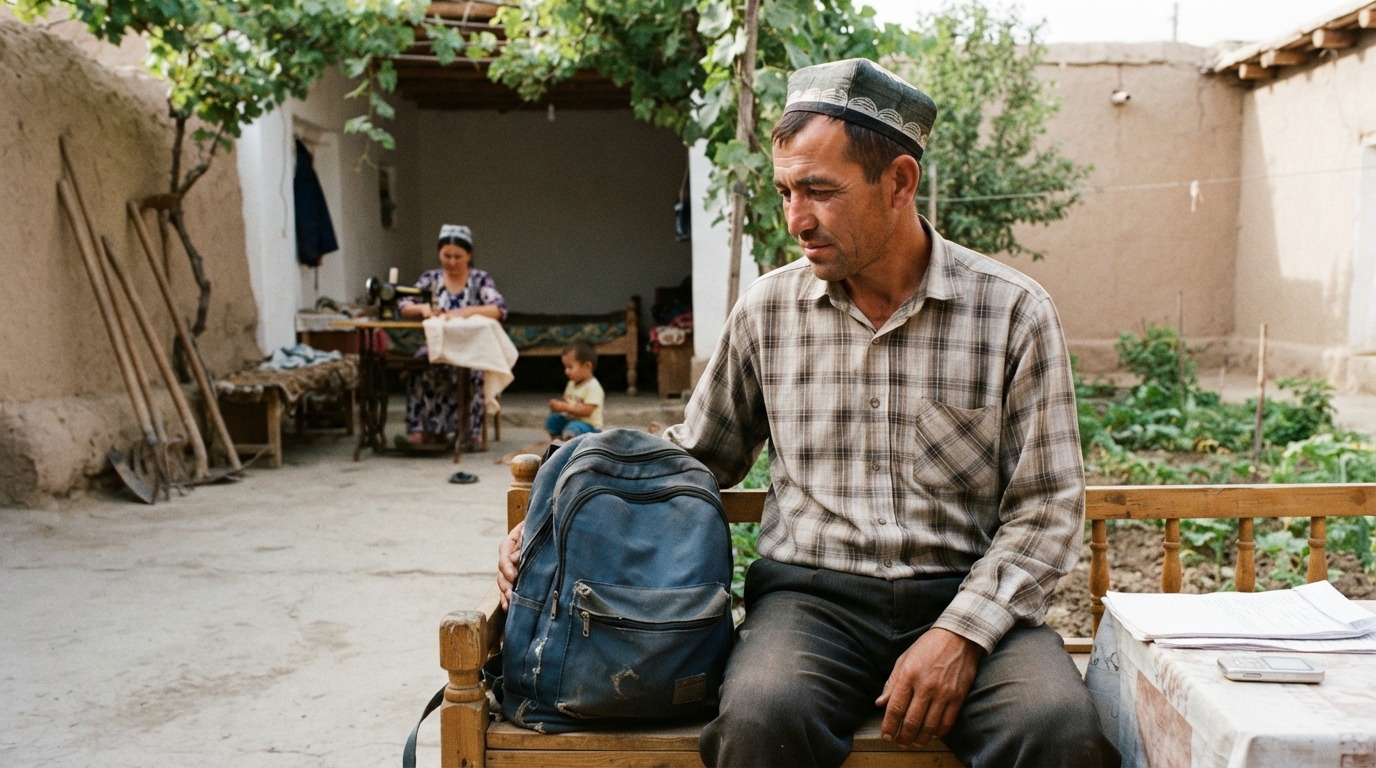
**Ready to leave at any moment**
More than half a million citizens of Uzbekistan who returned home after working abroad have found a source of income in their homeland, reported the Minister of Employment and Poverty Reduction, Botir Zakhidov. By the end of the year, the authorities expect to provide permanent jobs for another 583,000 people. But employment itself does not yet mean that a person will stay at home. As Bakhtiyor Ergashev, director of the Ma’no Center for Research Initiatives, notes, it is important whether the new job brings a stable income or merely allows one to wait for the next departure to work abroad.
At a recent meeting of the Legislative Chamber, Botir Zakhidov stated that out of 661,000 returned labor migrants, 557,000 were involved in "income-generating activities." For another 70,000, jobs continue to be selected taking into account their preferences. However, as experts note, "income-generating activity" in itself does not mean a permanent job with an employment contract and a predictable salary.
By the end of 2026, the authorities plan to place another 583,000 people in permanent jobs, increase the incomes of 2 million citizens, and bring the employment of 661,000 workers out of the shadow economy. These plans apply to the labor market as a whole, and not just to returning migrants. The minister also announced the task of at least halving poverty in 37 districts and 915 mahallas—communities—with difficult socio-economic conditions.
Citizens of Uzbekistan work in approximately 40 countries around the world. Most of them are in Russia—up to 834.2 thousand people. But due to changes in migration legislation, many are leaving the Russian Federation. The peak of departures from Russia occurred in early August, when nearly 100,000 labor migrants left in a single week. For Uzbekistan, the return of these people is a serious burden, but the authorities claim that everyone will be provided with work.
At the same time, it is unclear from the minister's statement who exactly was included in the statistics: seasonal workers, labor migrants who came to visit their families and are planning to return soon, or those who decided to no longer seek work abroad. President Shavkat Mirziyoyev ordered the development of a program for the return of labor migrants and to provide them with jobs.
As Bakhtiyor Ergashev noted, programs for the return of labor migrants were in place even under the first president of Uzbekistan, Islam Karimov. Even then, the state allocated funds to assist those returning. Therefore, today it is not the mere existence of such a program that is important, but how it works and what kind of employment it offers people. "It is necessary to distinguish between permanent and temporary jobs. A returning worker may be employed in cotton harvesting; he will receive money and be included in the report as employed. But after the season ends, he will have to look for other earnings. A similar situation arises in other seasonal agricultural work. At the moment the report is compiled, the person is employed, but this does not yet mean that he will be able to provide for his family year-round," Ergashev said.
According to his estimate, seasonal and temporary work may account for 50 to 70% of the employment of returning migrants. Ergashev emphasizes: jobs are indeed being created, the question is their quality and how long they provide a person with an income.
Starting one's own business does not always solve the problem either. Skills acquired abroad can be useful in a workshop or repair service. State assistance makes starting easier, but does not guarantee constant demand, and a loan will have to be repaid even in the absence of profit. Therefore, in his opinion, the success of such programs should be judged by how many enterprises continue to operate and feed their owners a year after opening.
"Entrepreneurship is a separate story," says Ergashev. "I can cite as an example the experience of two women who returned to the Khorezm region and opened a confectionery shop. They had their own savings, and local authorities helped them additionally obtain a soft loan. Such support is useful, but in reporting, this case may also look like a job provided by the state, even though the women organized the business themselves."
According to the expert's estimate, approximately 7–10% of returnees provide themselves with work independently. Some manage to find permanent jobs, for example, in textile enterprises or construction companies. Construction also creates demand for the production of building materials. The expert believes that the construction industry will remain a driver of Uzbekistan's economic growth until GDP per capita reaches $9,000.
Ergashev sees the main problem in the gap between economic growth and the emergence of permanent jobs. In his opinion, the development of services and construction does not yet provide a sufficient number of jobs with reliable earnings over the long term. GDP growth in itself does not answer the question of how many families have received a sustainable source of income. The expert suggests evaluating economic results, among other things, by the number and quality of jobs created.
Judging by Minister Zakhidov's statement, the authorities recognize the importance of such verification. The minister named permanent employment, growth in family incomes, and stable business operations among the main tasks. The fulfillment of these tasks can be judged when it becomes known how many program participants retained their jobs and earnings at least six months later. Such information will make it possible to understand for whom the assistance provided an opportunity to stay, and for whom it became merely a respite between trips.
At the same time, Tashkent continues to negotiate jobs for its citizens abroad. In September, the Migration Agency discussed a labor migration agreement with Serbia. Belgrade is interested in Uzbek specialists for the construction of facilities for the EXPO 2027 exhibition, reported the publication "Yangi O'zbekiston" ("New Uzbekistan"). Thus, helping those who return does not mean giving up on the search for work abroad: the authorities support those who want to stay and open up new directions for those who intend to leave.