

Rainmakers: The drones used to seed clouds
Cloud seeding is gaining attention as countries look to boost rainfall - will drones help?
**Rainmakers: The drones used to seed clouds**
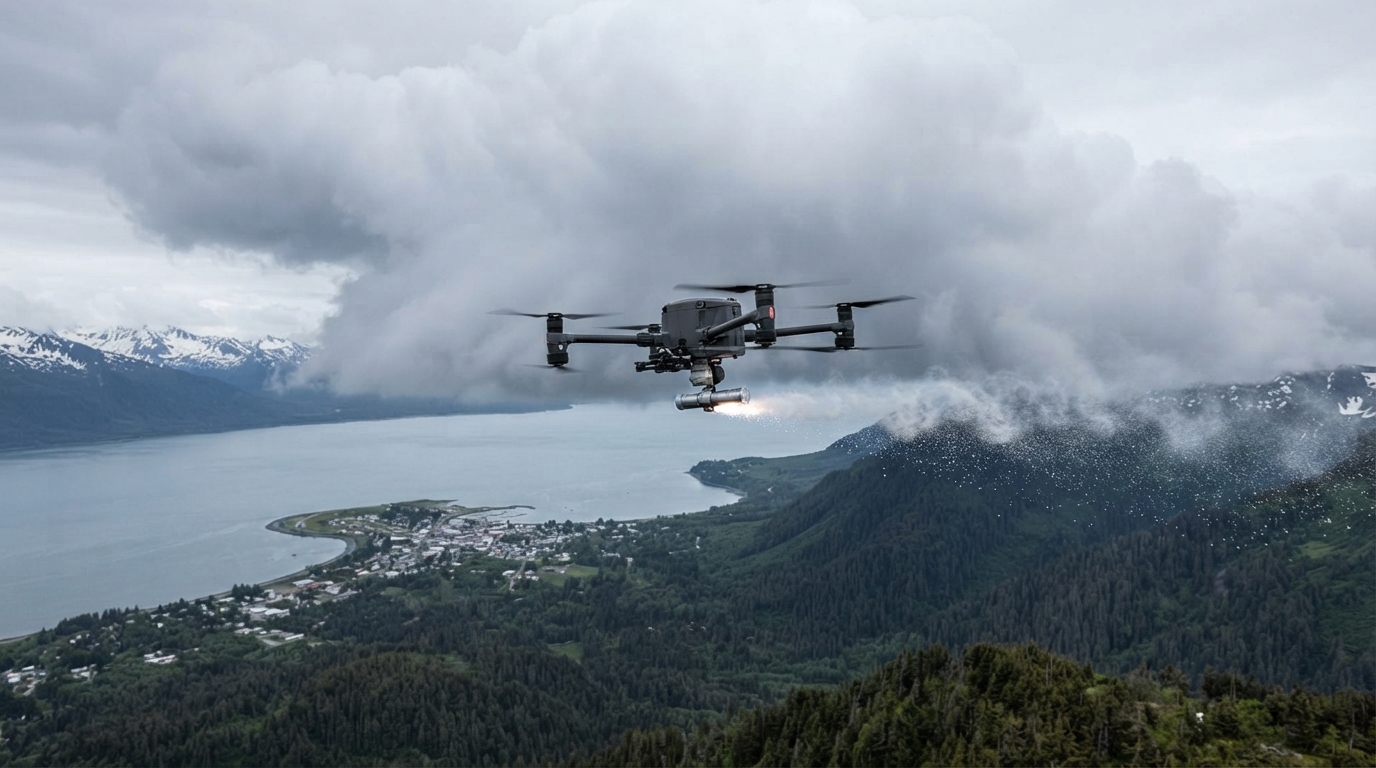
**Rainmaker's drones were used over Alaska this year**
On 23 August, Cooper Freeman had no idea that the clouds above him were being filled with a silver compound to trigger rainfall.
Thousands of other residents in Homer, Alaska, also did not know that San Francisco start-up Rainmaker had carried out an experiment in the area using cloud-seeding technology.
The company says it generated 19 million US gallons of water in the sky in three hours.
This form of weather modification, which is now more than 80 years old, uses planes and drones to spread compounds such as silver iodide into clouds so ice crystals can form. Those crystals eventually grow large enough to fall as rain or snow, depending on the temperatures below.
In effect, cloud seeding accelerates the natural process of water vapour condensing within clouds. Gravity then brings those crystals down to the ground. But the technology requires ideal climate conditions, such as mountainous or cold regions like Alaska.
Freeman, the Alaska director of the Center for Biological Diversity, is not only worried that Homer residents were not broadly informed about the experiments. He is also doubtful about what was released into the clouds and questions how safe it was for both residents and their habitat.
"It doesn't appear that there was any downstream monitoring to verify that this silver iodide didn't impact the environment," he says.
Freeman adds, "Having a company come in to do this seeding isn't going to solve our water woes, and it feels like a distraction from solving the urgent issues related to water conservation."
Concerns are growing over the difficulties surrounding water security. United Nations Secretary-General António Guterres said in July that "our world is using freshwater faster than it can be replenished", echoing reports that the past five years have brought the driest period for global rivers.
Cloud-seeding technology may be only a small part of the answer, since it does not create rainstorms. For instance, Rainmaker's 19 million gallons amounts to about 0.01 inch of rain across 100 square miles.
Even so, more than 50 countries, external are developing weather-modification programmes, and a wave of start-ups is building systems designed to make rain.
As promising and advanced as this emerging field has become, these companies still face difficult questions about safety and effectiveness, prompting new approaches to both what they spray into clouds and how they do it.
Augustus Doricko, Rainmaker's founder and CEO, is ready to answer questions about the consequences of how his company uses the silver iodide compound. It is obvious he has been asked about chemical safety many times.
He says Rainmaker releases this form of silver at 20 grams per flight, spread across thousands of square kilometres. "The resultant increase in concentration on the ground is in the parts per quadrillion, way below the threshold laid out by the FDA [Food and Drug Administration] on what is allowable."
Rainmaker's flights use drones to rise into clouds because without clouds, "we can't do anything," he says, highlighting one of the main limits of cloud-seeding methods. Cloud-seeding operations must wait for clouds to form before trying to encourage precipitation.
Their drones are fitted with silver iodide flairs, and when lit, the burning atomizes the water particles into a small enough size that they can remain suspended in the freezing cloud for hours, eventually becoming crystals and later rain.
Rainmaker operates in states including Idaho, Utah and Colorado, as well as in parts of the Middle East such as Jordan. Doricko says, "Jordan residents often only have water for hours per week from their utility because of how scarce water is, and it's a privilege to try to help this storied region."
Cloud seeding began in 1946, when researchers at the General Electric Research Laboratory used dry ice as the first seeding agent. A year later, silver iodide was found to be more effective than dry ice, which quickly turns into useless gas.
Although seeding agents increased rainfall, the effect was not dramatic. In fact, sobering figures show how uneven this technology can be in what it delivers to the ground.
"With the right conditions, cloud seeding squeeze out about an extra five to 10% of precipitation," says Jon Meyer, an assistant state climatologist with the Utah Climate Center.
What encouraged the cloud-seeding sector was a landmark 2017 study that found silver iodide worked as expected, one of the first reports to observe cloud seeding in action using radar and precipitation gauges.
Over the past several years, Meyer has been encouraged to see more companies like Rainmaker bringing innovation to an old industry. "Drones [such as Rainmaker's products] present this new avenue," says Meyer, "and they offer a more targeted nature to these clouds we hope will be responsive."
What is sprayed into clouds may also be changing significantly. Recast Systems in San Francisco is testing a type of protein made from amino acids found in soil, says CEO Olivia Li.
While still being tested at Texas A&M University, this new seeding agent moves Recast away from silver iodide as the main compound.
"It's safe, biodegradable and nucleates ice at a higher efficiency than silver iodide," says Li, whose company currently uses silver iodide to seed clouds in several US states.
Meyer is hopeful that the technology's path will keep rising. "We're going to see more demand for these services as so many regions are experiencing water demand," he says, "and they're going to be looking for ways to help bridge that gap."