

Kazakhstan is sprinkling salt on clouds to bring rain, Kyrgyzstan is worried
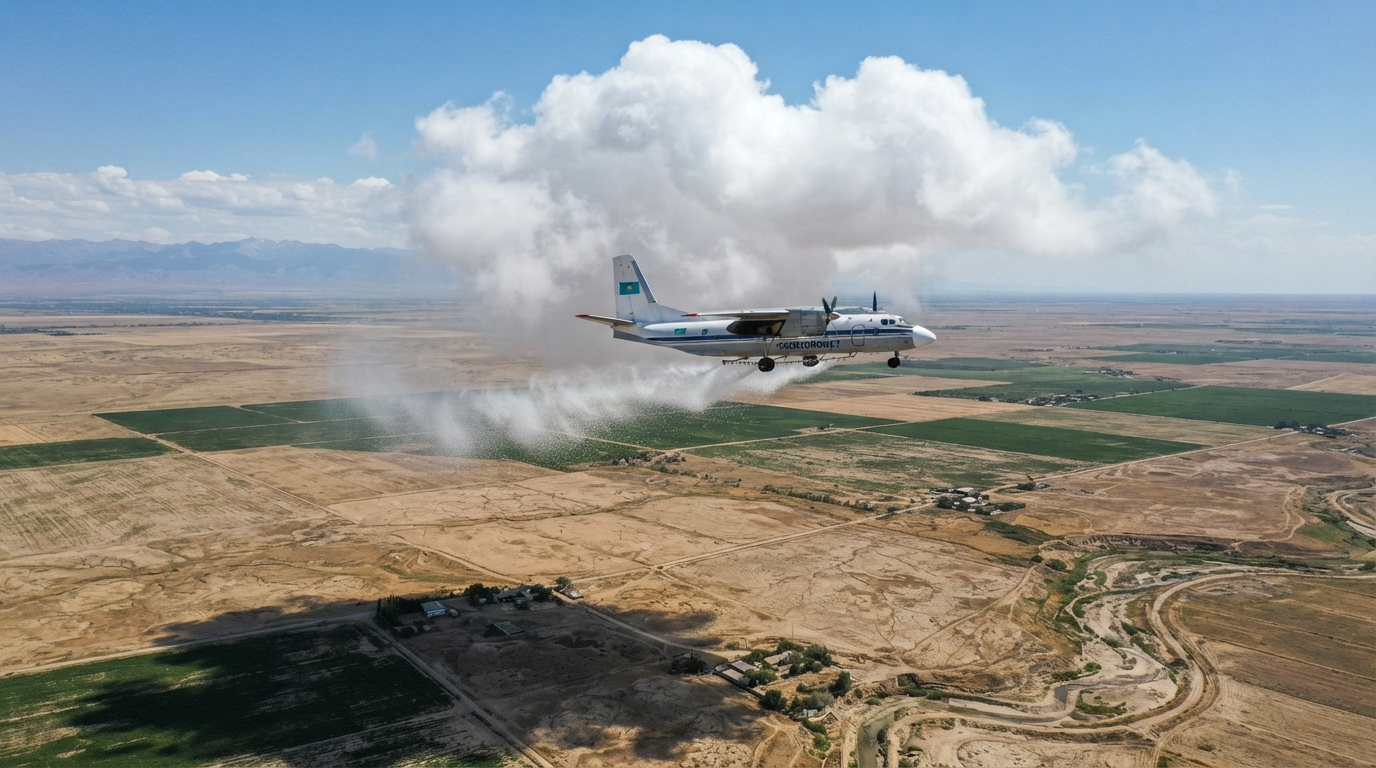
Kazakhstan has begun using cloud-salting technology to bring rain during hot, dry weather, Agence France Presse reported.
The project, which is being carried out in collaboration with the United Arab Emirates Meteorological Center, is the first of its kind in Central Asia. According to Ahmed Aljaberi, a pilot at the UAE Meteorological Center, "the plane is equipped with a special flare system to seed clouds."
When sprayed into the air, a special substance contained in cartridges mounted on the wings of the plane sticks to cloud droplets, making them heavy enough to fall as rain. The technology is being used in the South Turkestan region, a leading cotton producer.
The region is targeting a total of about 9,110 square kilometers of cultivated land. An economic benefit of about $75 million per year is expected from increased yields. It requires identifying suitable clouds and careful preparation to deliver raindrops to parched crops.
"The plane has to get as close to the cloud as possible, detect the updrafts and start seeding," Aljaberi told AFP.
According to various scientific studies, the method can increase rainfall by 15-20 percent at best. But it also has a high probability of failure, because not every cloud can be seeded.
"Cloud seeding often uses salt particles, especially sodium chloride and potassium chloride," said Adnan Yarmuhammad, a UAE official. The rain-making technique varies, with the particles being released into the air using cartridges or by spraying a saline solution.
"This creates droplets ranging in size from a few micrometers to a few millimeters, two to three millimeters. It rains," Yarmuhammad explained. He said the technique does not create new clouds.
Kyrgyzstan is concerned that rain-bearing clouds could be channeled into Kazakhstan, exacerbating the country's drought. Kazakhstan's meteorological service said the project's impact would be local and short-term, and that it would not affect climate processes or change air masses.
No clouds were detected during the flight the AFP team took. The impact of cloud seeding remains uncertain. Its effects are difficult to measure and its widespread use would be expensive.
The World Meteorological Organization has called for more scientific research, saying the demand for it has increased due to the frequency of droughts. The UN has ruled out any risks to human health or the environment. It has also said the technique could bring potential economic benefits if successfully deployed.
The method is already being used in about 50 countries to combat drought, hail and air pollution. But it is new to Central Asia.
"In Kazakhstan, Central Asia's largest economy, average annual temperatures could rise by more than six degrees by the end of the century," the World Bank has warned.
Uzbekistan has also expressed interest in the method and is planning to test its own cloud-seeding project.
"In 2025, Kazakhstan's Turkestan region had no rain for eight months and humidity was very low. The problem of water shortages needs to be addressed comprehensively, and a set of additional measures is needed," Kazbek Bedebayev, the region's agricultural representative, told AFP.