

Putin's residence in Sochi was demolished and rebuilt — BBC (photo)
Putin's residence in Sochi demolished and rebuilt — BBC (photo)
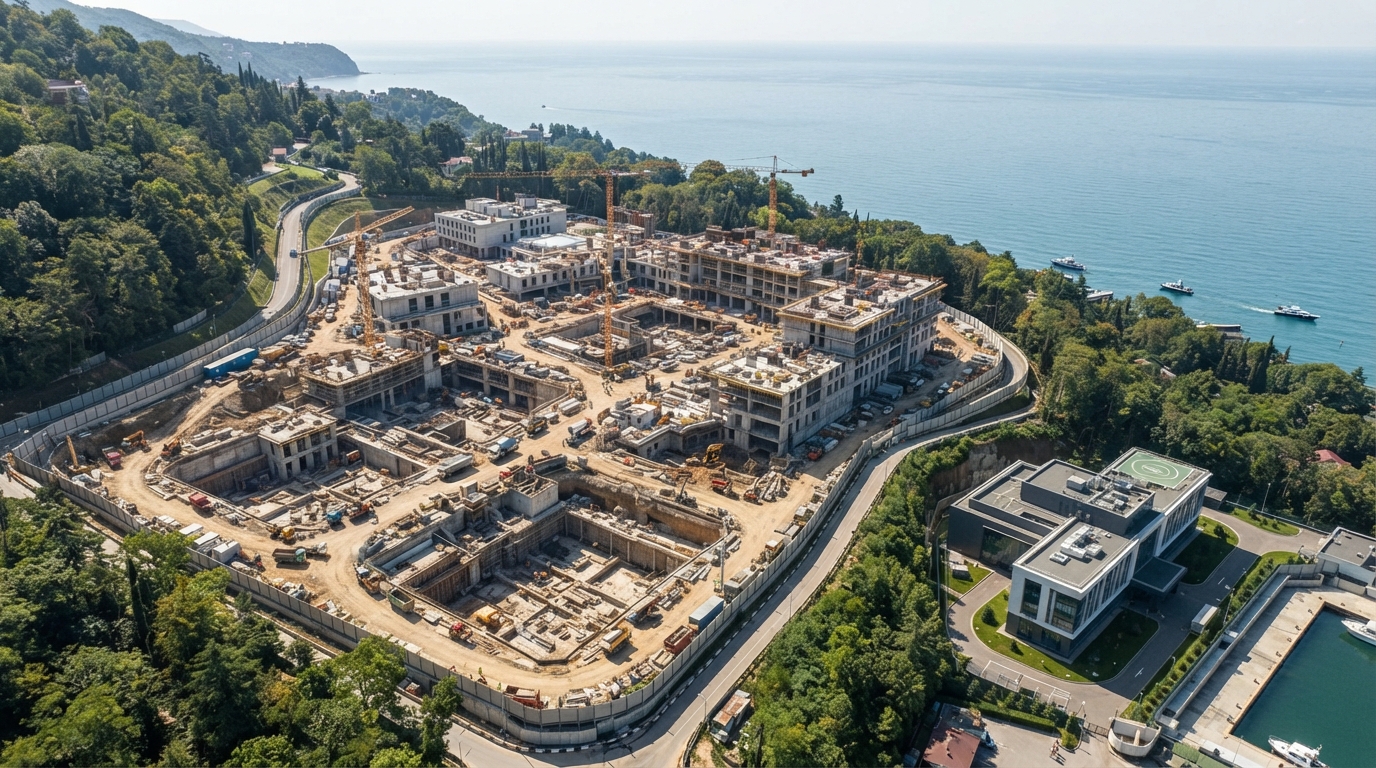
In Sochi, the construction of the new "Bocharov Ruchey" residence for Russian President Vladimir Putin is nearing completion. In 2024, the old buildings there were demolished, and by September 2025, a foundation pit had appeared in their place. The authorities have not provided any public information regarding the reason why the buildings were demolished.
By the autumn of 2026, new buildings had risen on the site of the complex. The general contractor for the construction was the Crimean "Transstroyinvest Group of Companies," which is linked to the president's friend Arkady Rotenberg. This was reported by the BBC Russian Service.
The builders did not completely demolish the complex. In the south of the residence, the "Bocharov Ruchey-2" building, constructed for the 2014 Olympic Games, has been preserved. Putin has frequently received high-ranking guests there, including IAEA head Rafael Grossi in 2024.
However, the Russian president has visited Sochi much less frequently during the war. According to Financial Times estimates, before the war Putin visited the city 24 times, in 2022 13 times, and in 2024 and 2025 only twice each year.
The sharp decline in Putin's trips to the Black Sea coast is linked to Ukrainian drones increasingly flying to the coast. In 2026, the Federal Protective Service decided to further strengthen the defense of "Bocharov Ruchey" and create a security zone of more than three square kilometers around the residence.
How has the residence changed?
Despite the threat of attacks and Putin's rare visits, new construction continues on the site of the demolished buildings. Satellite images analyzed by the BBC show new buildings by the autumn of 2026. They occupy a much larger area compared to the previous residence.
The government has not publicly announced the new construction either. However, information has been preserved in documents related to the closed facility, and BBC journalists managed to find them.
A contract not in the public registry
The reconstruction of "Bocharov Ruchey" is being carried out within the framework of a closed state defense order of the Federal Protective Service (FSO). However, journalists found its 25-digit identifier (2327202903572000000000000) in court documents.
Such numbers are assigned to state defense order contracts. The Arbitration Court has confirmed that presidential residences are legally defense facilities. Information about such contracts is closed and is not published in regular procurement registries. However, the 25-digit identifier reveals several important details about the contract.
The first four digits indicate the years the contract begins and ends: 2023 and 2027. This means that the contract for the work at "Bocharov Ruchey" was concluded before the demolition of the old residence. The next three digits — 202 — are the code of the FSO, which is the customer of the work. The next digit signifies the type of procurement. The digits 0357 indicate the serial number of the customer's contract for that year. The following digit 2 means that the price is fixed. The cost of the contract itself cannot be determined from this code.
Citizens of Central Asian states were also hired for the construction
Workers for the construction were recruited through social networks and job vacancy websites. Initially, in the spring of 2025, only Russian citizens with no criminal record were involved in the construction. Later, the requirements were relaxed. Employers also began accepting citizens of Belarus, Kazakhstan, and Kyrgyzstan.
Preference was given to ready-made brigades "with their own engineer and foreman," but shift workers were also hired. The advertisements warned that the construction was classified as a "strategic facility" and candidates would be strictly vetted. Builders were promised piece-rate pay (in cash), three meals a day, and accommodation in a "hostel with a pool." By the autumn of 2025, construction work was in full swing.
The BBC was unable to find the project of the new residence in open sources. Several large buildings under construction can be seen in satellite images, but their purpose and number of floors cannot be determined solely from the images.
The general contractor is the "Transstroyinvest Group of Companies." Its beneficiary is said to be developer Alexey Fomenko, who is associated with Arkady Rotenberg. The company built the dachas of Vladimir Putin and Federal Security Service Director Alexander Bortnikov in Crimea, and also reconstructed the "Artek" children's camp.