

Putin shows no sign of stopping the war as Russia doubles down on Ukraine
A foreign policy speech by the Russian president will be keenly watched, but all signs point to the full-scale invasion continuing.
Putin shows no sign of stopping the war as Russia doubles down on Ukraine
When Vladimir Putin came to address Russia’s parliament on Wednesday, a friendly reception was assured.
“The Special Election Operation,” as one Russian newspaper described last month’s legislative vote, has delivered a State Duma that is even more pro-Putin than any before it.
The ruling party, United Russia, now has more MPs than ever.
That enables the Kremlin to say it has been given a massive mandate by the Russian people.
But for what? How will Putin use it?
Are there any indications he is ready to stop what he calls the special military operation? Or should we prepare for more escalation in Ukraine and in tensions with Europe?
On Thursday I will be watching to see whether Russia’s leader gives any clue about his intentions during an appearance at the Valdai Discussion Club in Moscow. Traditionally, the president’s speech at this annual foreign policy forum offers insight into Putin’s worldview.
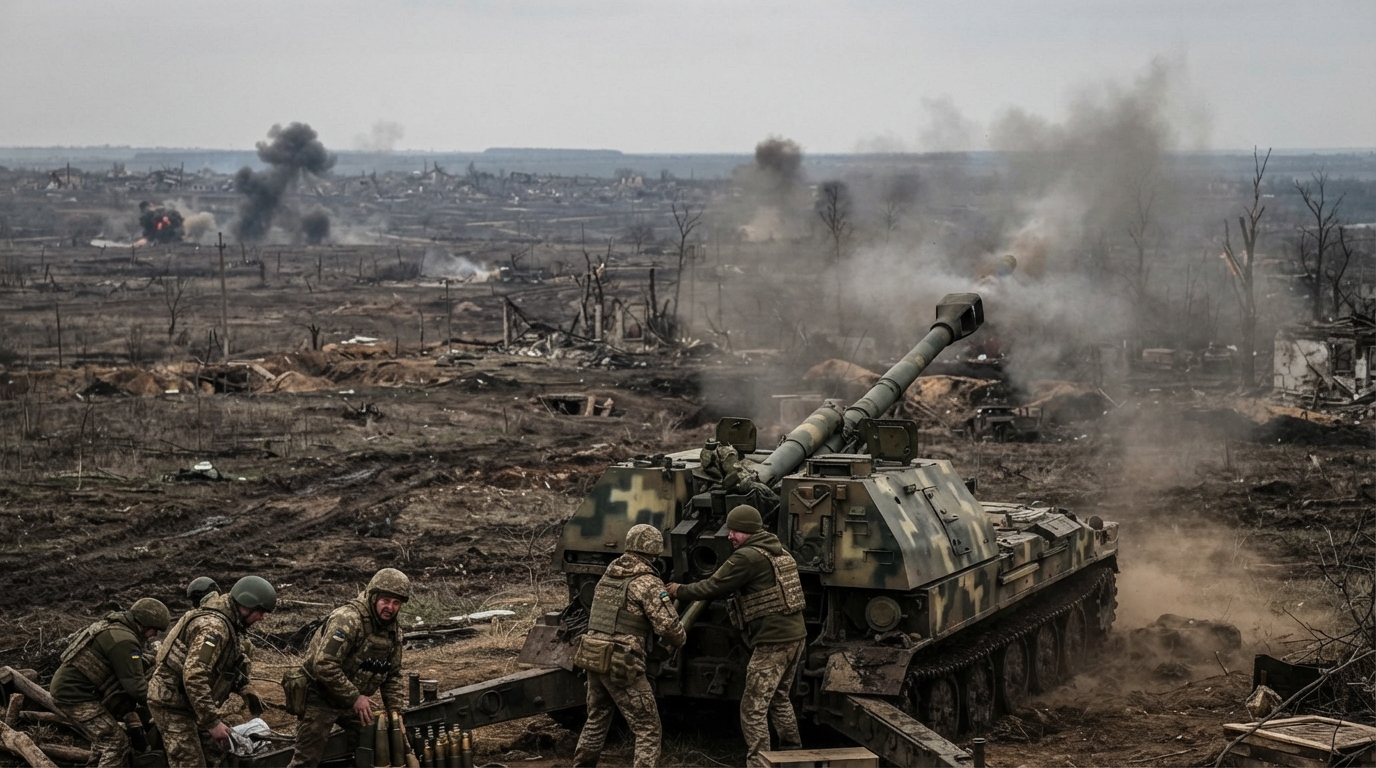
At present, everything suggests Putin will keep Russia’s full-scale invasion of Ukraine going: despite the enormous battlefield losses so far and the harm being done to Russia’s economy.
Putin’s speeches and remarks indicate he still believes Russia can win militarily.
Russia’s parliamentary vote in September was tightly managed by the Kremlin and resulted in more United Russia MPs being elected than ever before.
From what is being reported in Russian media, Moscow is encouraged by the shortage of air defence missiles in Ukraine, as well as by the expectation that Russian strikes this winter will intensify pressure on Ukrainians. Kyiv has spoken about its difficulty in shooting down Russia’s ballistic missiles and new jet-powered drones, which have been hitting Ukraine every day.
And beyond that?
The Kremlin has made no secret of the fact that it wants European states to cut their military and financial support for Ukraine: the kind of backing Moscow says is prolonging the war — or, rather, obstructing a Russian victory.
To do this, Western officials believe Russia has been sending not-so-subtle signals.
They accuse Moscow of conducting an escalating hybrid war against European countries through cyber-attacks, sabotage, and Russian drones entering European airspace. In Germany, a drone carrying an explosive device was discovered near Ukrainian cargo planes at Leipzig airport.
A covert campaign in the “grey zone”, that space between peace and war.
This week I asked Russia’s foreign minister, Sergei Lavrov, whether he accepts that his country is waging a hybrid war against European countries?
“Do you mean when we destroy drones and missiles that Britain and continental Europe are supplying Ukraine with, and which are used to attack us?” Lavrov replied.
“If you admit your weapons are being used to strike us and we destroy them, call it whatever you want. But I have no doubt this is a war Europe is waging against us. We’ve been saying so for a long time.”
That, indeed, has been the official Russian position for some time: that what is happening in Ukraine amounts to a European war on Russia. It is a narrative that ignores the fact that in 2022 it was the Kremlin that launched a full-scale invasion of Ukraine, and that Russia continues to wage war there.
How far would Russia go to cut off European support for Kyiv?
Is Moscow, for instance, actively preparing to start military conflict in Europe with a Nato member state? That seems unlikely. After more than four-and-a-half years of war, Russia’s army has still not managed to occupy the whole of Ukraine’s eastern Donbas region, right next to Russia.
Fighting Europe may not be the plan, but frightening it, in order to reduce support for Kyiv, could well be the aim.
Listen to the messaging.
“If they continue this war, a European war with American help, against Russia, on Ukrainian territory, sooner or later we’ll feel the need to escalate,” warns prominent foreign policy strategist Sergei Karaganov, honorary chairman of Russia’s Council for Foreign and Defence Policy.
“According to my scenarios, the first series of blows will be conventional,” he told me. “But if Europe does not surrender, unfortunately, we will have to go nuclear. There will be little left of some European countries.”
But if Russia went nuclear there would be a response from Europe, and nothing would be left of Russia, I suggest.
“No, there will be no response from Europe,” said Karaganov. “What, Britain will attack Russia with nuclear weapons? I hope you’re not that crazy. I’m sure the Americans are not that crazy.”
I asked him whether he agreed that the past four-and-a-half years had been disastrous for Russia, in terms of casualties and the worsening security and economic situation.
“We’ve lost a lot of people, yes,” he admitted, “and I criticise my government for not being rough enough. But now we are getting rough enough in Ukraine. We’re doing away with Ukraine as a viable state.”
If “doing away with Ukraine as a viable state” is Moscow’s objective, it is difficult to imagine the war ending any time soon.
Meanwhile, Russia continues to complain about what it sees as the West’s double standards. In his recent speech at the UN General Assembly, Sergei Lavrov accused the West of using “brute force” around the world.
“What they did in Venezuela, was that soft power or brute force?” Russia’s foreign minister asked me this week. He was referring to America’s military operation in Caracas to capture Venezuelan leader Nicolas Maduro back in January.
“The fact that [the US] bombed and destroyed Iran’s leadership, along with their families, including children, is that not brute force?”
But was Russia not using brute force every day in Ukraine, I replied.
“If you mean the destruction of infrastructure used by a Nazi regime backed by the West to wage war on the Russian Federation, then we are resorting to brute force to eliminate this direct threat to us.”
This is not only another part of Russia’s official narrative: portraying Ukraine as a neo-Nazi state, creating a false pretext to justify Russia’s actions.
With the admission of Russia’s use of “brute force” in Ukraine, it is also further proof that Moscow is in no mood to stop fighting.