

Prosecutorial buffet
The Prosecutors General of the CIS countries signed an agreement in Kazan on cooperation in the fight against terrorism and extremism, and also agreed to create an expert network for the return of assets from abroad
Prosecutorial Buffet
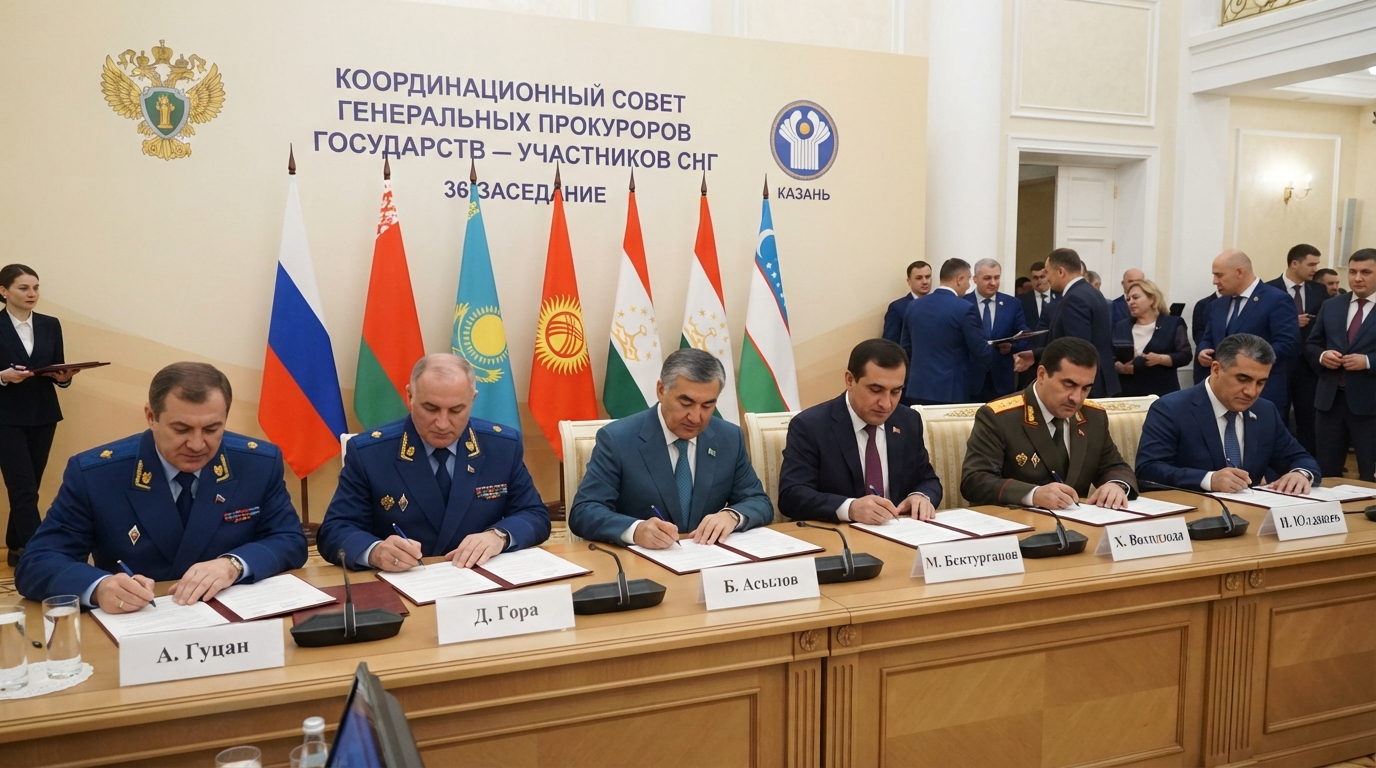
The 36th meeting of the Coordinating Council of Prosecutors General of the CIS was held in Kazan, attended by the heads of supervisory authorities from Azerbaijan, Armenia, Belarus, Kazakhstan, Kyrgyzstan, Russia, Tajikistan, and Uzbekistan.
Following the meeting, the heads of the respective agencies of several Commonwealth countries — Alexander Gutsan (Russia), Dmitry Gora (Belarus), Berik Asylov (Kazakhstan), Malik Bekturganov (Kyrgyzstan), Khabibullo Vokhidzoda (Tajikistan), and Nigmatilla Yuldashev (Uzbekistan) — signed an agreement on cooperation in the fight against terrorism and extremism.
The document expresses the "concern of the parties" over the rise in cases of terrorism and extremism, including those related to the rehabilitation of Nazism, "posing a serious threat to the security of the states, as well as to their political, economic, and social stability."
The agreement provides for the rapid exchange of information on terrorist and extremist organizations, groups, and individuals that threaten the security of the states. The parties will also share data on the establishment of international contacts between terrorist and extremist groups. In addition, the countries intend to exchange information on encroachments violating the sovereignty of the states or on potential terrorist attacks. Information on illegal armed groups using terrorist, sabotage, and extremist methods shall also serve as a basis for data transmission to the parties.
The parties pledged to inform each other about human, weapon, and drug traffickers, as well as organizers of illegal migration.
Separately, information will be shared regarding foreign terrorist fighters or those returning "to their states of origin" and their family members, including through the use of procedures to detect forged identity and travel documents.
Furthermore, the heads of the supervisory authorities of the Commonwealth countries agreed to establish an interagency expert network for the recovery of assets obtained through criminal means and initiated the preparation of a specialized international treaty.
Prosecutor General of the Russian Federation Alexander Gutsan stated that traditional mechanisms of extradition and legal assistance often fail due to politicization and differences in national laws. Criminals use cryptocurrencies and proxies for the rapid transit of funds, while FATF standards are not always effectively implemented in practice.
"The rates of actual asset recovery from abroad are extremely insignificant," stated Oleg Krylov, representative of the CIS Council of Heads of Financial Intelligence Units.
To optimize operations, a 14-step guide for foreign partners has been posted on the website of the Prosecutor General's Office of Russia. The algorithm defines the procedure for submitting requests to search for, freeze, and confiscate property in the Russian Federation. The document requires foreign applicants to conduct preliminary consultations, detail the damages, and provide guarantees of reciprocity. A key condition: the incriminated act must be punishable by imprisonment for a term of at least one year under the laws of both countries.
The use of existing procedures has already allowed the Russian Federation, together with its partners, to seize the property of defendants in embezzlement cases in Kazakhstan, Tajikistan, Mongolia, Bulgaria, Hungary, and Spain.
To resolve systemic problems, the CIS prosecutors intend to harmonize national legislations and draft a model law. The draft treaty on cooperation in the field of asset recovery has been sent to the member states for consideration.