

Private suppliers and cylinder sales in stores. How the liquefied gas market is being reformed
Uzbekistan plans a phased liberalization of the liquefied petroleum gas market. Proposals for free market prices will be prepared by May 2027, and regional divisions of LPG-Trade are expected to be privatized in the future, along with allowing the sale of 5 and 10 kg cylinders in retail outlets.
Private suppliers and sale of cylinders in stores. How the liquefied gas market is being changed
In Uzbekistan, proposals for the liberalization of liquefied gas prices for the population are intended to be prepared by May 2027.
The document envisages the further easing of price regulation for liquefied gas and expanding the participation of the private sector in its supply to the population.
According to the draft, the Ministry of Economy and Finance, together with the Ministry of Energy, must submit proposals on price liberalization to the government by May 1, 2027. In preparing them, it is necessary to take into account the level of development of the liquefied gas market, the results of pilot projects, and the need for social protection of the population.
At the same time, the draft does not specify specific timelines for the transition to free prices for all household consumers.
As a reminder, a presidential decree dated September 12, 2026, provides for an experiment to be conducted in the Andijan region starting October 1.
As part of the pilot project, private entrepreneurs were allowed to import liquefied gas and directly supply it to the population in household cylinders at free prices.
Explanatory materials prepared by the authorities state that in the first stage, supplies under the regulated system will be maintained. At the same time, private operators will be able to offer consumers additional volumes of gas at market prices.
Based on the results of the experiment in the Andijan region, it is planned to consider the possibility of extending this model to other regions of Uzbekistan.
In the future, it is expected to expand the participation of private companies in the import, storage, and delivery of liquefied gas to the population.
The reform will also affect LPG-Trade, a company created under JSC "Hududgazta'minot" to organize the procurement of liquefied gas on the exchange and its supply to household consumers.
According to the explanatory materials from the authorities, a privatization strategy for LPG-Trade's assets is planned to be developed with the involvement of international consulting companies. In particular, the phased privatization of the company's regional divisions as turnkey business projects is provided for.
In the long term, the authorities intend to change the current model of supplying liquefied gas to the population, under which consumers mostly receive 20-kilogram cylinders at a set periodicity.
It is assumed that citizens will be able to independently choose the supplier, the required volume of gas, and a convenient time of purchase.
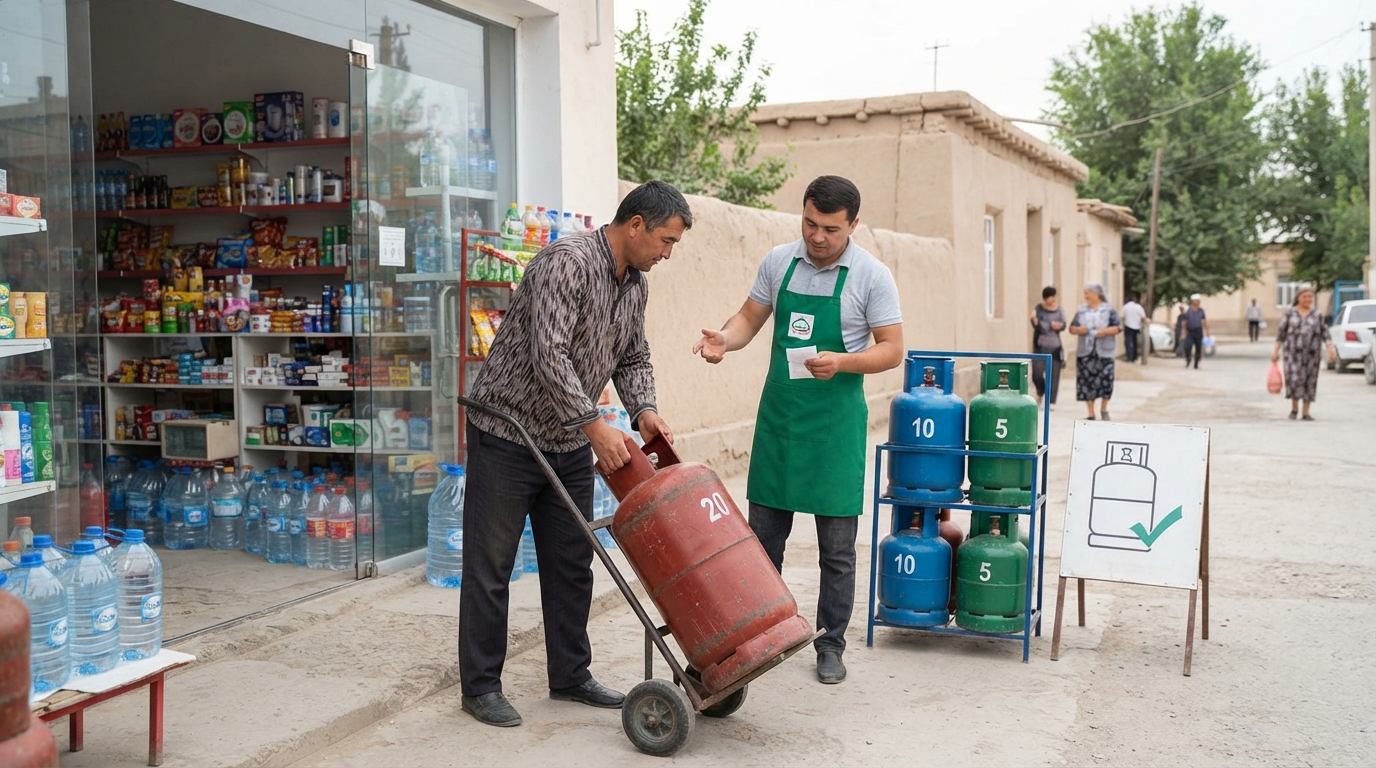
In particular, the possibility of free sale of liquefied gas in household cylinders with a capacity of 5 and 10 kg is being considered. They can be purchased not only with home delivery through private operators, but also in retail outlets, including regular stores and supermarkets.
The explanatory materials state that the transition to such a model will be gradual, as competition develops and the activities of private suppliers expand.
The timing for the start of gas cylinder sales through retail stores has not yet been determined.
A separate provision of the draft concerns the provision of liquefied gas to several families living in a single household property.
It is proposed to allow issuing a separate household gas cylinder to each family, even if the house has a single cadastral number. Such an exception will be permissible if there is a separate or shared kitchen, as well as a gas stove that meets technical requirements.
To receive separate cylinders, representatives of the "mahalla seven" and the gas supply organization will have to inspect the household property and draw up a corresponding report.
These changes are proposed to be introduced from November 1, 2026.
Today, there are about 4 million consumers of household liquefied gas in Uzbekistan. As part of this same reform, the Ministry of Economy and Finance proposed raising the regulated retail price of liquefied gas for the population from 2,000 to 5,000 soums per kilogram — a 2.5-fold increase.
The authorities explain the revision by a decline in domestic production, an increase in imports, and insufficient supply volumes.
For families in need, a compensation of 3,000 soums is provided for each purchased kilogram of gas within 20 kg per month. The maximum compensation will be 60 thousand soums per month.
The difference between the procurement cost of gas on the exchange and the price set by the state for the population is expected to be covered from the national budget through subsidies to LPG-Trade.
As a reminder, ahead of the heating season, it is planned to pay more than 1 million families in need 1 million soums each in November. It is also proposed to expand the circle of recipients of compensation for electricity, gas, and coal, extend the payments, and increase the basic electricity quota to 350 kWh for residents of areas without gas supply.