

Polish ambassador joins WW2 plaque unveiling
The Polish ambassador said the "hospitality and solidarity" shown here needed to be remembered today.
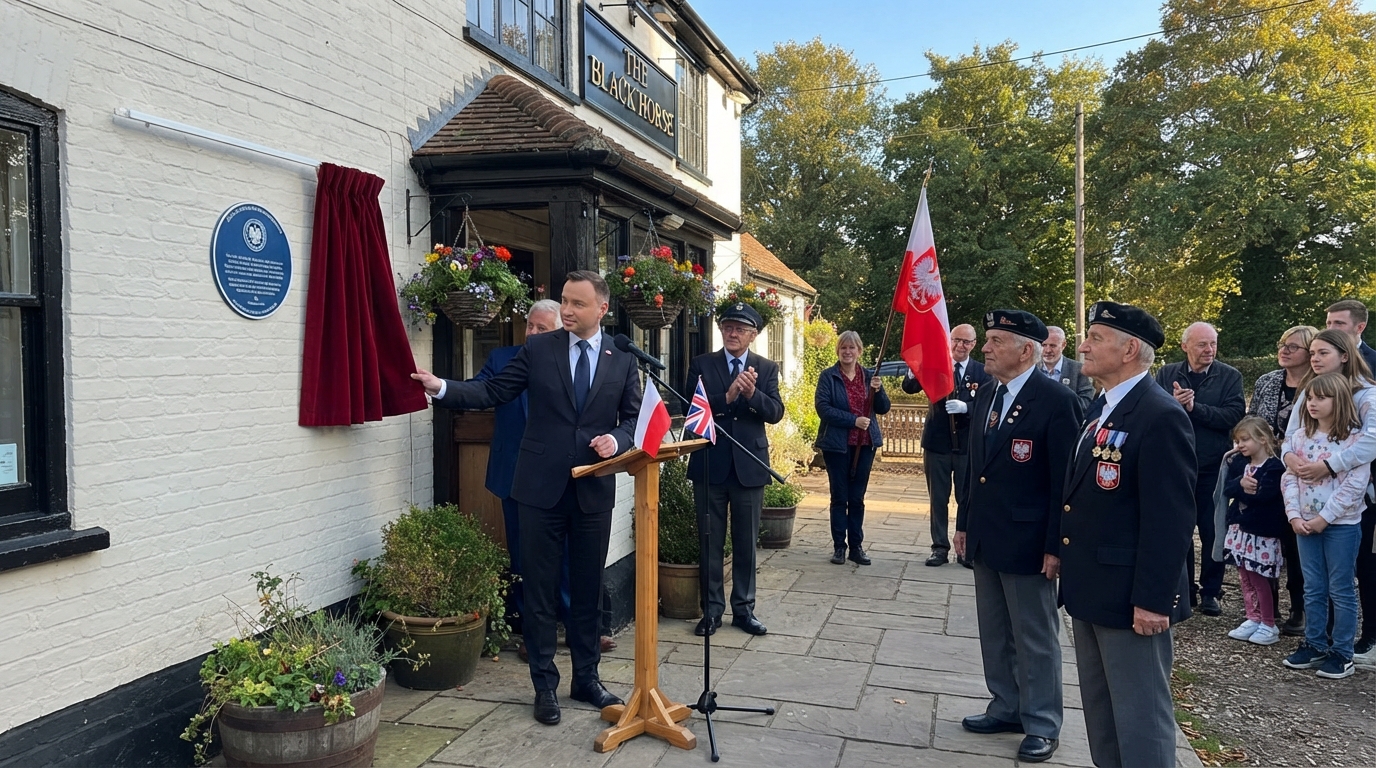
Polish ambassador attends WW2 plaque unveiling
A blue plaque has been unveiled at a pub in Oxfordshire to honour Polish soldiers and their families who settled nearby after the Second World War.
The Black Horse Pub in Checkendon was a gathering place for hundreds of Poles who lived in woodland refugee camps in Checkendon, Nettlebed and Highmoor from 1946 to 1961.
After the war, the Soviets occupied Poland, so many Poles who had fought alongside the British began new lives in Oxfordshire because they could not return home.
At the unveiling on 2 October, Polish Ambassador to the UK Rafał Wiśniewski said the "hospitality and solidarity" shown there should be remembered today because "we are now again exposed to military conflict" in Europe.
Many of those present grew up in the camp and were the children of soldiers from the Polish 2nd Corps, who fought at the deadly battle of Monte Cassino in Italy, where some 55,000 allied troops lost their lives.
Stanislawa Szpak recalls the "idyllic" atmosphere of the camp and the "freedom" of going "anywhere they liked", despite the basic accommodation in Nissen huts with no running water.
"It was hard for the adults. But it was home. They could just get on with life after so many years of uncertainty, cruelty, malnutrition. They had bread on the table", she said.
The Black Horse has belonged to the same family for more than a century, and it was a place where Polish and British troops drank.
Earlier this year, an event marked the deep ties formed between the Polish community and local villagers.
Mr Wiśniewski said it is "a very symbolic place both for the past and for the present" and for Polish-British friendship.
The ambassador spoke alongside veterans, families and units with links to the Polish forces.
In his speech at the event, he stressed the need for the British audience to remember the annexation of parts of Poland by Russia.
He also referred to the journey many Polish families had made across two or three continents to reach Britain, while others died after being forced to work in Gulags and treated as "slaves".
When asked whether Britain takes the threat from Russia seriously, he said it is important to consider the "geographical distance".
"It's easier for societies which are literally next door to understand it, also emotionally, but I think the United Kingdom is very much engaged."
"I think that it is also thanks to events and stories like this one today that this approach is still very strong and very alive."