

Play, Musician
Power, society, elites: who sets the rules of the game in Kazakhstan? — expert opinion
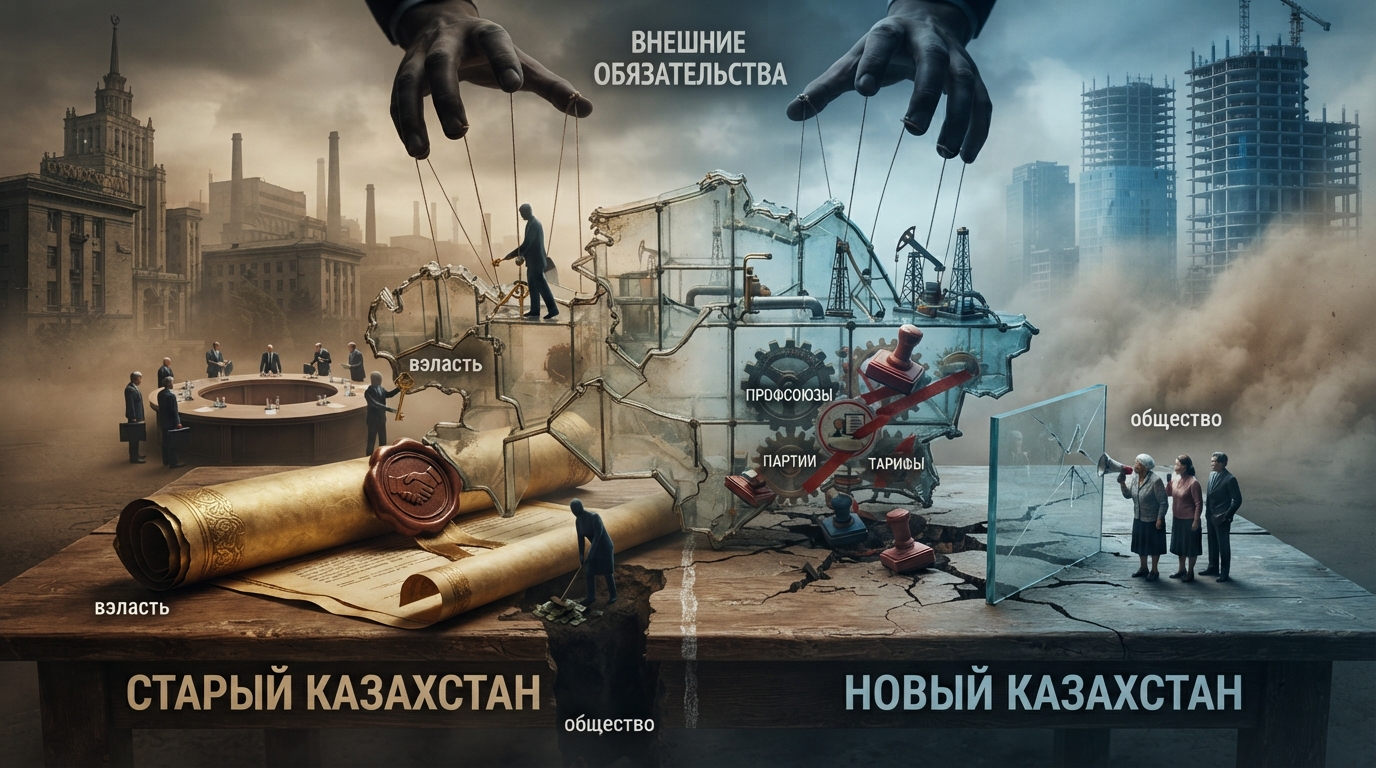
**Play on, Musician**
In the "old Kazakhstan," an unspoken principle was at play: the authorities promised the public socio-economic well-being, and in return, the public did not interfere in politics and the affairs of the political elite. In practice, however, this promise was hardly kept. Now that the course toward building a "new Kazakhstan" has been proclaimed, a question naturally arises: has a new social contract emerged in its place? If so, on what terms? And is it even needed? We asked Pyotr Svoik, a well-known Kazakhstani economist, political scientist, and public figure, to discuss this.
— Pyotr Vladimirovich, in your opinion, is a social contract in the context of Kazakhstan a myth or a reality?
— It is probably not possible to speak of the existence of a contract, even an unspoken one, between the authorities and society in Kazakhstan, either then or now. If only because it presupposes the presence of two parties, whereas our society is in no way structured for a conversation with the authorities—neither in a formal nor in an informal sense. And this is largely the result of the actions of the authorities themselves…
— What is needed for society to become a fully-fledged party to such a dialogue? And why do we not have this?
— First, we need strong and independent trade unions. In many countries, especially developed ones, this is one of the most powerful instruments of public representation. But in our country, they exist only formally and represent employers rather than workers. Nobody is interested in their activities, and they manifest themselves in almost no way in the public space.
Attempts to revive the trade union movement were, of course, made, but in the "old Kazakhstan" they led to nothing, and in the "new" one they resulted in even greater bureaucratization. Even the General Agreement between the government and trade unions for 2024–2026 turned out to be a pure formality. It contained no concrete decisions that could really interest employees: neither on the minimum wage, nor on the consumer basket, nor on working hours, nor even on the abolition of the single time zone, which also concerns people one way or another.
Second, representation is needed along the lines of social protection—pensioners, single mothers, people with disabilities. But in this country, no one is engaged in defending the interests of these categories of citizens. Except, perhaps, the "Generation" movement of Irina Savostina, which, even if it did not interact with the authorities systematically, at least actively declared its demands. Now even that is gone.
Third, tariffs. They concern everyone and could become an effective channel of dialogue between the state and society. But this is not happening. For example, the "Transparent Tariff" Association of Kazakhstan, which I head, has repeatedly proposed ways for the public to participate in tariff policy, but all to no avail.
And fourth, political parties. No matter how much they boast about their membership numbers, in reality, they represent very few people. Our citizens as a whole are not oriented toward any party. "Amanat" has some degree of public representation, but largely due to public sector employees and workers of large enterprises. At the same time, the party's policy itself does not depend on these people in any way.
At the same time, one cannot say that the government does not fulfill its obligations to society at all. It tries to pay pensions and benefits on time, and to provide people with education and healthcare services after a fashion. But this, too, is done unilaterally, without contact with the population.
If there are bilateral relations in the country, they are, as a rule, between the authorities and the counter-elites. It is precisely this kind of contract that has always existed, and it looks very interesting.
— How did these relations develop?
— Let's start with the "old Kazakhstan." Many did not notice this, but the first president, for all his permanence and inviolability, existed under conditions of serious counter-elite resistance for almost his entire tenure. It began back during the dissolution of the Supreme Council, when none other than the ex-chairman of the Supreme Council, Serikbolsyn Abdildin, and then ex-prime minister Akezhan Kazhegeldin went into opposition to him. The former revived the Communist Party, and the latter tried to create the Republican People's Party but could not register it.
A little later, the "Azamat" civil movement emerged, which also included members of the government and a number of prominent academics. Then, on the initiative of Mukhtar Ablyazov and Galymzhan Zhakiyanov, the "Democratic Choice of Kazakhstan" was created. This was followed by the "Ak Zhol" party, co-chaired by Bolat Abilov, Alikhan Baimenov, and Oraz Zhandosov. And finally, the ex-chairman of the Mazhilis, Zharmakhan Tuyakbay, joined the opposition ranks, leading the "For a Just Kazakhstan" movement. With this slogan, he ran in the 2005 presidential election, where he took second place, and after that, he founded the Nationwide Social Democratic Party.
All these leaders, in their own minds and in the expectations of their supporters, were virtually ready-made presidents capable of replacing the incumbent. Such a serious intra-elite and inter-clan opposition, which emerged from the authorities themselves and possessed financial and media resources, did indeed exist in the country back then. And, by the way, the economic situation of the second half of the 1990s and the early 2000s gave it serious hopes for the realization of its plans.
The opposition to Nursultan Nazarbayev by his own appointees ended only after he demonstrated in the most convincing way that he was not going to give up power or allow any of the counter-elite members into parliament, maslikhats, or even election commissions. And what helped the future Elbasy to virtually neutralize it, to make his rule truly irreplaceable and unshakable, was... the "fat years." The multi-year rise in global oil prices that began after the attack on the Twin Towers in New York became the foundation of the regime's success.
As for the "new Kazakhstan," it also experienced an opposition surge, but no longer in the form of legal party building, but through an attempted coup d'état in January 2022. Kassym-Jomart Tokayev managed to quickly suppress it thanks to a demonstration of external support. The resistance of the conspirators fizzled out even before the CSTO troops arrived in Kazakhstan, but rather when it became known that they were about to fly here.
— Is there any guarantee that intra-clan resistance will not flare up again?
— I am afraid there are no such guarantees. For now, the intra-clan opposition is keeping quiet. Apparently, the example of Qantar taught it a lot. And in general, the situation in Kazakhstan is not that bad—it is not improving, but the "export-oriented" economy is still working. However, the prospect is quite real that someone from the authorities themselves or from some counter-elite groups will think that it is already possible to pressure the incumbent president and heat up the situation.
In parentheses, I will note that the current harsh cleanup of the information space in all directions is probably due to the fact that the authorities understand: destabilization is possible. Therefore, they are trying to take preventive measures.
What do we have in the end? There is a unilateral contract under which the state tries to fulfill its obligations to the population so as not to agitate it. And there is an intra-elite bilateral contract under which the counter-elites so far refrain from appealing to the people. Especially since their attempts to draw society to their side by bringing a large number of people onto the streets, as during Qantar, ended badly.
— What, then, holds the political system together?
— It is held together by agreements on external obligations—both formal and informal. I will name two fundamental blocks.
The first is the production sharing agreements for Karachaganak and Kashagan, as well as the stabilized contract for Tengiz. We are talking about specific documents that largely determine the "export-oriented" economy of Kazakhstan, where foreign concessionaires extract the main rent, and the government gets a relatively small share. They definitely need to be revised, and the president spoke about this a couple of years ago—though only about adjustment, not revision. But so far, only underlying movements are visible in this direction. Kazakhstan is suing not over the substance of the agreements themselves, but over various environmental violations.
The second block is a whole set of signed agreements related to the external financing of Kazakhstan and the obligations of the National Bank to the International Monetary Fund, including compliance with its rules and guidelines. This set also includes the National Fund, which is presented as the property of the people and a fund for future generations, but in reality is one of the instruments of external exploitation of Kazakhstan. Through it, the countries that buy our oil receive back their foreign currency paid for this oil, in exchange for storing their debt obligations.
Thus, within the framework of the IMF, there is an obligation according to which the exchange rate of the national currency must be floating, that is, unstable. And the main condition, which is not written down anywhere but formally and objectively exists, is the non-interference of the state in its own external balance of payments. It is entirely given over, firstly, to foreign concessionaires, and secondly, to various financial speculators, also largely external.
Or rather, like this: the most important condition shaping the "export-oriented" economy of Kazakhstan is the monetary policy imposed on the National Bank, in particular, the setting of a high base rate allegedly to fight inflation. In reality, it is this policy that drives inflation and blocks the credit and investment capacity of the tenge. Which was to be demonstrated: the "export-oriented" economic model excludes domestic investment and assumes only external investment.
All these fundamental formal and informal agreements, I repeat, ensure the operation of the "export-oriented" economy. Within their framework, there is a mechanism, probably even written down somewhere, of the comprador integration of the former ruling elite of the "old Kazakhstan" into this model. That is, it is quite possible to assume that a certain and significant part of foreign investments and borrowings is money withdrawn from here. And the opportunity for this elite to store them in London and Dubai in the form of real estate and bank accounts also serves as a guarantee of preserving the system of external exploitation of Kazakhstan.
— Has anything changed in the structure of this model with the arrival of the "new Kazakhstan"?
— In essence, nothing. The entire constitutional reform bypassed the foundations of this "export-oriented" comprador scheme. Yes, there was a replacement of power and property within it, but the scheme itself remains the same for now.
However, a big plus for the current president is that he personally has never participated in comprador schemes, although he emerged from the "old Kazakhstan." This gives him the opportunity to really revise this model of external exploitation. But so far, I emphasize, this is only an opportunity. We will see what happens next. After all, the legal proceedings with foreign concessionaires are only beginning and are not political in nature.
— Let's return to the original question: under what conditions can a contract between the authorities and society actually start working?
— Such a contract may well be implemented within the framework of the presidential policy of building a new and just Kazakhstan. But this requires two conditions.
The first is to revise relations with foreign concessionaires and bring them into line with the Constitution, which states that the land and subsoil belong to the people. Then the sale of subsoil wealth will be carried out, if not on behalf of the people, then at least with their knowledge, and not in a confidential manner.
The second is to revise the very scheme of external financing. As I have already said, it is built on the fundamental suppression of national credit and domestic investment. And this suppression is carried out by the National Bank, which in this sense is rather anti-national. It is its policy, linked to obligations to the IMF and following its recommendations, that kills domestic credit, deprives the tenge of investment potential, and shifts the economy to external financing with the export of income.
Moreover, this revision must be justified not only economically, but also politically. That is, to move the issue to the plane of protecting national interests and creating national credit and investment potential. And if the government succeeds in doing this, then, perhaps, the social contract will start working and become bilateral.