

Pictured: Winning entries for Wildlife Photographer of the Year 2026
Striking images including an urban coyote and an elephant carrying a dead calf are among this year's winners.
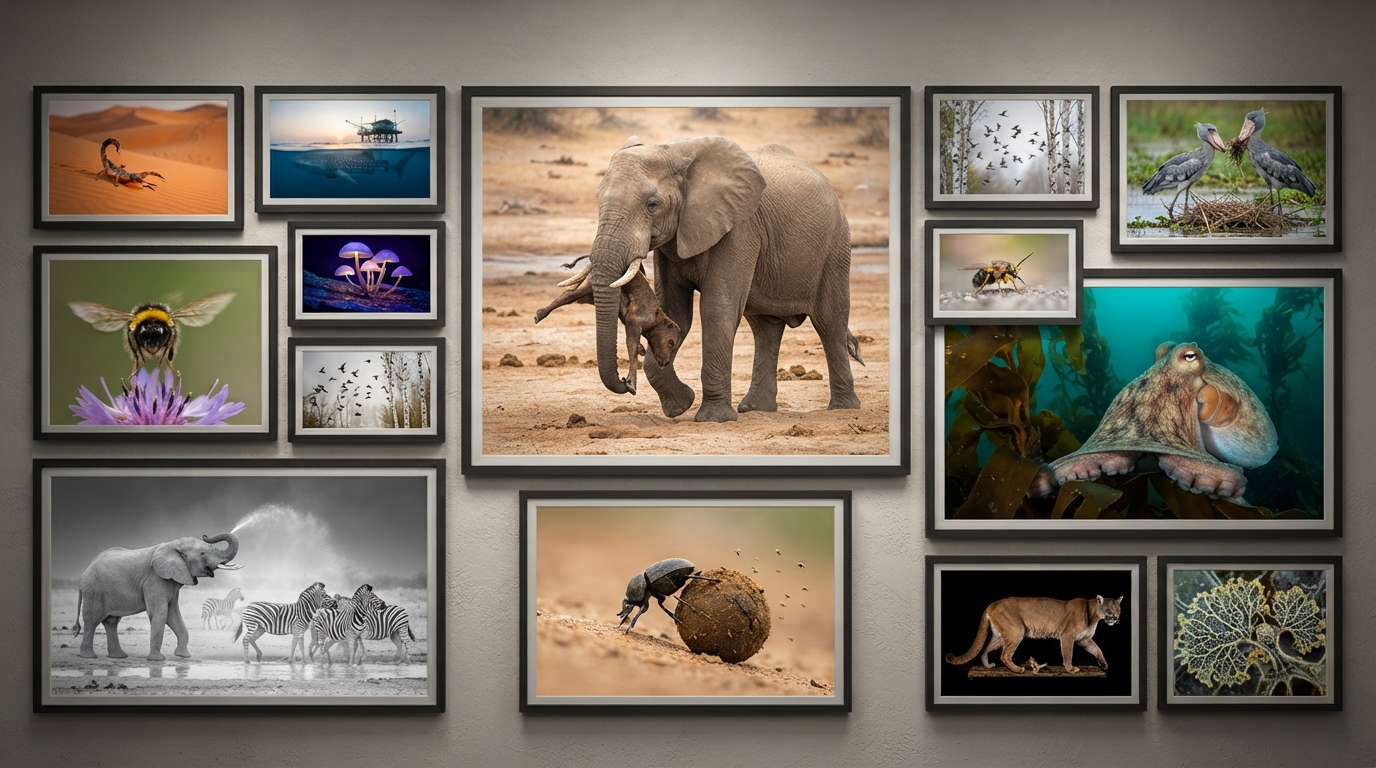
**Pictured: Winning entries for Wildlife Photographer of the Year 2026**
An emotional image of an elephant carrying a dead calf has won Italian photographer Federico Veronesi the title of Wildlife Photographer of the Year 2026.
While following elephants in Namibia's Huab River Valley, Veronesi noticed an unusual line of drag marks crossing the sand of a dry riverbed.
Tracing the marks, he found a female elephant carrying a dead calf, with its leg caught between her tusk and trunk.
At first, Veronesi believed the elephant was the calf's mother. But after he shared the photos with an elephant research project operating in the area, he discovered that this was not certain.
Researchers identified the elephant as a female that had lost a calf several years ago and said she had previously lifted dead calves belonging to other females.
For Veronesi, the encounter carried deep meaning. "Of all the 20 years I've done photographing animals, this is the most heart-wrecking and fascinating and dramatic," he said, calling it "revealing of the depth and complexity of the emotions, the feelings of the animals."
He hopes the picture will prompt people to see beyond animals' physical appearance and understand them as individuals with their own relationships, memories and emotions. "It's a small window that opens just a crack into the complexity of their world," he said.
Only by lying in the dust and photographing the beetle at eye level could Whitfield show how much strength the task demanded.
During a family game drive in Zimbabwe, near his home in Victoria Falls, he saw the dung beetle struggling to push a ball of dung uphill through the sand, with a line of flies trailing close behind. After trying different angles and compositions, he captured a moment that shows the remarkable effort behind this apparently simple task.
"I hope that when people look at the photograph, they can see too, and maybe appreciate how much can be happening in a small moment in the natural world," says Whitfield.
You do not need a camera or a plane ticket to make an award-winning photo. Davis took this image in the garden using her dad's smartphone.
The picture captures a single wingbeat from a common carder bumblebee as it gets ready to land on a flower.
Lewin made this dreamy black-and-white image of a young bull elephant spraying zebras at a waterhole.
He reduced the normally harsh light by using a camera converted to infrared.
Common octopuses are usually found in the warmer Mediterranean Sea. But as global warming raises springtime sea temperatures, sightings in south-west England have risen sharply.
Sanders described the moment he noticed a single eye peering out from behind the kelp: "We remained perfectly still, watching one another with a seemingly shared curiosity."
Fewer than 5,300 mature shoebill storks are thought to remain in the wild. Yet Pretorius, while canoeing with a guide, managed to photograph these two – likely a breeding pair gathering material for their nest.
Despite their name, shoebill storks are actually more closely related to pelicans, herons and ibises.
A scorpion is shown burrowing into the shifting dunes of India's Thar Desert.
While exploring the dunes at night, Raul saw many scorpions hunting for prey, but as temperatures climbed after sunrise, the scorpion dug into the sand to avoid the intense heat.
A whale shark examines the catch of a mobile net-fishing platform known as a bagan. Lindbloom looked for sharks around dawn, using the bagan's bright lights to light them when there was too little natural light for his drone.
Papatsanis used ultraviolet light to illuminate mushrooms known as "beautiful bonnets" growing from a decaying log on the lower slopes of Mount Olympus in Greece.
Tinker-Tsavalas uses macro photography to expose the intricate details of tiny animals that are easily missed, especially in urban habitats. His interest in macro photography grew during the Covid-19 lockdowns, when he was limited to habitats close to his home in Berlin.
Michalski used a slow shutter speed to photograph birds flying against a backdrop of leafless birch trees. A field of unharvested sunflowers had drawn mixed flocks of birds, especially goldfinches and bramblings, before they were flushed into the air by a sparrowhawk.
Visbal records how a single engineered line can transform an entire wetland as part of a long-term project on the industrial impact on waterways. The pink colour comes from microbes thriving in extremely salty water after the area was cut off from fresh water.
Negroni captures this scene of a dead puma displayed as a hunting trophy in Santa Cruz, a province in Argentine Patagonia. Although Santa Cruz banned puma hunting in 2025, illegal persecution continues.
Uddin's photographs examine the miniature world of slime moulds, organisms that can be barely visible to the naked eye and whose fruiting structures are only one to two millimetres high.