

Scientists have determined why more animals gather around dead elephants
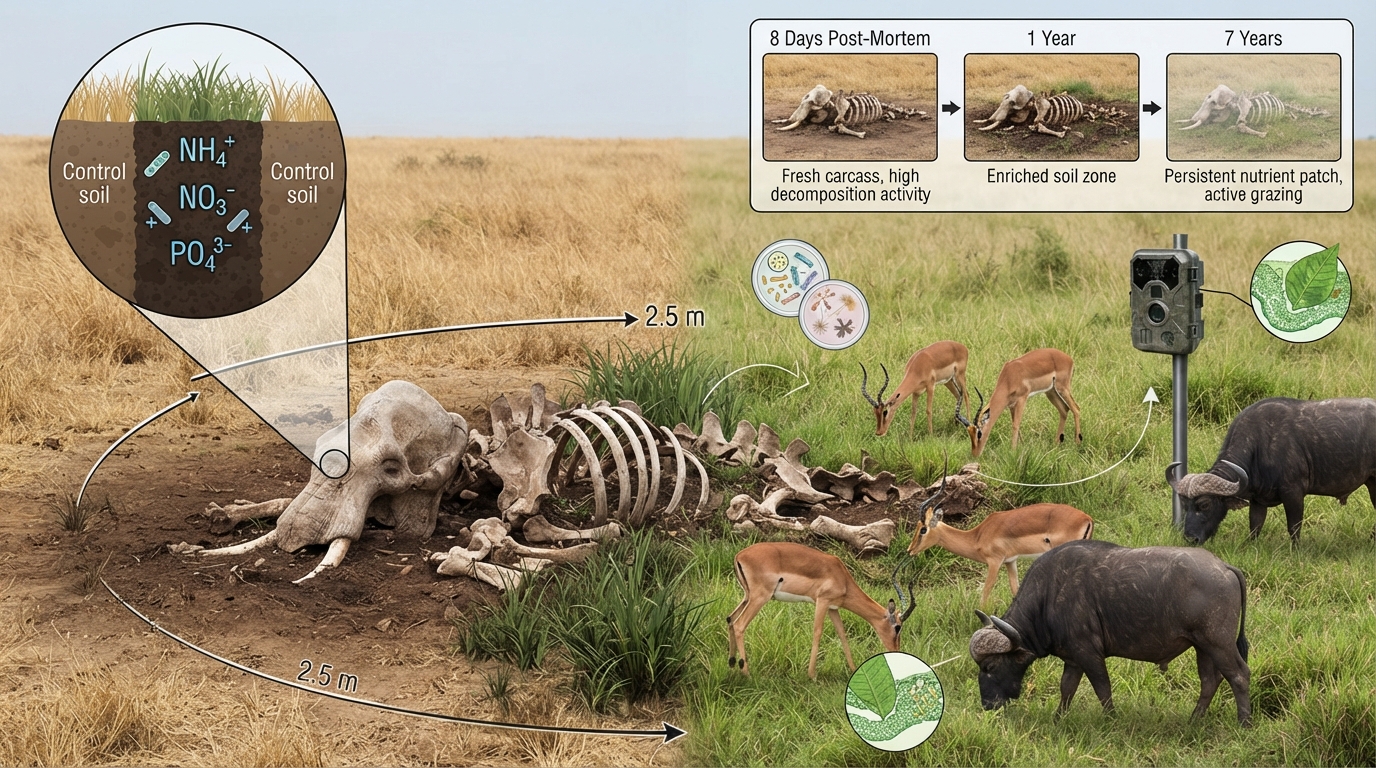
A study conducted in Kruger National Park in South Africa showed that elephant remains affect the soil, plants, and the diet of herbivores for more than seven years. In such places, grasses were more nutritious, but the diversity of plants and soil microorganisms decreased.
Scientists have determined why more other animals gather around dead elephants
The scientific work on this was published in the journal Proceedings of the National Academy of Sciences.
While alive, elephants alter the savanna landscape by consuming large amounts of vegetation, breaking branches, and sometimes knocking down trees. Researchers studied how long their impact on the ecosystem persists after their death.
Scientists examined 40 sites where elephants had died. The age of the remains ranged from eight days to 2,814 days, which is nearly 7.7 years.
At each site, soil and plants at distances of 0.5 and 2.5 meters from the elephant remains were analyzed. The results were compared with control plots at a distance of 15 meters. Additionally, micro-organism DNA was studied, and animal feeding was observed using camera traps.
The largest changes were found in the chemical composition of the soil. Near the elephant remains, ammonium levels were on average 31 times higher, nitrates seven times higher, and phosphorus three times higher compared to the control plots.
Near some fresh remains, the level of nitrogen compounds in the soil increased by up to nearly 3,000 times the usual level. It is stated that this was caused by the release of a large volume of organic matter into the soil as a result of the decomposition of the multi-ton animal's body.
However, an abundance of nutrients was not always beneficial for plants. Extremely high concentrations of ammonium can have a toxic effect on them. Therefore, unfavorable conditions for plant growth were created around fresh remains.
Plant diversity near the elephant remains was significantly lower than in the control plots. This difference persisted even around 7.7-year-old remains.
The diversity of bacteria and fungi in the soil also decreased. At the same time, the activity of micro-organisms that decompose organic matter remained high for one to two years.
Interestingly, the grasses that managed to grow in such places were more nutritious. The nitrogen content in their leaves was on average 1.5 times higher compared to the control plots. This phenomenon was observed around older remains as well.
Camera traps showed that impalas and buffaloes fed near elephant remains about three times more often than in control plots. Such active grazing continued even more than seven years after the elephant's death.