

Photo: Chuseok, the national Korean harvest festival, was held in Tashkent
At the Palace of Korean Culture and Art in Tashkent, Chuseok—the Korean festival of harvest and family—was celebrated. Guests were welcomed with traditional games, masterclasses, a food court featuring national cuisine, and a photo zone with hanbok. The atmosphere of the day is captured in a photo report by "Gazeta" correspondent Orifjon Khoshimov.
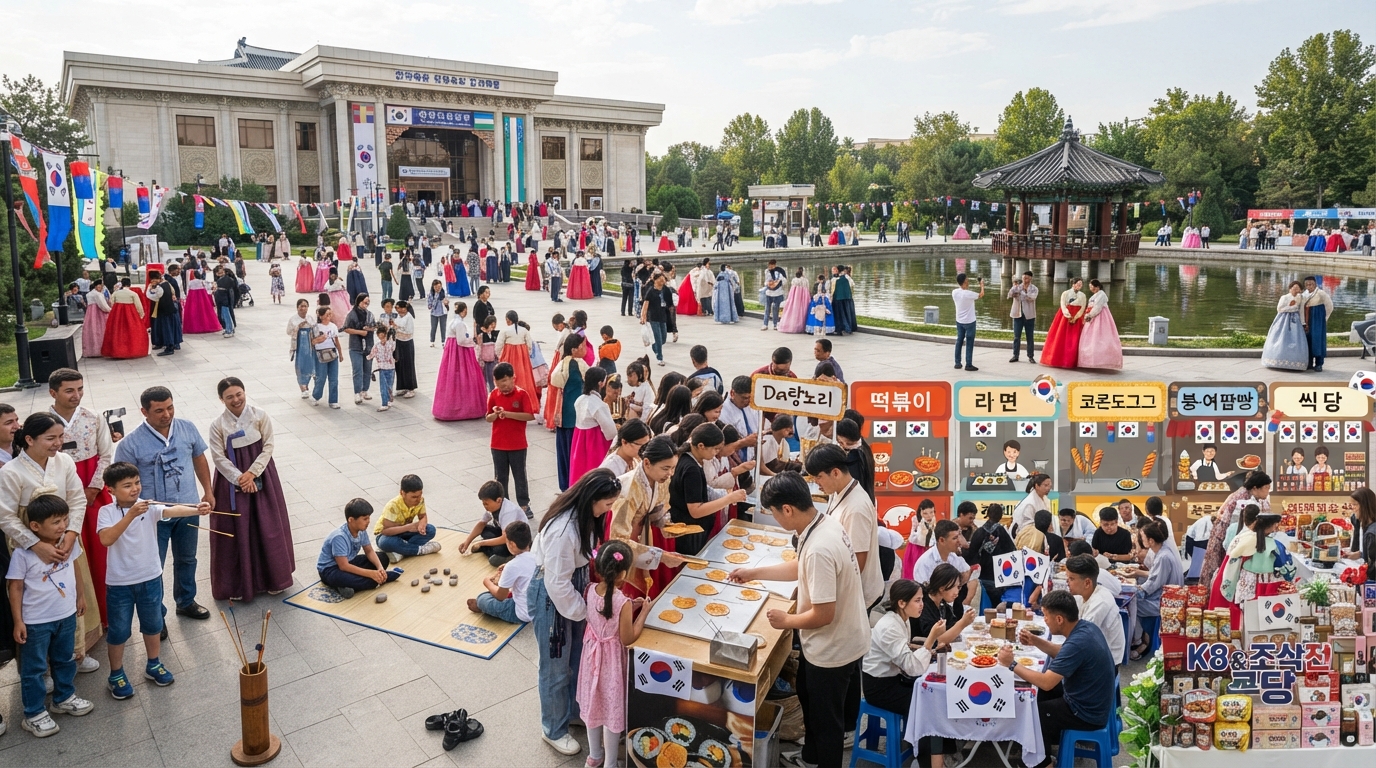
Photo: Chuseok, the national Korean harvest festival, celebrated in Tashkent
Last Saturday, September 26, the Palace of Korean Culture and Art in Tashkent hosted Chuseok, the Korean festival of harvest, family, and respect for elders. The event was organized by the Association of Korean Cultural Centers of Uzbekistan.
Over three decades, the festival has grown into a city-scale event. Choi Young-ha, Ambassador of the Republic of Korea to Uzbekistan from 1997 to 2000, noted that Chuseok used to be celebrated much more modestly—within a small circle at the House of Koreans.
"I am confident that such events contribute to even greater cohesion, strengthening the identity and unity of our Korean community. In Korea itself, Chuseok is usually celebrated at home, within the family circle; such mass celebrations are not held there. But here, in the countries of the region, I see how our Koryo-saram gather together to preserve unity and pass on the culture from generation to generation," he said.
Guests of Chuseok could try their hand at several traditional games: throwing arrows into a narrow jar in tuho-nori, spinning a paengi top, competing in paengichigi, playing the card game ddakjichigi, or gongginori—a game of tossing pebbles. One spectator, watching her grandson play gongginori, remarked that in her childhood there were no special pieces—children played with ordinary pebbles.
A queue formed at the table where volunteers were making dalgona—sugar honeycombs. Guests were not only treated to the delicacy but were also taught how to carve a shape out of it using a mold. According to the volunteers, this is easy to replicate at home. Participants in a neighboring masterclass were taught how to roll kimbap.
At the food court, local establishments offered street food currently popular in Korea itself: bungeoppang, cheese coins, corn dogs, tteokbokki, ramen, and trendy desserts.
By the pond with a gazebo, visitors could rent a hanbok and take photos against the water. A nearby fair sold Korean snacks and cosmetics.