

Peace to our home
Uzbekistan entered the top 50 of the global ranking of the most peaceful countries with the best result in Central Asia
Peace to Our Home
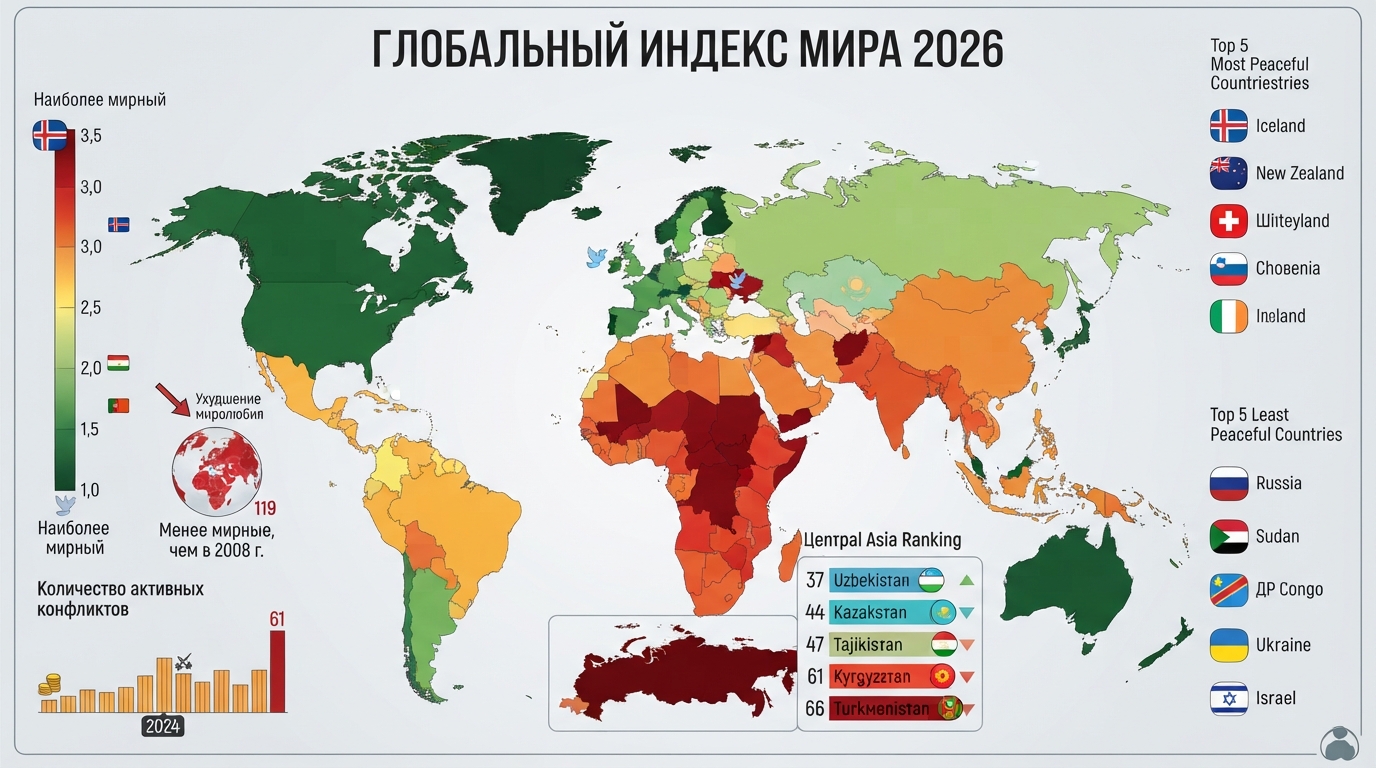
The level of peacefulness in the world continues to decline. According to the Global Peace Index (GPI) 2026, the global average score deteriorated by 0.7% over the past year. Negative dynamics have been recorded for the 12th consecutive year, and over the last 18 years, deterioration was noted 15 times. Over the year, indicators worsened in 99 and improved in 62 of the 163 countries and territories. Currently, 119 countries are less peaceful than they were in 2008.
The rising number of armed conflicts remains one of the key factors behind this deterioration. According to the latest available data, the number of active state-based armed conflicts reached 61 in 2024, marking the highest level since World War II. In parallel, the economic impact of violence is also increasing: in 2025, the Institute for Economics & Peace estimated it at $21.8 trillion, or 10.5% of global GDP.
Iceland remained the most peaceful country in the world in 2026, with a score of 1.161. It has held the first place for 19 consecutive years. New Zealand is in second place (1.343), followed by Switzerland in third (1.363). Next are Slovenia (1.369) and Ireland (1.371). The top ten also includes Austria, Portugal, Singapore, Finland, and Japan. Seven of the ten most peaceful countries are located in Europe.
The bottom of the ranking is mostly occupied by states where major armed conflicts are ongoing. Russia took the last, 163rd place with a score of 3.367. Positioned above it are Sudan (3.195), the DR Congo (3.189), Ukraine (3.184), and Israel (3.124). The ten least peaceful countries also include South Sudan, Afghanistan, Yemen, Syria, and Mali. Russia has ranked last in the GPI for the first time.
Against this backdrop, Central Asian countries occupied relatively high positions. Uzbekistan showed the best result in the region: a score of 1.726 and 37th place in the world. Kazakhstan took 44th place with a score of 1.771. Tajikistan ranked 47th (1.799), Kyrgyzstan 61st (1.853), and Turkmenistan 66th (1.903). The IEP classifies all five states of the region in the high peacefulness group. At the same time, three Central Asian countries entered the top 50 of the global ranking, and all five ended up in its upper half.
Over the past year, indicators improved only for Uzbekistan and Kazakhstan. A year earlier, their GPI stood at 1.781 and 1.791 respectively. In Tajikistan, Kyrgyzstan, and Turkmenistan, on the contrary, the situation deteriorated: in 2025, the index was 1.749, 1.812, and 1.859 respectively.
In the global ranking, Uzbekistan placed between Albania and Equatorial Guinea. The country also ranked higher than the United Kingdom, Sweden, Greece, and South Korea.
This dynamic aligns with a broader regional picture. Eastern Europe and Central Asia became the only one of the eight GPI regions where the average level of peacefulness improved. In the remaining seven regions, indicators deteriorated, with the sharpest decline recorded in South Asia.