

Passions for Abai
Richer parents mean higher intelligence among their children. How does this work in Kazakhstan?
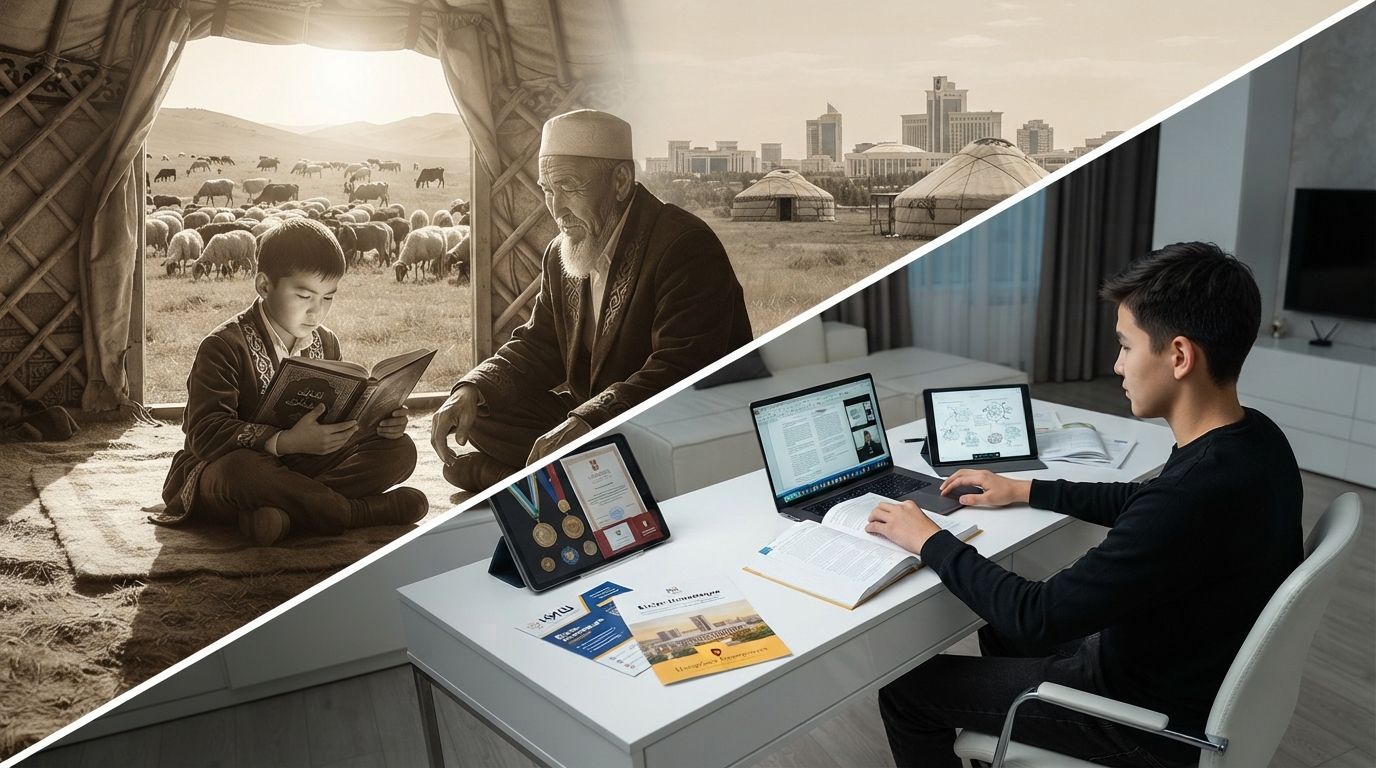
**Abai Passions**
The recent statement by the leader of the Respublika party that Abai owed his rise to fame to "fat paternal herds" and his call for an increase in the number of "kunanbays" in the country sparked a wave of widespread discontent in the Kazakh media. Although Aidarbek Khodzhanazarov may have expressed his thoughts poorly and chosen an inappropriate example, the direct link between parents' wealth and their children's chances for intellectual development cannot be denied.
**Out of Range**
Nature can gift children from any family, rich or poor, with outstanding intellectual potential. However, having wealthy parents provides an inherent advantage in developing this potential through access to knowledge, competencies, and a broadened horizon. This, of course, is conditional on one's own diligence and commitment to self-improvement.
Almost all members of the first wave of Kazakh national intelligentsia, including Abai, Shokan Valikhanov, Ibrai Altynsarin, Shakarim, as well as Mustafa Shokai, Mukhamedzhan Tynyshpayev, Alikhan Bokeikhanov, Akhmet Baitursynov, and other prominent figures of the Alash movement, grew up in wealthy families. The only exception was Sultanmakhmut Toraigyrov, but modern researchers argue that his childhood was not as difficult as portrayed in Soviet textbooks.
At that time, only wealthy parents could provide their children with the conditions for a decent education. First, they freed them from the need to herd livestock or engage in other labor from a young age (including hired labor, which, from the second half of the 19th century, increasingly forced Kazakhs and their children to do for a living), so that their children could devote their time to studying and reading. Secondly, they could send their sons to urban Russian schools and gymnasiums, paying for their tuition and board.
Most Kazakhs, however, couldn't even dream of such a thing. If their children studied at all, it was in rural "mektebs," where they mostly memorized the Quran, often failing to understand the meaning of the Arabic text. But even these were few. Therefore, by the mid-1920s, the literacy rate among Kazakhs did not exceed 7%. We cite the results of the first all-Union census, which defined literacy as "those who could decipher printed words at least syllable by syllable and write—who could sign their surname—in their native or another language" (from the "Instructions for Census Takers").
Before the revolution, only about 120 out of 4 million Kazakhs, or 0.003% of the total, had received higher education, and these were exclusively young people from wealthy, often aristocratic, families. At the same time, the rate of university graduation in the Russian Empire as a whole was around 1%. Moreover, a relatively high proportion of students came from the raznochintsy (commoners), workers, and peasants: before the start of World War I, it constituted around 40% of university students, and over half of those in institutes training technical personnel (for mining, agriculture, transport, forestry, etc.). This was explained, among other things, by the fact that poor students were often exempt from tuition fees, while those with wealth paid relatively little—several times less than in Europe.
**Equal Opportunities**
During the Soviet period, when school education became compulsory, free, and therefore accessible to all, children's opportunities were equalized. Moreover, the standard of living for the majority of people became roughly equal. Private property (not to be confused with personal property) was abolished, and there remained no more rich landowners, merchants, or representatives of other wealthy classes. Subsequently, no "homo sovieticus" was allowed to become particularly wealthy—at least not legally. Certainly, there was some social stratification, but it was nowhere near what it was before the revolution, or what we see in modern Kazakhstan. Today, some call it equality in poverty, while others call it a society of equal opportunity.
All general education institutions in the USSR were exclusively state-run and provided roughly the same level of education. Yes, some specialized schools were opened, but they were few and far between. In Kazakhstan, for example, the only such school was the Almaty Russian Medical School. As for specialized schools with in-depth study of foreign languages (such as, for example, Kazakh School No. 12, practically the only Kazakh school in Almaty), they differed little from regular schools and were incomparable to today's specialized schools and the "Bilim-Innovation" lyceums. Tutoring, a widespread practice today and a significant source of parental expense, was considered illegal income. Despite the ban, some teachers continued to practice it, but discreetly, without publicizing it or advertising their services, and their services were used by a very small percentage of the population.
Since 1956, higher education in the USSR was made completely free, and it remained so until the collapse of the Union. Since parents' income levels varied little, their influence on a young person's admission to university was minimal. However, some influence persisted, and corruption, the university system sadly ranked among the most susceptible to corruption, along with retail and housing allocation, was to blame.
Since universities and colleges admitted no more than a third of high school graduates annually through competitive selection, many people tried to get their children admitted dishonestly. Either by exploiting official position and connections (the prerogative of the party-Soviet, scientific, and creative elite), or by bribing rectors and deans, which could reach five thousand rubles, or 25-30 times the average monthly salary in the country, or even more.
Incidentally, this loophole was also exploited by those commonly referred to as ordinary workers. For example, shepherds and rural machine operators, who received substantial bonuses for exceeding production targets (and many livestock breeders, tending state farm flocks and herds, owned hundreds of head of livestock, a form of "live merchandise"—something not prohibited during the Brezhnev era), used this money, through the mediation of "big shots," to secure their children's admission to universities.
However, 70-80% of the student body was still selected through a fair selection process, and truly talented young people had every chance of receiving higher education. The latter, in those days, generally meant good preparation for practical mastery of various specialties (engineering, teaching, etc.) and served as an important social lift—unlike today, when studying at many Kazakh universities, where even the lowest-performing students are accepted, guarantees neither knowledge nor career prospects, nor even employment consistent with the diploma.
It was under these conditions that the Kazakh national intelligentsia of the Soviet period was formed. A significant portion of it, as we know, came from rural areas, children of humble origins—they occupied a high proportion of scientists, engineers, and technicians representing the titular ethnic group, not to mention writers, composers, and people in other creative professions. The same can be said of the party and business elite, especially since in these cases, a working-class background, considered socially close to the communist regime, even provided an advantage in career advancement.
**Review of the Past**
What is the situation now, 35 years into independence and the construction of a market economy? Social stratification is evident: there are the super-rich, the simply rich, members of the middle class, those living paycheck to paycheck, the poor, those living below the poverty line... In addition to regular schools, there are special types of state-run educational institutions that recruit the most gifted students and the most qualified teachers (NIS, "Bilim Innovation" lyceums). Private institutions have emerged, including those designed for the children of very wealthy parents, creating much better conditions for children's intellectual growth. And now, as at the beginning of the last century, the quality of education received by particular children directly depends on the social well-being of their parents.
Someone might object: any capable and diligent child can enroll in the same NIS and "Bilim Innovation" lyceums. In theory, this is true, but in practice... We all know how competitive it is to get into these schools. For example, last year, on average, 11 students across the country competed for every spot at a NIS. And in such intense competition, those whose parents were able to pay for their education and upbringing, first in private kindergartens (development centers), and then in elementary grades at private schools, where each class has at most 20 students, where there are more opportunities for individual work with students, and where they are provided with additional knowledge beyond the required standard, have a distinct advantage.
Furthermore, admission to "high-quality" public schools often requires extracurricular activities, also paid for, and the involvement of professional tutors (in a wide variety of subjects), whose services are expensive. Clearly, the poorer the parents, the less they invest in education and, consequently, the lower their children's chances of emerging victorious in this competition.
Those who have studied at NIS or the "Bilim Innovation" lyceums, with their higher level of teaching, will subsequently find it much easier to win state or university grants and enroll in the best domestic (Nazarbayev University, KIMEP) or strong foreign higher education institutions to study in the most prestigious fields. It's worth remembering that twenty years ago, before NIS and NU existed, the lion's share of grants at KBTU, considered the country's most prestigious university at the time, went to graduates of Kazakh-Turkish lyceums.
Meanwhile, applicants who graduated from regular schools will face a much more difficult situation. They will have to compete with each other for free higher education at simpler universities and in less prestigious fields. And again, all other things being equal, those young men and women whose parents could afford tutors or classes at UNT preparation centers will have an advantage.
One could debate at length how adequate and fair Kazakhstan's current system of access to quality education is. But many would surely agree that this access largely depends on the availability or lack of sufficient financial resources among parents (just as it once depended on the number of livestock in our ancestors' time). But how to change the situation, whether it needs to be changed, and if so, how—these are topics for a separate discussion...
Zhaldos Asynbekov