

Overcooked? Why robotic pizza makers are failing
A string of failures has sapped confidence that robots will take over production at pizza restaurants.
## The Unbaked Promise: Why Robotic Pizza Makers Are Falling Flat
The ambitious vision of robotic pizza makers has largely failed to materialize into profitable ventures, leaving a trail of defunct machinery and unfulfilled promises.
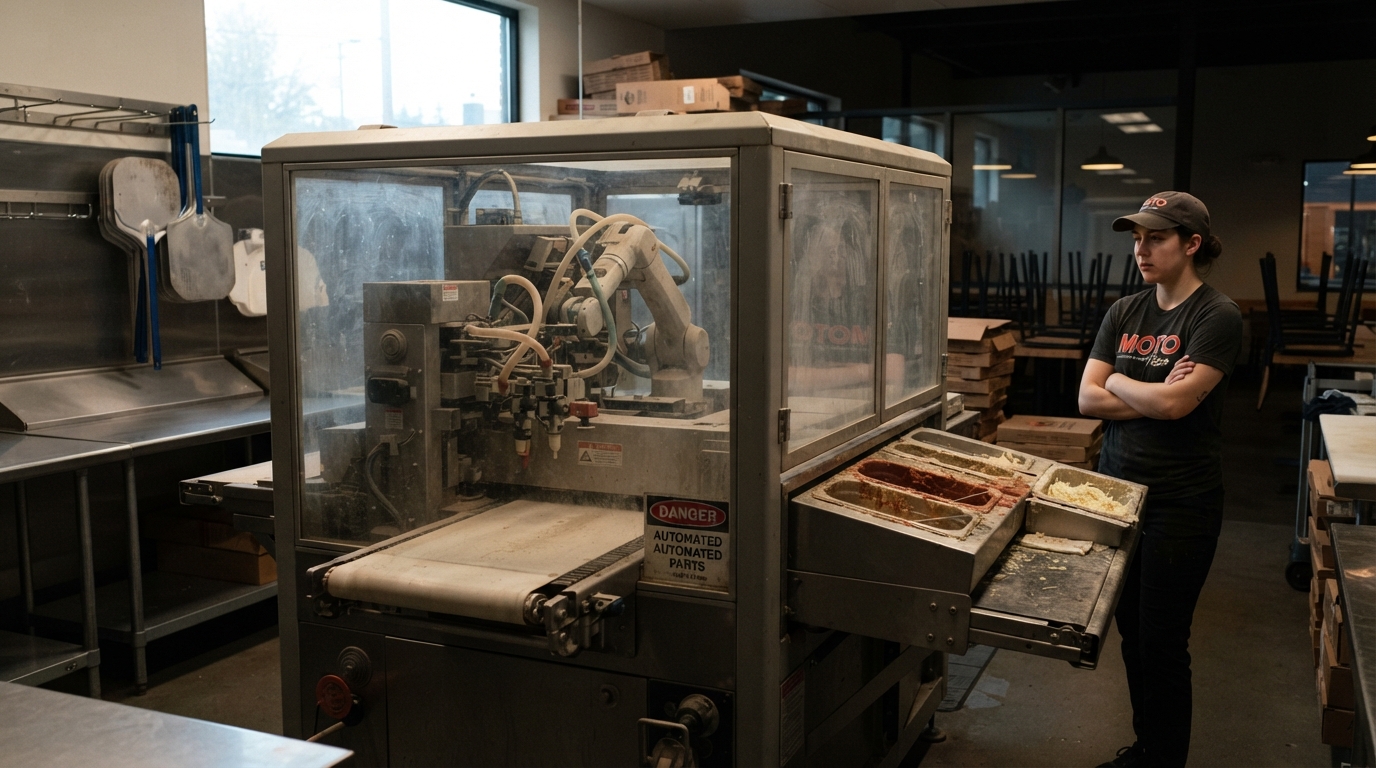
At a Moto Pizza establishment in Seattle, a pair of robots, once intended to be the heart of pizza production, now sit idle. Their "dough feeder," sauce and cheese modules, and even the pepperoni-sprinkler are all motionless. These machines were rendered "basically useless" in May when their supplier, Picnic, abruptly ceased operations. Lee Kindell, founder and chief executive of Moto Pizza, recounts how technical support for the robots vanished overnight, leaving him to ponder the fate of his $160,000 (£118,000) cabinet-like investments and the overall wisdom of integrating pizza bots. "I don't know if I want to do a partnership again because of the failures," he admits, reflecting on his unsuccessful experiment.
Kindell's experience is far from unique in the robot pizza-making sector, which has been plagued by "overcooked promises and melting fortunes." Beyond Picnic, other companies like Zume, Pazzi, and Basil Street, a purveyor of pizza vending machines, have also come and gone. While fast food might appear to be an ideal candidate for automation, it has proven more challenging than anticipated. Furthermore, the introduction of robots into pizza restaurants raises concerns about the displacement of entry-level jobs within the hospitality industry.
Sara Senatore, a senior restaurants analyst at Bank of America, whose employer has financial interests in major pizza chains such as Papa Johns and Domino's, acknowledges, "We haven't yet seen any of the success stories materialise the way some people thought they would." She points out that food preparation bots can be clumsy, occasionally misplacing ingredients, whereas "Humans are very efficient at making pizza."
Despite his frustrations with Picnic, Kindell remains surprisingly resolute. A staunch advocate for full automation, he envisions a future where "I want to be able to walk up to, let's say, a type of kiosk, put in your order, and it makes a fresh pizza." Kindell, who once made all his dough by hand until an elbow tendon injury prompted him to explore machine alternatives, is now developing his own pizza-making robot. While he keeps details under wraps, he reveals that his contraption will produce square pan-style pies, drawing inspiration from 3D printing technology. He hopes to have a fully operational version by the summer of 2027.
When questioned about investing in such a risky business, given his admitted "no experience" in robotics, Kindell argues that even failed pizza robot companies have contributed valuable data and technological advancements. He firmly believes it's only a matter of time before someone perfects these machines.
Regarding job displacement, Kindell asserts that even "fully autonomous" pizza robots won't threaten workers. He previously deployed Picnic's robots at T-Mobile Park, home of the Seattle Mariners baseball team. While a traditional setup would require approximately 10 people to make pizza, the robots reduced that number to two. However, the other eight employees were redeployed into customer-facing roles, promoting pizza around the stadium. "We had so many more people able to hand out the pizza," Kindell explains, adding, "It was so much faster."
For some pizza robotics engineers, speed is a primary driver. Last year, Canadian firm Appetronix installed a 24/7 robotic pizza unit for the Donatos pizza chain at the John Glenn Columbus International Airport in Ohio. Appetronix is actively developing newer versions of its technology, aiming for a furious pace of pizza assembly. Co-founder and chief executive Nipun Sharma's ultimate goal is to have a pizza emerge from these machines "every minute." To achieve this, his team is exploring methods to deposit sauce onto a pizza base significantly faster than the current 9.5 seconds. "Think of it as a shower head that blasts the sauce in 1.5 seconds," Sharma illustrates. The company is even investigating lasers and ultrasound as potentially quicker methods for slicing pizzas than traditional knife blades.
When confronted with the preference many people have for hand-crafted pizza and the potential loss of human connection with food made by machines, Sharma responds, "What we're going after is a chain market. You want the pizza to taste the same every single time." This fundamental divide between businesses prioritizing repeatability and those offering a more artisanal, human-centric experience predates robotics but will likely shape the integration of technology into the pizza world.
Senatore emphasizes that human interaction is potentially even more crucial today than in the past, even for restaurants considering pizza robots. "It's a risky proposition to not have people," she warns, suggesting that pizza parlors could lose their "human touch" and potentially frustrate customers if machines malfunction without human intervention.
Nevertheless, new pizza technology is expected to continue emerging. Even seemingly defunct meal-assembling robot companies are still influencing food start-ups. Rich Hull, chief executive of Miso Robotics, which produces the French fry-cooking bot Flippy, believes that Zume's "vision for robotic pizza making was really brilliant," but they were "a beat too early in the market," as customers weren't "ready" for robot-made pizza. Hull suggests that Zume's patents could help Miso Robotics expand Flippy's capabilities, though he doesn't provide specific examples, stating, "That's one of those things that we're going to be learning about."
The inherent dynamism of the fast-food pizza business is set to persist. Kindell remains steadfast in his commitment to automating pizza production. "There is no doubt in my mind that there will be a fully autonomous pizza robot," he declares. "It's just, who's going to do it first?"