

Beyond China's humanoid robots, a quieter machine revolution is unfolding
There are more than two million robots working in China's factories - and they are scaling up fast.
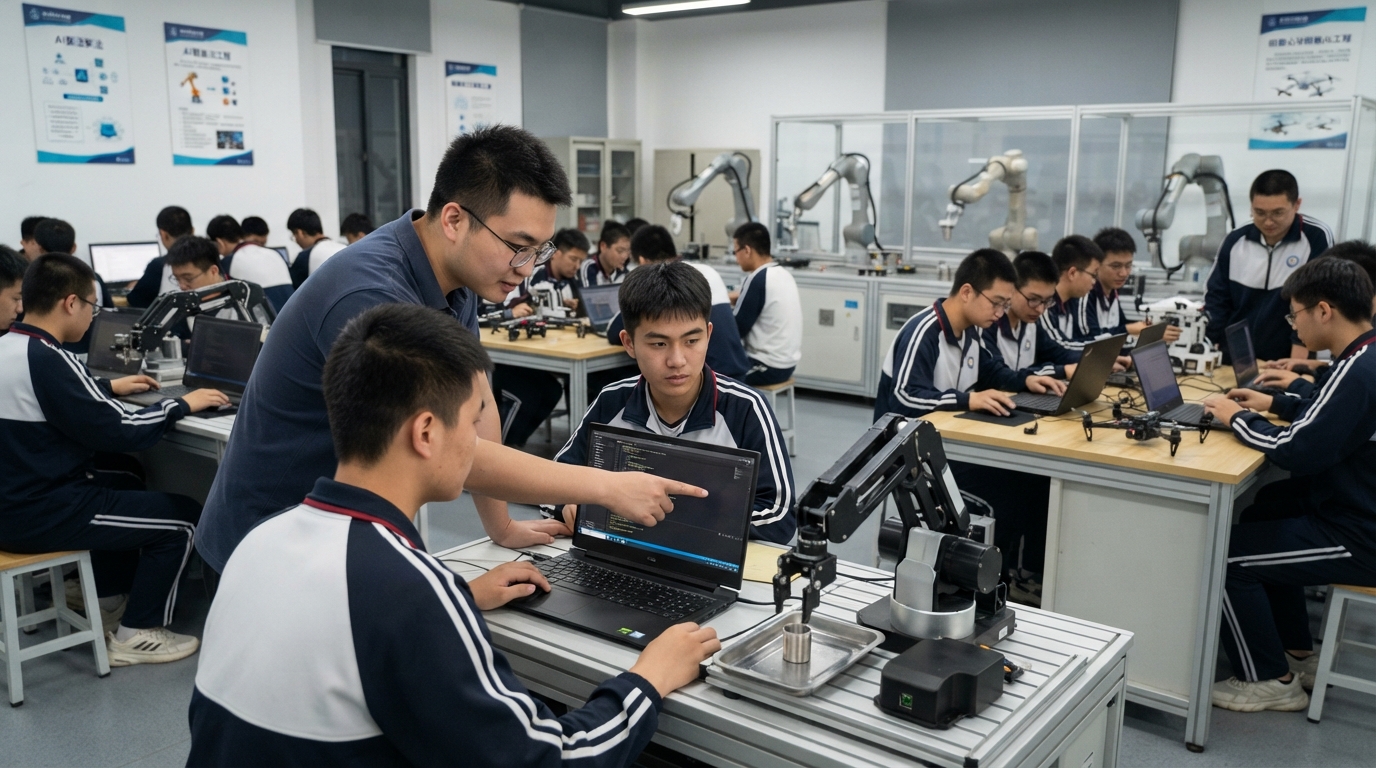
"I take a nap and the world changes," remarks Chen Tianyu.
Indeed, his world is in constant flux. The 28-year-old stays current with technological advancements by dedicating his free time to visiting factories undergoing automation. This practice informs his priorities when instructing his artificial intelligence (AI) and robotics class.
Before him, approximately 30 college students are engrossed in coding. One student types rapidly, his gaze flitting between the screen and a robot. He explains, "The idea is it will grab that cylindrical piece and move it over there."
A row of industrial robots awaits programming, while in another section of the classroom, students endeavor to develop robotic medical instruments. As he guides them, Chen asserts, "If you are not needed by the world of AI and robotics, then you'll definitely be among those eliminated."
For those present, this represents a significant stride—or rather, a leap—towards a future meticulously crafted by China: President Xi Jinping's $20 billion (£14.7 billion) initiative to position the nation at the forefront of innovation and in direct competition with the United States.
Evidence of this ambition is pervasive. They are situated in the Hangzhou Technician Institute, one of several expansive, purpose-built vocational schools aiming to cultivate the next generation of tech-savvy engineers. The campus lies on the outskirts of Hangzhou, a former imperial capital whose futuristic skyline merely hints at its burgeoning role as a global tech hub.
Across China, over two million robots are operational in factories—a number exceeding any other country—and their deployment continues to accelerate at an extraordinary pace.
This commitment is poised to transform the world, much like the previous monumental shift in the Chinese economy. China is already exporting its robots globally, with more than half of the world's industrial robots now manufactured there.
Less certain, however, is the full impact of such widespread automation in a nation central to global manufacturing, trade, and innovation. What implications does this hold for China's human workforce, for instance? And how can the true cost of this transformation be accurately assessed within a regime that tightly controls information?
The future of China's workers remains ambiguous amidst the industrial revolution the world has been observing: gleaming solar grids, peak hours silenced by electric vehicles, and machines that outpace Usain Bolt. Over the recent weekend, China hosted the second World Humanoid Games, featuring robots engaged in boxing, sprinting, and marching.
Fueling this public spectacle is a less visible revolution occurring within factories and classrooms.
The BBC has visited industrial sites where non-humanoid robots, which do not dance or perform on stage, were demonstrated. Instead, they weld, paint, lift, assemble, and operate continuously without breaks or benefits. Some are specifically designed to construct more robots. The BBC has also toured academies where China is training individuals to collaborate with its robotic workforce.
This offers a firsthand view of what Jinping terms China's "new productive forces"—and their potential to reshape the country.
On a factory floor in the southern city of Chengdu, the old and new coexist.
An assembly line of approximately 30 middle-aged men and women are engaged in screwing, drilling, and polishing CRP Technology's signature product: a robotic arm designed for various industrial tasks. Also in the room are four young engineers gathered around a console, attempting to decipher the code for a prototype—a new robot they hope will assist in building other robots.
Pang Kai, 31, a member of the research and development team, pushes the sleek skeleton across the room. China's future workforce isn't quite ready for full deployment. For now, it can only execute simple, repetitive motions, such as scanning a QR code.
"Maybe in another half year, it can do another task," Pang says with a wistful smile. It's a lengthy journey, and the team celebrates every minor achievement.
CRP Technology, employing around 300 people, has been manufacturing robot arms for nine years. Each arm can be customized to a factory's specific needs, aiding in the production of cars, electronics, or wind turbines. The company states that a single arm can be programmed to perform over 90% of repetitive tasks.
The engineers also ponder whether, one day, they might replace the company's human workforce. "We want our new robot to be like human beings. We hope it can think by itself," Pang states. "We need these kinds of robots because maybe in 10 years, we won't have enough workers in China."
A declining population and an aging workforce are additional factors driving Beijing's urgency to revolutionize its factories. By 2035, official estimates project that over a third of China's population will be above 60. Furthermore, some estimates suggest the country will lose nearly 60 million people in the next decade—a figure almost equivalent to France's population.
The expectation is that increased automation will bridge this impending labor gap before it impacts an already sluggish economy. However, the pace of this transition is critical. Approximately 120 million people are still employed in the manufacturing sector. If China moves too rapidly, job losses could ensue, delivering a catastrophic blow to millions reliant on factory wages.
"In theory, machines can work 24 hours a day, which is certainly an advantage compared with human workers. But machines also require maintenance. Every day we need time for that, and each month the production line also requires inspection and repair," explains Cao Li, vice-president of EV maker Leapmotors.
Increasingly popular in Europe and the UK, Leapmotors' budget-friendly, tech-focused cars are assembled at their Hangzhou factory, with robots assisting at every stage. At the end of the assembly line, more human workers appear.
The company employs over 25,000 workers, hundreds of whom conduct final checks as the gleaming new vehicles roll past. Will there come a day when their roles are no longer necessary?
"It's entirely possible," Cao admits. "And it may come relatively quickly. In workshops, including stamping, welding, and painting, we've basically achieved 100% automation."
China possesses an advantage over the US due to its vast manufacturing base. Motors, batteries, electronics, gears, sensors—all components required to construct a robot's body are readily available.
"China also has an idea. It has a plan. They know where they want to be in five years. They plan at a top level, but they break it down to the regions, to the municipalities," observes Dr. Susanne Bieller, General Secretary of the International Federation of Robotics.
"If you want to build a robot in Shenzhen—there's an entire ecosystem. It takes you less than one hour to source the components you need to make a robot. In Europe it can take you up to a week."
However, she acknowledges that while China excels at building the physical robot, the US still leads in developing the "brain," which encompasses the AI for programming robots. Yet, Chinese firms, from DeepSeek to Moonshot, have been unveiling new AI models that they claim can rival top US companies.
Driven by an "open-source" approach, where AI start-ups share their code, Chinese innovation has advanced faster than anticipated, despite US export controls on critical advanced chips. Analysts now believe the next phase of this competition will be determined not by who possesses the superior language model, but by who can integrate this intelligence into millions of machines.
This explains China's investment in cultivating a generation of students trained to envision future possibilities.
At the Hangzhou Technician Institute, for example, children can commence their studies from the age of 15. The scope of instruction can be astonishing. An entire building is dedicated to engines and aeronautics, and a restricted floor is reserved for students who will work to maintain China's leadership in processing rare earths—another vital commodity in the rivalry with Washington.
Some view this as a solution to China's persistently high youth unemployment rate, with one in five struggling to secure a job. "Our students are in demand and can even be pre-booked by companies. They don't need to worry about employment at all, and we hold competitions as part of their training," says Chen, the young teacher.
"It's better to find your position within the technologic wave. In the process of progress, structural changes are bound to occur, and these structural changes are exactly where students' future employment opportunities lie."
Nevertheless, China still confronts significant economic challenges, ranging from an ongoing property crisis to substantial local government debt and consistently low consumption.
It remains unclear if and how the revolution Beijing is promoting will address these issues, and it is difficult to gauge the sentiments of those whose jobs are threatened by the impending changes. Will robots generate prosperity for them, or simply displace many of their roles?
"My students ask me what will happen in the future," Chen recounts. "I say I don't know. Technology is changing so fast. But we can't just stand still and sleep here. We have to move forward to see what we are capable of doing."