

One word - fountain
Uzbek President Shavkat Mirziyoyev presented seven national programs. What's behind the promise to double the country's GDP and usher in a new decade? Opinion
**One word – fountain**
On August 28, the day of the 35th anniversary of independence, Shavkat Mirziyoyev not only summed up the country's achievements but also effectively opened a new political cycle. The President of Uzbekistan presented seven national programs, promised to increase GDP to $300 billion, and called the next decade a period of national recovery. Cronos.Asia decided to analyze the rationale behind the Uzbek leader's new initiatives and the realistic nature of his stated goals.
It's worth noting that behind the solemn language lies a very specific objective: reforms must move from removing old restrictions to increasing productivity, strengthening institutions, and significantly improving the quality of life.
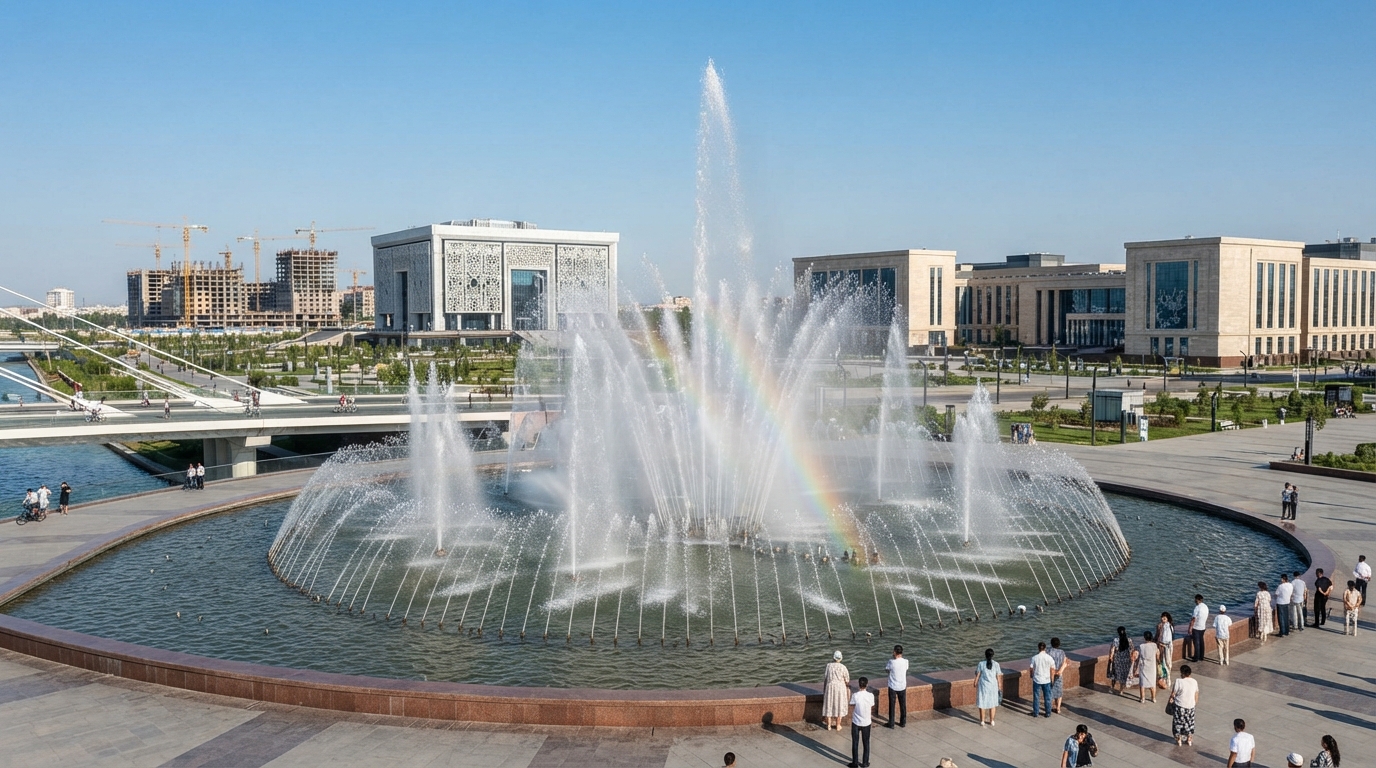
The location for his anniversary speech was chosen with almost theatrical precision. The President of Uzbekistan delivered his address in New Tashkent, a city still under construction but already positioned as a future center of science, education, and culture. New university buildings and the National Library have opened here, and the musical fountain has already made it into the Guinness Book of World Records. Even the record-breaking fountain in this structure serves more than just aesthetic purposes.
The concept is clear – New Tashkent must become the tangible embodiment of the New Uzbekistan and prove that the presidential concept exists beyond official rhetoric. It now has tangible forms – universities, a library, and the record-breaking fountain.
That's why Mirziyoyev's speech, delivered on the eve of the 35th anniversary of Independence, looked to the future rather than the past. The anniversary of independence provided the president with a convenient opportunity to complete one stage of reforms and announce the next.
**Continuity without awkward questions**
The historical part of the speech followed a familiar vertical lineage: ancient statehood, the First and Second Renaissances, Amir Temur, the Jadids, the independence of 1991, and today's New Uzbekistan. Thus, modern politics acquires a long historical pedigree, and Mirziyoyev's reforms become a continuation of the country's centuries-long journey toward freedom and development.
The president separately honored the memory of the first president of independent Uzbekistan, Islam Karimov. But almost immediately afterward, he listed the problems the state had eliminated under the new government: forced and child labor, restrictions on currency conversion, residence permits, and closed borders. The result was a subtle political construct. It would seem that continuity has been preserved, with the previous leader being hailed as an outstanding statesman, but the difference between the two eras is quite clearly outlined. The shortcomings of the old system are acknowledged, but their authorship is tactfully left out.
This is also important for the domestic audience. Mirziyoyev is not proposing to reconsider independence or dispute its legacy. He proposes to consider his own reforms the second stage of the same historical project.
**Seven programs instead of one slogan**
The main news of the speech is the seven national programs. They cover education, healthcare, a high-tech economy, the environment, justice, mahalla development, and foreign policy.
The number itself is no coincidence. The current Development Strategy of the New Uzbekistan for 2022-2026 is also structured around seven priority areas. The current speech effectively bridges the gap between the concluding strategy and the next cycle, although a new unified document has not yet been announced.
Translated from celebratory to political language, the formula looks like this: the previous stage was supposed to open the country and remove the most painful restrictions; the new stage is to transform openness into sustainable economic and social results. Hence the shift in emphasis:
First and foremost, what is immediately noticeable is that in education, the focus is no longer simply on coverage, but also on international standards, in-demand professions, and ensuring that at least ten universities are included in the global top 1000.
In healthcare, the focus is on a transition to a preventative model, universal health insurance, and spending at 5% of GDP.
In the economy, the focus is on productivity, startups, venture capital, and artificial intelligence.
Overall, the list looks modern. Now it will need a less formal section—deadlines, responsible agencies, funding sources, and indicators that will distinguish a completed program from a mere wishful thinking.
**The economy must almost double in four years**
Let's take a closer look. The most ambitious promises were made in the economic section. Mirziyoyev stated that the initial goal of increasing GDP to $160 billion by 2030 will be achieved by 2026. The next milestone is $300 billion by 2030, two million high-income jobs in industry, and over $10,000 in GDP per capita over the next decade.
The starting position has indeed become stronger. According to the World Bank, Uzbekistan's nominal GDP in 2025 was approximately $147 billion, with real growth reaching 7.7%. The IMF reported that the economy grew by another 8.7% year-on-year in the first quarter of 2026, although it simultaneously warned of the risk of overheating and the need to continue structural reforms. This is no longer an economy that needs to be revived from scratch.
But going from $160 billion to $300 billion in just four years means an average increase in nominal GDP in dollars of approximately 17% annually. This result depends not only on real production but also on inflation, the exchange rate of the sum, and the external environment. Furthermore, it seems that the $300 billion figure is not a forecast in the strict sense, but rather a political benchmark against which investment, industrial, and monetary policies will now have to be adjusted.
As for the promised $450 billion in foreign investment over ten years, this also deserves a closer look. On average, this amounts to $45 billion per year—roughly what the president himself says the country is already attracting. In other words, the challenge isn't a one-time investment spurt, but rather the ability to sustain the current high investment flow for an entire decade and transform it into technology, jobs, and productivity.
And here, perhaps, comes the most challenging part. The World Bank previously noted that Uzbekistan's previous growth was largely based on capital accumulation. And moving into the upper-middle-income group will require increased productivity, a reduction in market and regulatory distortions, and the development of competition and human capital. Therefore, be that as it may, it is now clear that investment alone does not guarantee an economic miracle—even if it is solemnly calculated in billions.
**The Social Contract Becomes Measurable**
Now let's talk about economic indicators. The President of Uzbekistan noted that in the new era, more than 650,000 families have become owners of new, modern housing, and the image of a New Uzbekistan is coming to thousands of mahallas.
"By openly acknowledging the existence of poverty in the country, a system of work at the mahalla level was established to increase incomes, develop skills, improve health, educate children, and improve the living conditions of needy families," says Shavkat Mirziyoyev.
According to official estimates, the poverty rate has fallen from 35% in 2017 to 4%, and the number of students has reached 1.6 million, with more than half of them being girls and women. This isn't just a social issue. This is how a new contract between the state and society is being formulated: a rapid pace of reform is justified if it becomes visible not only in the macroeconomic table but also in the income, education, health, and housing conditions of individual families.
It's telling that Mirziyoyev explicitly stated that the main criterion for social policy should not be numbers, but changes in people's lives. However, the president supported this thesis primarily with numbers, meaning that state statistics remain the primary language of political reporting.
Youth is given a special place. The government intends to engage 10 million young people in the digital industry and professions of the future. The scale is impressive, but it must be acknowledged that the current formulation is too broad. Whether this will include full-time employment, vocational training, school courses, or any exposure to digital skills will only become clear once the program criteria are established.
**Mahalla will receive development orders**
The next program makes the mahalla the primary customer for social development. District budgets, investment programs, and infrastructure projects are expected to be formed based on grassroots demands.
For the Uzbek model, this is a logical step. The mahalla has already become the basic unit of social policy, through which needy families are identified, aid is distributed, and local problems are addressed. Now, it is promised influence not only on social support but also on budget priorities. However, there is an important boundary here. True decentralization begins not with the mandate to take the mahalla's opinion into account, but with clear powers, proper resources, and accountability for results. If orders from below continue to undergo lengthy approval from above, the new model risks remaining a well-organized collection of wishes.
Equally telling is the program, where judicial independence and the rule of law coexist with the fight against cybercrime, drugs, human trafficking, and the shadow economy. The state currently speaks of justice as both an institution for protecting citizens and a tool for maintaining order. Whether judicial independence can become an independent value, rather than part of the law enforcement agenda, is one of the key tests of the next stage.
**Water No Longer an Environmental Decoration**
Speaking generally about the environmental block, its main goal is to increase the coverage of cultivated areas with water-saving technologies to 100% within five years. Admittedly, this goal seems almost maximalist, but the problem truly leaves no room for modest plans.
According to the World Bank, climate change could reduce water availability in Uzbekistan by 30-40% and simultaneously increase the need for irrigation by 25%. But much of the irrigation infrastructure is outdated, and pumping stations consume approximately 16% of the country's electricity.
Therefore, water conservation in Mirziyoyev's program is not a green supplement to economic policy. It is a matter of food security, energy, regional employment, and relations with the countries of Central Asia. And, perhaps, this is the point of the speech where the cost of delay is most clear.
**Uzbekistan is preparing to speak on behalf of the broader South**
There are no sharp turns in foreign policy. Mirziyoyev reaffirmed an open, pragmatic, and balanced approach, developing relations with Central Asia, the CIS, the European Union, the United States, the Asia-Pacific region, and the Arab-Muslim world.
However, his ambition has become more visible. In 2027-2029, Uzbekistan will chair the Non-Aligned Movement for the first time. For Tashkent, this is an opportunity to move beyond its role as a regional mediator and test itself as a voice of the Global South. Continuing a separate policy on Afghanistan reinforces the same message: Uzbekistan seeks to be not an observer, but a platform for discussing complex regional issues.
This approach fits well with economic diplomacy. For a country hoping to attract tens of billions of dollars in investment annually, it is more beneficial to cultivate friendships with several centers of power than to choose just one. In this sense, Uzbekistan's foreign policy remains, perhaps, the most pragmatic part of the larger project of national recovery.
**The next stage will be more difficult than the first**
Summing up the Uzbek President's speech, it should be noted that the main thrust of Mirziyoyev's speech was not the seven programs or even the promise of a $300 billion GDP. The President stated that the era of Uzbekistan's initial opening up is ending. The country is being asked to move to a stage where success is determined by the quality of education, business productivity, judicial independence, the effectiveness of local governance, and the ability to conserve water.
The first stage of reforms was easier to explain: lift the ban, open the border, allow currency conversion, acknowledge poverty. But the second stage is much more difficult. It requires not just one political decision, but the daily work of institutions—precisely where a fine decree can no longer replace implementation.
Therefore, Shavkat Mirziyoyev's anniversary address can be considered an offer of a new political contract. The state promises growth, social mobility, and a higher quality of life. In return, society is expected to demonstrate hard work, knowledge, unity, and a willingness to move at the given pace.
In New Tashkent, this contract looked convincing: new universities, a library, a future city, and a world-class fountain. But the true content of national upsurge will be determined far beyond the festive venue—in ordinary schools, district hospitals, courthouses, mahallas, and fields, where water must reach not in a presidential speech, but in reality.