

Oh, the sea, the sea…
Just recently, a sea splashed here. Today, saxaul rises across the vast expanses of the former Aral. But right next to it, the opposite process is unfolding: Kazakhstan is trying to bring water back to the northern part of the Aral, the so-called Small Aral, or Kazakaral. Uzbekistan, in turn, is actively implementing a project to "green the dried seabed" of the southern part of the sea. Both tracks — watering and greening — address the same task, but lead to a different future. What should emerge in place of the departed sea: water, forest, or a new landscape with room for both?
### The sea is gone, the problems remain
The Aral disaster has long been one of the most famous examples of how human economic activity can alter the nature of an entire region. As recently as the middle of the last century, the Aral was the world's fourth largest inland sea, and its water surface area was about 68–69 thousand square kilometers. Then, ever-increasing volumes of the Amu Darya and Syr Darya waters were diverted to irrigate fields. Canals, reservoirs, and hydroelectric power plants were built, and cotton and rice crops expanded. Economic goals were achieved quickly, but the ecological price turned out to be colossal. The sea lost more than 90% of its area. Today, instead of a single Aral, there are several fragmented bodies of water, and a new desert — Aralkum, covering an area of about 6 million hectares — has emerged in place of its dried southern part. Its appearance brought land salinization, desertification, and dust-and-salt storms to the region. But in the last two decades, the story of the Aral took an unexpected turn. It turned out that the sea can not only be lost. In some places, it can be brought back.
### When the water returned
In 2005, the Kokaral Dam was built in Kazakhstan. It separated the Small Aral and allowed the retention of the Syr Darya water in it. The result was impressive: the water rose, salinity decreased, and the fish fauna began to recover. By 2026, the level of the Northern Aral reached approximately 42 meters on the Baltic system. Along with the water, fishing began to return, meaning jobs and economic life for coastal villages.
The Kokaral Dam proved an important point: the degradation of the Aral is reversible. But this success immediately posed a new question: can we go further? The answer depends primarily on water. The Syr Darya and Amu Darya supply agriculture, cities, industry, and energy in Central Asia. To increase inflow into the Aral, one must either reduce water consumption upstream or significantly increase the efficiency of its use. Therefore, the fate of the sea no longer depends solely on Kazakhstan or Uzbekistan. It is linked to the water policy of the entire region.
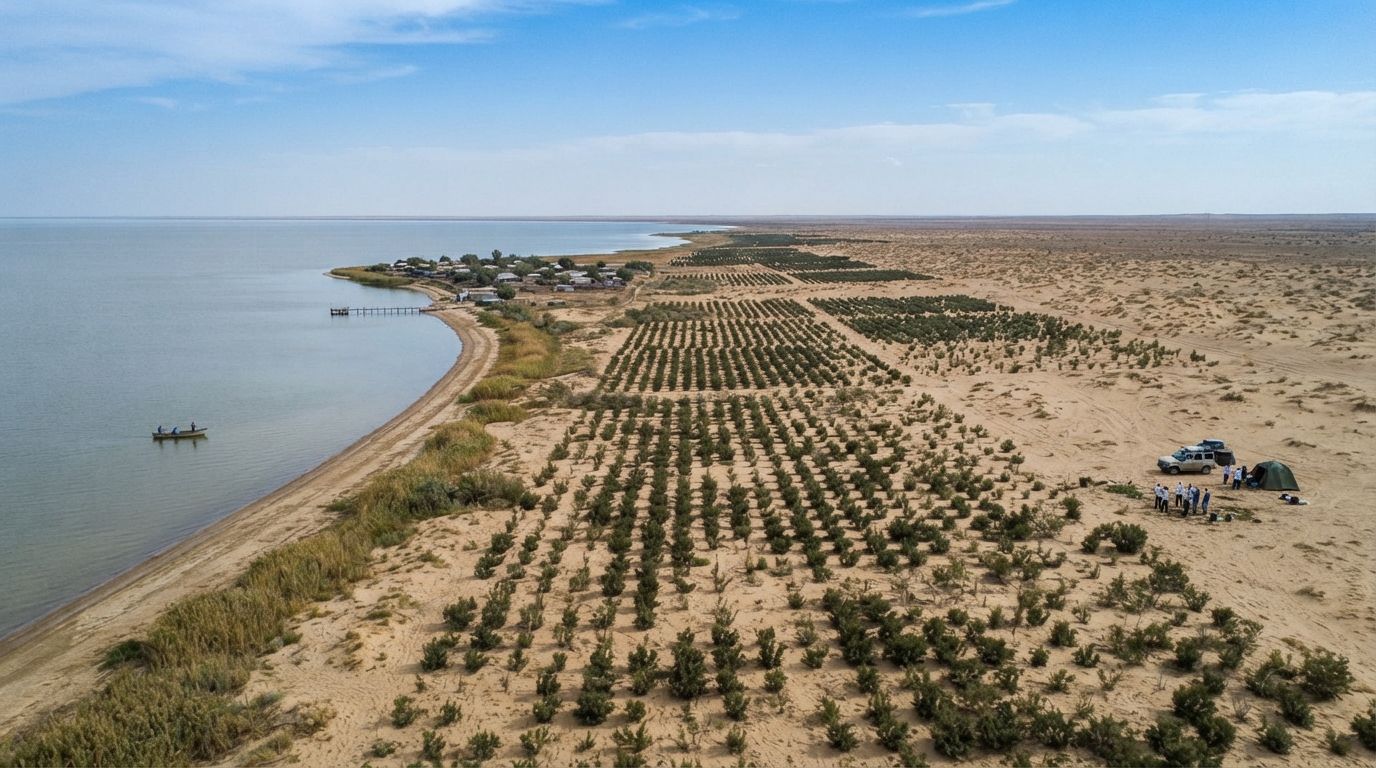
Where the return of water is currently unlikely, a different path was chosen. Uzbekistan began large-scale greening of the dried seabed of the Aral. Kazakhstan later joined this effort. On the Aralkum, they primarily plant saxaul, zhyngyl (tamarix), and other plants capable of surviving on saline and nearly waterless land. Their task is simple: to hold back sand and salt, reduce dust storms, and gradually form a stable vegetation cover. The scale of the work is immense. According to press reports, greening covers more than 1.5 million hectares in Uzbekistan and about 500 thousand hectares in Kazakhstan. Thus, a second strategy for the future of the Aral was formed.
The first — "watering" — attempts to bring back the sea; the second — "greening" — aims to make the land left behind after its disappearance safer. For a long time, it seemed that these approaches simply complemented each other. But new scientific data forces a more complex look at the problem.
In 2022, Spanish scientists, with the direct participation of activists from the Aral district of Kyzylorda, conducted large-scale studies of bottom sediments at the Aral Sea. Their results were recently published in the journal Science (DOI: 10.1126/science.aeb2344) and attracted international press attention. It turned out that the dried seabed possesses another dangerous property: it releases carbon dioxide. According to the researchers' estimates, since the onset of intensive drying of the sea in the 1960s, its former bed has released about 748 million tons of CO₂, which is comparable to the current combined annual emissions of Spain, France, and Belgium. So much organic carbon remains in its sediments that a potential additional 605 million tons of CO₂ could be released in the future. While the seabed is underwater, the organic matter accumulated there is partially protected from oxygen. When the water recedes, air penetrates the soil. The decomposition of organic matter begins, and carbon escapes into the atmosphere.
An unexpected effect emerges: the former sea turns from a carbon sink into a source of emissions. The researchers also came to another important conclusion: in the extremely dry climate of the Aralkum, vegetation is unable to fully absorb the carbon dioxide released from the soil. When it comes specifically to reducing such emissions, returning water to part of the dried seabed may prove more effective than greening.
### Water versus forest?
Does this mean that planting saxaul is in vain? Certainly not. Greening solves other, no less important tasks. Plants anchor the soil, reduce the transport of sand and salt, and create vegetation cover. The new study does not negate these results. It merely shows that a forest cannot completely replace the sea. But a real contradiction arises here. If a stable terrestrial ecosystem is formed on the former seabed for decades, this territory is effectively fixed as land. If the intention is to flood it with water again someday, long-term greening loses its purpose. What to choose then? Perhaps there is no need to choose at all.
Not "either/or," but "both/and." The former Aral is too large for a single recipe to apply to its entire territory. The Small Aral has already proven that where there is a real possibility to ensure water inflow, the sea can be restored. This yields not only an ecological, but also an economic effect. In the deltas of the Syr Darya and Amu Darya, water is also necessary to preserve lakes and wetlands. But there are vast expanses of the Aralkum where water is unlikely to return in the foreseeable future. Here, greening remains the most realistic way to mitigate the consequences of the disaster.
Therefore, the two strategies do not have to be opposed, but can be divided by territory. Where it is realistic to return water — water it, and where it is impossible — green it. The river deltas can become transitional zones where water bodies, vegetation, and economic activity coexist. This is precisely the approach proposed in the original article. And this will be a different Aral — not the former sea, but not an ordinary desert either.
### Is it possible to profit from the return of the sea?
The new study offers another unusual idea. According to its authors' calculations, investing about 8.5 billion euros in more efficient water use could potentially create the conditions to restore about half of the Aral's area relative to its 1960 level. The researchers suggest seeking part of the funds through the "carbon credits" market. In short, "carbon credits" are elements of global market mechanisms aimed at reducing greenhouse gases (CO2 and methane), the quotas of which can be traded on international exchanges. The legislative framework in Kazakhstan already exists and has successfully begun to develop in recent years. The logic here is as follows: if returning the water stops CO₂ emissions from the former seabed, the avoided emissions acquire economic value. The researchers estimate it at approximately 3.1–15.8 billion euros. For now, this is a proposal for discussion rather than a ready-made project. But it changes the very view of the Aral. Restoring the sea begins to be viewed not only as a costly environmental program, but also as a possible climate and economic project.
### Science that already lives by the sea
But there is another participant in this story who is mentioned far less often — the residents of the Aral region themselves. Here, the experience of public organizations such as "Aral Tenizi" is important. People who have lived next to the Aral for decades possess knowledge that satellite images and short-term expeditions do not provide. Fishermen see how the water changes, where fish appear or disappear, and what happens to the coastline and delta lakes. When these long-term observations are combined with professional scientific research, what is known today as "citizen science" emerges. It is precisely the participation of the local population in the research discussed above that serves as an important addition to academic scientific studies and contributes to this "intellectual revival of the Aral." This is especially crucial now, when the question being decided concerns not so much the past, but the future of the sea and the entire coastal population.
### What Aral will we leave behind?
It is impossible to fully bring back the Aral of the mid-last century today. Too much has changed — population, agriculture, water consumption, and the economy of the entire region. But this does not mean the future is already predetermined. The Small Aral shows that water can be brought back. The Aralkum shows that the dried land can be gradually anchored with vegetation. New research warns that every solution has its limitations and consequences. Therefore, today the main question no longer sounds like this: which is better — water or forest? It is far more important to understand what part of the former sea can still be returned to water, what part must be greened, and where the boundary between them lies. And this should be decided not only by scientists, officials, and international organizations. The final word must also belong to the people who continue to live here. Because for them, the Aral is not an ecological symbol on a world map. The Aral is their home.