

Nuclear power through the eyes of the new generation: what young specialists discussed in Tashkent
Microreactors, nuclear technologies for space, and even memes. Such an unusual range of topics was discussed by the participants of the Youth Nuclear Dialogue in Tashkent. Young people were interested in promising technologies, opportunities for professional development, and proposed new ways to talk about nuclear energy to a wide audience. The National Youth Nuclear Dialogue took place on October 9 as part of the Impact Team 2050 international initiative. The event brought together students, young […]
**Nuclear power through the eyes of the new generation: what young specialists discussed in Tashkent**
Microreactors, space nuclear technologies, and even memes — this was the unusual range of topics discussed by participants of the youth nuclear dialogue in Tashkent. Young people talked about promising technologies, professional growth opportunities, and proposed new ways to present nuclear power to a broad audience.
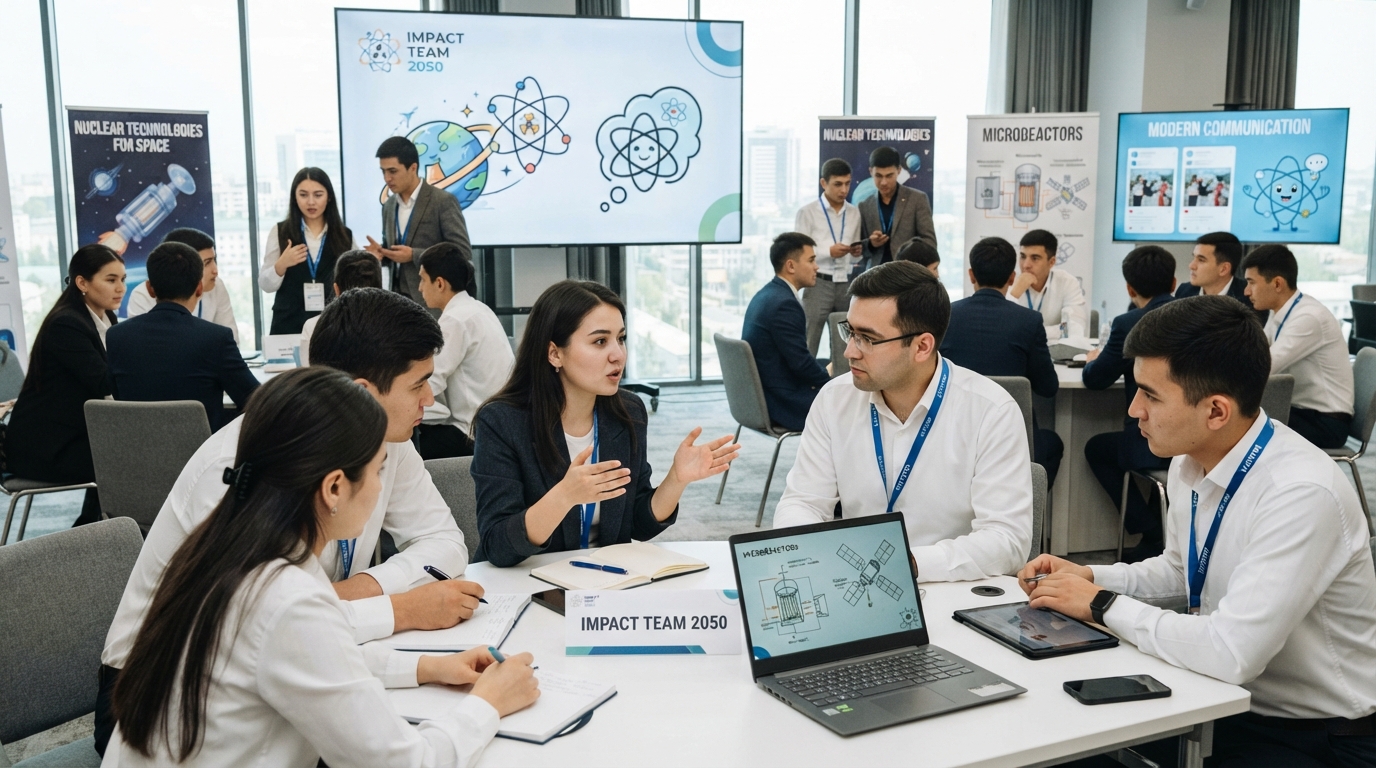
The National Youth Nuclear Dialogue took place on October 9 as part of the Impact Team 2050 international initiative. The event brought together students, young scientists, representatives of universities, specialized government agencies, industry organizations, and youth associations. Muhiddin Umidov, Uzbekistan's representative on the Impact Team 2050 International Youth Advisory Council under the Director General of Rosatom, shared details about the issues raised and the highlights of the meeting.
The dialogue began with an open discussion between the young participants and nuclear industry leaders. Azim Akhmedkhadjaev, Director of the Uzatom Agency, suggested skipping lengthy opening remarks and moving straight to the students' questions and expectations. Speaking about the prospects of nuclear power development in Uzbekistan, he noted that the current generation of young specialists will be directly involved in shaping the industry.
"You have a unique, historic chance to enter a breakthrough industry right now, while its foundation is being laid. You can become not just specialists, but the creators of the nuclear industry of the new Uzbekistan," the Agency Director said.
One of the key stages of the event was team work. First, participants were asked to independently identify the barriers young people face when choosing nuclear professions and in their professional development. Then, they needed to propose potential solutions and present them to experts. The discussion covered education, career prospects, career guidance, regional infrastructure, and public perception of nuclear power.
Students showed particular interest in modern engineering fields, some of which go far beyond traditional perceptions of working at a nuclear power plant.
"I was pleased to see students from various universities and young specialists taking part in the discussion. They were interested in automated process control systems, modeling, and microreactors. There were even questions about applying nuclear technologies in space. I must admit, some of these topics came as a surprise to me as well. Young people are eager to understand complex and forward-looking areas," Muhiddin Umidov said.
Students from the Tashkent branch of MEPhI, the Tashkent State Technical University named after I. Karimov, "New Uzbekistan" University, and other higher education institutions participated in the dialogue. Future educators were also among the invited guests.
Umidov considers their participation logical. Training personnel for nuclear power begins long before entering a specialized university. A solid school foundation in mathematics, physics, and languages is required to later master engineering disciplines, nuclear physics, and NPP operation technologies. Therefore, the quality of teaching these subjects is directly linked to shaping the industry's future specialists.
Participants also discussed opportunities to gain practical experience, undergo internships, and learn about the operations of industry organizations. These issues are becoming increasingly important as nuclear power generation develops in Uzbekistan and specialists are trained for future facilities.
Another topic was the public attitude toward nuclear power. Umidov is convinced that future specialists need more than just technical knowledge — it is crucial to be able to explain complex technologies to people without a specialized background.
The Tashkent meeting also addressed ways to raise awareness of nuclear professions and make technical explanations more accessible to the younger generation.
"The nuclear industry has its own professional information environment, and it is not always easy for outsiders to navigate technical issues. At the same time, the Uzatom Agency and the Tashkent branch of MEPhI are already covering nuclear power on social media. Participants suggested using such platforms more actively and making information clearer for young people. Some participants even mentioned humor and memes, taking into account, of course, the full seriousness of the topic. After all, it can be difficult to engage someone outside the industry with complex technical material," Umidov noted.
At the same time, the discussion about new communication formats was accompanied by a conversation on professional responsibility. Azim Akhmedkhadjaev, Director of the Uzatom Agency, recalled the high standards expected of nuclear industry specialists.
"The nuclear field does not forgive levity. It requires not only deep knowledge, but also strict discipline, internal maturity, and a high safety culture. We need leaders who are ready to learn continuously and understand the gravity of every decision they make," he emphasized.
International cooperation was another topic of the meeting. Dmitry Konstantinov, Deputy General Director of Rosatom Central Asia, drew attention to the importance of experience exchange, internships, and joint youth initiatives for training nuclear industry specialists.
Muhiddin Umidov is gaining such experience himself. After graduating from the Tashkent branch of MEPhI, he continued his studies in the master's program at the Obninsk Institute for Nuclear Power Engineering (IATE), where he studies the operation of nuclear power plants. Simultaneously, he represents Uzbekistan on the Impact Team 2050 International Advisory Council.
One of the council's initiatives is a series of national youth nuclear dialogues being held in 16 countries this autumn. Their outcomes will be consolidated into a roadmap containing recommendations for overcoming barriers to choosing nuclear professions. The document is planned to be presented to Rosatom Director General Alexey Likhachev at a meeting on the sidelines of the COP31 UN Climate Conference, which will take place in Antalya in November.
For Umidov, participating in the international council is primarily driven by a desire to expand opportunities for young specialists in Uzbekistan and help them integrate into the global professional community.
"I would like young specialists from Uzbekistan to be able to voice their ideas at the international level. It is important to open opportunities for them to communicate with colleagues from other countries. We are considering creating a national Impact Team 2050 youth team. It could bring together young people interested in developing Uzbekistan's nuclear industry," he said.
The Tashkent dialogue has concluded, but work on the participants' proposals continues. The next step is to determine which of these initiatives can be developed practically to expand opportunities for youth in education, professional growth, and participation in industry projects.