

Nothing on earth passes without a trace.
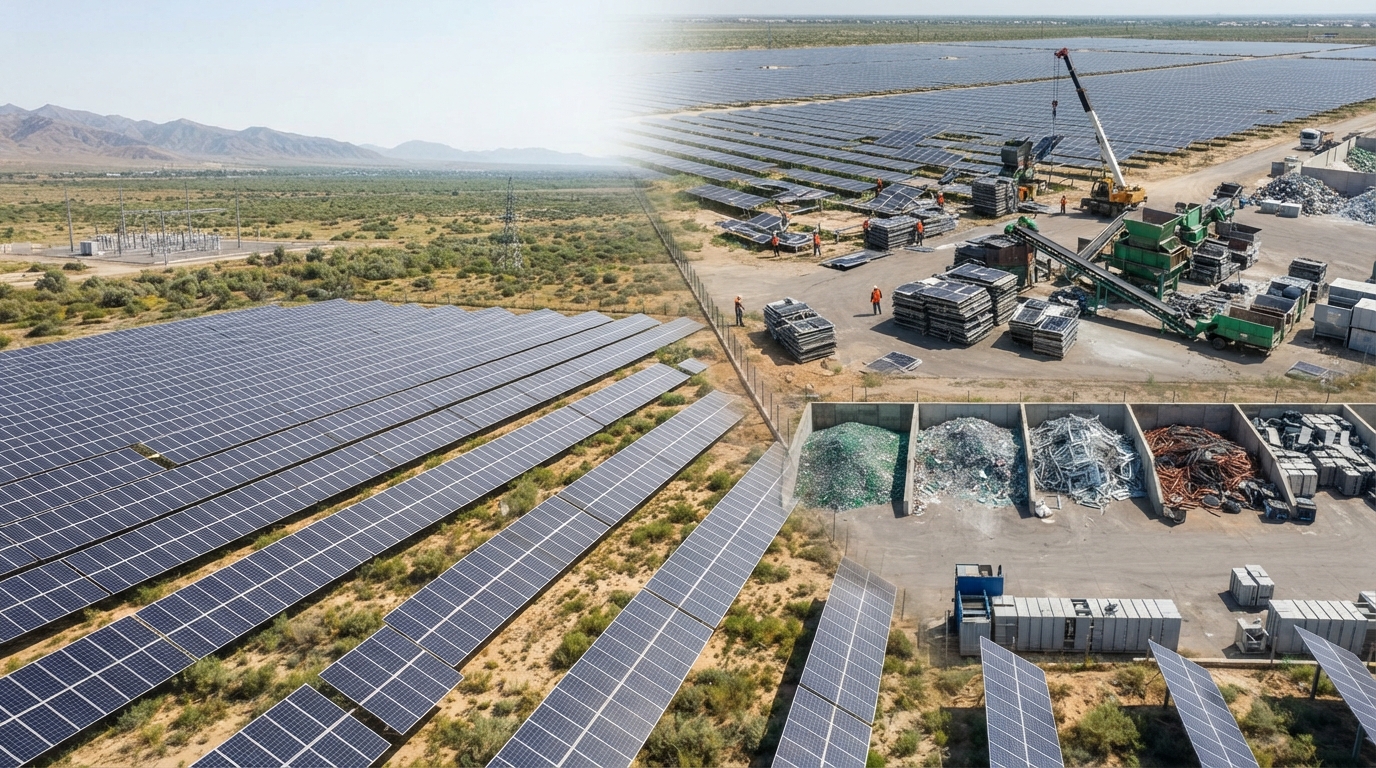
Millions of panels will do their job: Is Central Asia ready for solar waste?
Nothing on earth goes unnoticed.
Central Asia is rapidly developing solar energy, demonstrating a pace comparable to the recent construction of gas-fired power plants, transmission lines, and substations. This process is particularly active in Uzbekistan and Kazakhstan, where solar power plants with capacities of hundreds of megawatts are already operating, and promising projects number in the gigawatt range.
Uzbekistan plans to increase its renewable energy capacity to 25 GW by 2030, providing approximately 40% of its electricity consumption. For example, a solar power plant in the Khorezm region covers 177 hectares and will produce over 240 million kWh per year. A 250 MW complex, complemented by a 63 MW and 126 MWh battery storage system, is under construction in the Bukhara region.
Similar trends are observed in Kazakhstan, and large solar facilities are also gradually being built in Kyrgyzstan and Tajikistan. For the energy system, this means new generation sources, for investors, a new market, and for governments, an opportunity to reduce energy shortages.
However, this solar boom has a hidden side. The panels installed between 2025 and 2030 will not disappear at the end of their useful life. In 20-30 years, they will become bulky industrial waste. Along with them, cables, metal structures, inverters, transformers, control systems, and, where the plant is equipped with storage, thousands of battery modules will need to be dismantled. Thus, Central Asia is simultaneously building a new energy industry and shaping a future waste stream, the volume of which is currently virtually undetectable.
The scale of the problem becomes clearer when considering the physical characteristics of a solar power plant. A modern photovoltaic module weighs approximately 20-30 kg, and its capacity is typically several hundred watts. A 1 GW plant requires approximately 1.5-2 million panels, depending on their characteristics. This represents tens of thousands of tons of glass, aluminum, silicon, polymers, copper, and other materials. The panels are designed for 25-30 years of operation, although this does not mean they stop producing electricity immediately after the warranty period expires. Their performance gradually declines, and some modules may fail earlier due to temperature fluctuations, wind, hail, defects, mechanical stress, and material degradation. Furthermore, plants can be upgraded ahead of schedule. If new panels prove significantly more efficient than old ones in 15-20 years, it may be more cost-effective for the plant owner to replace the equipment before it wears out completely.
Therefore, the first significant wave of solar waste in Central Asia may emerge before the formal 25-30-year lifespan of today's facilities expires. The global market is already moving toward this point. By the end of 2025, installed solar power capacity worldwide will have reached approximately 2.4 TW. Early IRENA estimates suggested the accumulation of approximately 78 million tons of used photovoltaic modules by 2050, while more recent estimates indicate that at the current rate of deployment, this volume could exceed 200 million tons. Thus, solar energy is gradually becoming not only an energy industry but also a raw materials industry: old stations are being converted into material deposits located not underground, but above ground.
This is the fundamental difference between a solar panel and ordinary waste. Much of its mass is potentially useful raw material. The main component is glass, which can account for approximately two-thirds of the weight of a silicon module. Other components include an aluminum frame, copper, silicon, small amounts of silver, and various polymeric materials. The simplest recycling involves removing the aluminum frame, separating the cables, and shredding the remaining structure. However, the economic value of this operation is limited: glass scrap is inexpensive, and the most valuable materials are contained within the complex multilayer structure. The panel is specifically manufactured to withstand heat, frost, humidity, ultraviolet radiation, and mechanical stress for decades. What makes it durable in the deserts of Kazakhstan or Uzbekistan also makes it difficult for recyclers. The layers must be separated, the silicon, silver, and copper extracted, the polymers removed, and materials of sufficient purity obtained for industrial reuse. Modern technologies are gradually addressing this challenge. Mechanical recycling is already the primary commercial method for silicon modules, and a combination of mechanical, thermal, and chemical processes allows for significantly more efficient recovery of silicon and precious metals. The economics of the process will improve as waste volumes increase. A plant producing several hundred tons of panels per year may be unprofitable. A facility processing tens of thousands of tons faces a completely different cost.
For Central Asia, scale is a key issue. The region is vast, and solar power plants are distributed over vast distances. Kazakhstan occupies 2.7 million square kilometers, and Uzbekistan, almost 449,000 square kilometers. Solar facilities are logically built where there is available land, high insolation, and grid connectivity, rather than near a future recycling plant. In two decades, a paradox may arise: the material of a used solar panel is valuable, but transporting it 500–1,000 km to a recycling facility eats up a significant portion of the economic impact. Panels are heavy primarily because of the glass, and transporting cheap glass over vast distances is uneconomical. Consequently, Central Asia will need not just one giant facility to handle waste from the entire region, but a multi-tiered system. Primary sorting and dismantling could be carried out at the power plant site, aluminum, cables, and other easily separable elements could be removed in regional centers, and more complex materials could be sent to several specialized deep-processing facilities. This system resembles not a typical household waste management system, but rather metallurgical logistics, where raw materials undergo several stages of preparation before final processing.
The situation with energy storage devices is even more complex. A solar power plant itself only produces electricity when the sun is shining, so as the share of renewable energy grows, countries in the region are beginning to install large battery systems. The 250 MW Bukhara project in Uzbekistan already includes a 63 MW/126 MWh battery. This represents a new technological category for Central Asia. The service life of a battery system is typically shorter than that of the solar power plant itself, meaning that some batteries may require replacement several times over the life of a single power plant. Unlike a glass panel, a battery is a more concentrated set of chemical materials and requires much more careful handling. Lithium iron phosphate and nickel-based batteries have different recycling costs, different risks, and different residual values. Damaged batteries cannot simply be stored next to dismantled panels. Diagnostics, safe discharge, special transportation conditions, and protection against short circuits and fire are required. However, a spent energy battery does not necessarily immediately become waste. If its capacity is no longer sufficient for operation at a power plant, it could potentially be used for several years in less demanding stationary systems. Therefore, the future industry will consist not only of recycling but also of diagnostics, repair, reuse, and only then final recovery of the raw material.
The main question isn't even the technology, but who will pay. While the equipment is new, recycling seems like a problem for 2045–2055. But it's precisely now that we're determining who will be responsible for dismantling millions of modules in 20–30 years. If responsibility isn't defined in advance, a classic infrastructure project scenario could arise: the power plant is out of commission, the initial investor sells the asset, the equipment changes hands several times, and the disposal costs ultimately fall to the state. For a plant with a capacity of hundreds of megawatts, dismantling is no longer just site cleanup, but a separate industrial project.
The European model is based on extended producer responsibility: the cost of future equipment management should be taken into account even when it's brought to market. This idea is particularly important for Central Asia, as a significant portion of solar panels, inverters, and batteries are imported. If the region restricts equipment imports without establishing regulations for their return, within a few decades, countries will be left with thousands of hectares of sites containing equipment that is economically unviable to relocate. A possible mechanism could be a mandatory solar power plant decommissioning fund. For example, a small portion of the facility's revenue is set aside annually in a special account. Over 25 years, this fund accumulates enough to cover the dismantling, transportation, and recycling of the equipment, regardless of the financial status of the last owner.
This problem also presents an industrial opportunity. Central Asia is almost entirely dependent on imported photovoltaic equipment, but recycling old power plants has the potential to create its own technology segment. A few years ago, IRENA estimated the value of materials that could be recovered from the global stockpile of old solar panels by 2050 at over $15 billion; at that time, they were talking about approximately 78 million tons of raw materials.
Today, when global solar capacity is growing significantly faster than previously predicted, the logic itself becomes even more obvious. Glass can be recycled into building materials production and, if of sufficient quality, into more complex products. Aluminum has a stable secondary market. Copper is in demand by the energy sector, regardless of its origin. Silver is expensive and therefore of particular interest for advanced recycling. Silicon is significantly more difficult to recycle into photovoltaic production, but purification technologies are advancing. Even the metal support structures of solar power plants retain their raw material value after decades of operation. As a result, an old plant can be considered an artificial deposit, whose chemical composition is known in advance, its location mapped, and the approximate start date of development determined decades in advance.
This is precisely why Central Asia doesn't need to build dozens of solar panel recycling plants today: there isn't enough raw material for them yet. However, an equipment inventory should already be created. For each large power plant, the panel manufacturer, technology, number of modules, weight, chemical composition, year of installation, expected replacement date, inverter type, and battery parameters can be determined. In 15-20 years, such a registry will become a map of future secondary raw materials. Governments and businesses will be able to see in advance, for example, that tens of thousands of tons of equipment are expected to be decommissioned in a given region between 2048 and 2052, and recycling infrastructure can be built to accommodate this flow. Without this registry, the opposite situation will arise: waste will suddenly appear before regulatory authorities, even though it has been physically present for a quarter of a century. For Kazakhstan and Uzbekistan, where the largest volumes of new solar generation are being generated, such a system is particularly relevant. Kyrgyzstan and Tajikistan may join later or establish regional cooperation, as building a separate deep recycling facility with a small national waste volume may be economically feasible.
In 20-30 years, the debate over solar energy will look different than it does today. Currently, the main indicator is the number of megawatts commissioned. In the 2040s, the number of megawatts that a country can properly decommission will be no less important. Central Asia's first energy transition involves replacing some gas and coal with solar and wind power. The second, less visible transition is intended to transform the linear "import-install-use-dispose" model into a closed industrial cycle. Millions of solar panels, which today symbolize a new energy sector, will inevitably age. The only question is whether, in a quarter of a century, they will become a huge mass of cheap glass and complex electronic waste or the raw material base for a new industry. Central Asia has a rare advantage: future waste is already located at specific sites, its quantity can be calculated, and the approximate time of occurrence is known in advance. Most environmental problems are discovered after they arise. In the case of solar energy, the region sees problems 20-30 years before their full scale. Not taking advantage of this lead time would be significantly more expensive than recycling the panels themselves.