

Not even half a century has passed…
What the transition to targeted recruitment of migrants in Russia will lead to
Not even half a century has passed…
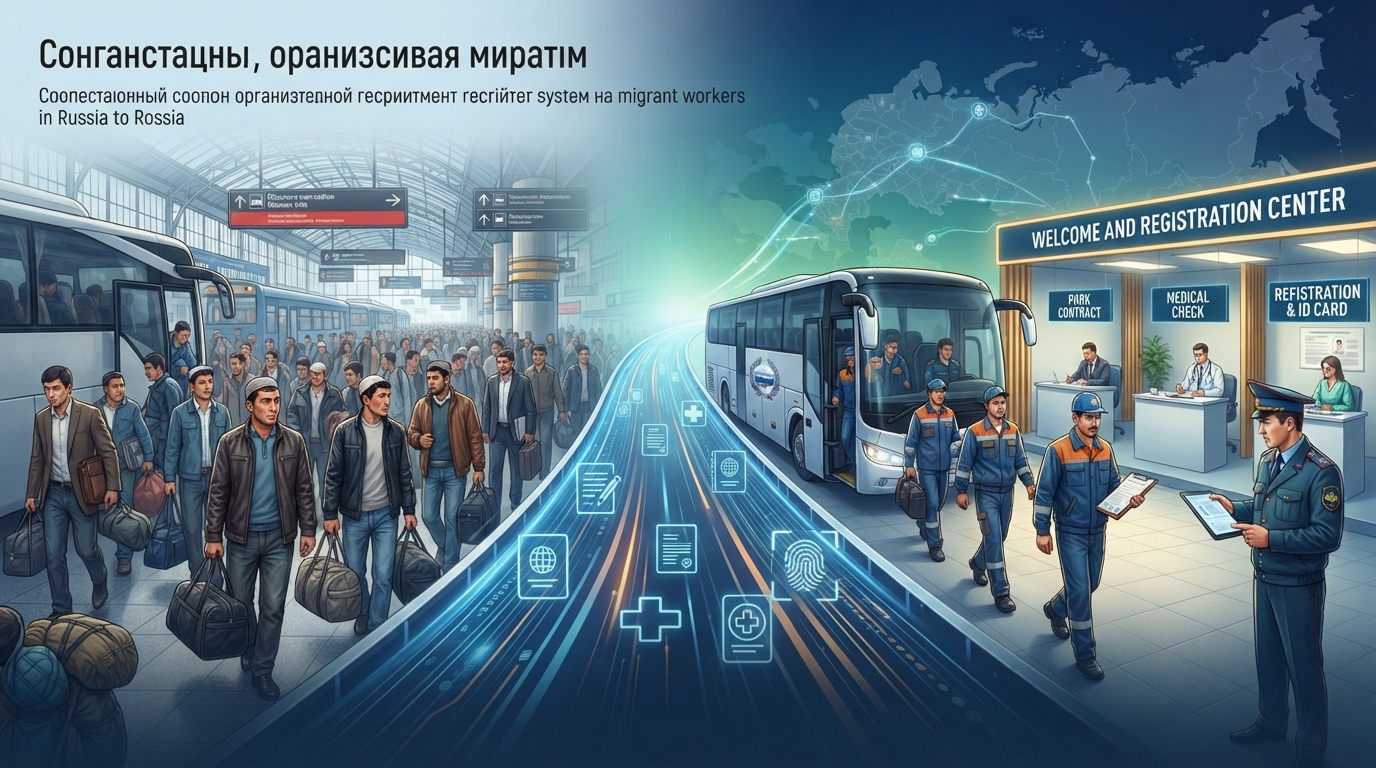
Organized recruitment of labor migrants, an experiment to transition to which is set to launch next year, will noticeably affect the volume and structure of human flows coming to Russia from Central Asian countries.
In late October, Russian media, citing sources in federal government authorities, reported that the start of the Ministry of Internal Affairs (MVD) experiment to transition to the targeted recruitment of foreign labor by employers has been postponed from January 1 to March 1, 2027. The delay was caused by holdups in introducing necessary amendments to legislation and the unreadiness of the IT infrastructure.
Targeted, or organized, recruitment of foreign labor is intended to replace the previous model of free entry of labor migrants to search for work "on the spot" with the help of relatives and acquaintances, which developed after the collapse of the USSR and remains dominant to this day. Given the scale of the changes associated with the transition to organized recruitment, the postponement of the experiment's start date does not look unexpected. Moreover, once launched, the new model will clearly require fine-tuning of its operational mechanisms.
The transition to targeted recruitment of foreign labor is also anchored in the new concept of state migration policy for 2026–2030, approved by the President of the Russian Federation on October 15 of last year. Paragraph 15 of the third section, dedicated to assessing the results of state migration policy, provides for "accelerating the transition to targeted organized recruitment of foreign workers (primarily those arriving without visas)," which, compared to the previous system, implies several restrictions at once: 1) working for a specific employer; 2) at a specific workplace; 3) for a specified period; 4) on the basis of an employment contract and a work permit.
Most of these restrictions did not exist before. Even the patent system operating for citizens of visa-free CIS countries that are not members of the EAEU "binds" a labor migrant only to a specific region, rather than to an employer and a workplace. Furthermore, the validity period of the patent can also be extended if timely payments are made and the necessary documents are processed.
The transition to targeted recruitment of labor migrants is also stipulated in other sections of the concept. Thus, the fifth section, devoted to the main directions of implementing migration policy, mentions expanding the list of forms of organized recruitment to increase the efficiency of migration regulation (subparagraph "d"), improving its mechanisms, and creating the necessary infrastructure (subparagraph "e"). It is planned to incentivize employers to transition to targeted recruitment of labor migrants and reduce its unregulated forms (Article 29, subparagraph "i"). Among the expected results of migration policy implementation listed in the ninth section, an increase in the number of labor migrants arriving via organized recruitment is also specified. All this indicates that the transition to targeted recruitment of foreign workers is one of the key goals of Russia's new migration policy, which is based not on solving demographic problems through migration as before, but on ensuring public safety.
The targeted recruitment experiment will be conducted nationwide, except for the capital region—Moscow and the Moscow Region—which lead in the number of foreign labor force. According to the latest official data published by the MVD for the first half of 2023 (after which their publication ceased), 38.4%, or 4 out of every 10 foreigners arriving in the Russian Federation, were registered in these two federal subjects. In absolute figures, the volume of the incoming migration flow amounted to almost 2 million registrations, which, maintaining the same pace, would have provided 4 million registrations per year.
Obviously, such massive human flows create an increased burden on the host regions, including social, transport, housing, and other infrastructure, as well as MVD bodies. Unsurprisingly, these regions have so far decided to exclude themselves from the experiment, extending it to them only after working through the most complex issues.
According to the action plan for the implementation of the migration policy concept, approved by Prime Minister M. Mishustin on December 30, 2025, the information system and mobile application for the organized recruitment of labor migrants must be ready by December 1 of this year. The unreadiness of these tools, necessary for the transition to targeted recruitment of migrants, became one of the reasons for postponing the start of the experiment. Meanwhile, other items of this plan are also linked to their readiness. For instance, informing and consulting activities for employers, as well as retraining programs for staff of the MVD migration divisions, were supposed to begin in December. In addition, it was planned to conclude international agreements on the organized recruitment of labor migrants with foreign states interested in "exporting" them. As of today, Russia has such agreements only with Uzbekistan and Tajikistan, and outside the CIS—with India.
Under the new plans, the first stage of the bill will launch after March 1, 2027, and the second—after January 1, 2029. All labor migrants arriving in Russia from both visa-free CIS countries and visa countries will fall under the scope of the law. Exceptions will be made only for citizens of Belarus, highly qualified specialists, and workers employed in territories with special status. How these norms will be reconciled with the EAEU Treaty, to whose citizens the restrictions operating on the member states' labor markets should not apply, remains unclear.
Companies needing foreign labor will have to be included in a special MVD register and submit an application for a specific number of workers through the FSUE "Passport and Visa Service," indicating exactly where and under what conditions they will work. Enterprises will have to conclude fixed-term contracts with foreign workers, which must correspond to the data specified in the application.
Employers will be required to pay for the genomic registration of migrants and, if necessary, the costs of their deportation, which are currently funded by the state itself. Moreover, this does not come cheap. Last year, state expenditures on the deportation of foreigners reached 830 million rubles, an increase of one-third compared to the previous year. The growing number of deportations, observed against the backdrop of tougher migration policy, as well as rising transport costs, lead to an increase in these expenditures.
If an employer wants to hire more than 15 labor migrants, they will be obliged to provide them with housing for the duration of the contract. Individuals will not be able to hire more than 5 foreign workers. Migrants themselves will have to register for migration, obtain an identification card for a three-year period, and undergo a medical examination. Labor migrants who have already arrived in the Russian Federation will also have to register within six months. Their exact number is unknown. As of July 1, 2026, the Security Council of Russia estimated the number of foreigners staying in the country at 6.4 million people.
The question regarding the consequences of a complete transition to targeted migrant recruitment remains open for now, as all the parameters of this transition are not fully clear. Obviously, the recruitment of labor migrants by private individuals, small, and possibly medium-sized businesses—which will face bureaucratic hurdles and additional expenses—will decrease the most. Large business, possessing well-established corporate governance, should experience fewer problems attracting foreign workers.
Information transparency in all foreign worker hiring and employment processes will significantly simplify monitoring them, leading to a reduction in illegal labor migration. If all rules are observed, it should disappear altogether in the future, which will entail a certain reduction in labor migration flows from Central Asia. At the same time, official employment will increase the legal protection of migrants, making their income much more stable and guaranteed.