

Nipple tattooist 'frustrated' by online censorship
Lauren Carter says her tattoos on post-mastectomy patients are flagged as nudity and banned.
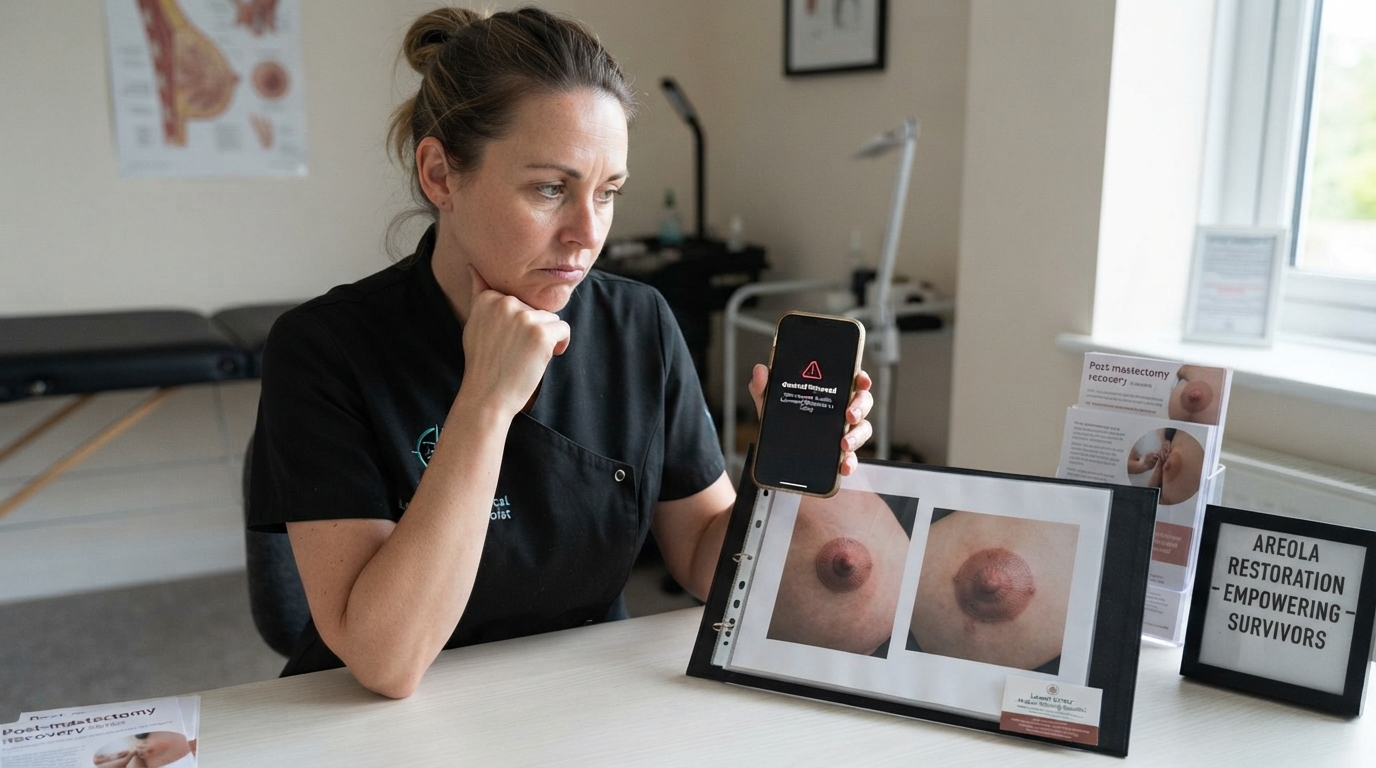
**Nipple tattooist 'frustrated' by online censorship**
Lauren Carter says social media platforms often mistake her medical tattoos for inappropriate content
A medical tattoo artist has called the online censorship of nipple tattoos for mastectomy patients "wholly unfair and discriminatory".
Lauren Carter, who is based in Hanham near Bristol, says social media bots and algorithms frequently misidentify her hyper-realistic work as "inappropriate nudity".
Carter says she has been banned from posting many times, and her images have been permanently deleted, leaving her "struggling" to attract new clients.
A spokesperson for Facebook and Instagram owner Meta said it "continues to work on improving" how it identifies and protects medical and health-related content.
Because medical tattoos are made to appear as realistic as possible, social media bots and algorithms can sometimes mistake the inked 3D effect for bare skin.
A Meta spokesperson confirmed that post-mastectomy scarring and areola tattoos are permitted on Facebook and Instagram, but said its systems "occasionally make mistakes".
"We understand how frustrating that can be, which is why we allow users to appeal these decisions and we continue to work on improving how we identify and protect medical and health-related content," they said.
"We recognise the important role medical tattooists play in supporting breast cancer survivors, and we want this content on our platforms."
Carter says her pictures of nipple tattoos are removed "nine times out of 10"
Even though she posts disclaimers and covers the nipple tattoo with emojis, Carter says every update to her online portfolio risks years of hard work and positive reviews.
"It really does upset me - there's a sense of injustice," she said.
"I'm annoyed and frustrated, not only for myself, but for the people who are looking for this sort of thing and can't find it. I don't know how else to reach people."
Carter says her posts are automatically removed "nine times out of 10". She always appeals the decision, but "it's as if nobody even reads it".
"It's interesting how the photos I post of male nipples following my treatments do not get banned or reported as a sexual image," she added.
"For me, this work is about so much more than beauty. It is about helping people feel confident, comfortable and like themselves again."
Carter uses colour and shading to create depth and definition that appears 3D
Jessica Bowler, a nurse from Bristol, had a double mastectomy with implant reconstruction at the age of 32 after being diagnosed with breast cancer in 2019.
"Although I knew the treatment was necessary to save my life, it was still incredibly difficult physically and emotionally," she said.
"I would look in the mirror and almost not recognise myself. My chest was a reminder of everything I had been through."
Bowler said choosing to have areola reconstruction tattoos was an important step in her recovery, calling the procedure "empowering".
"The tattoos weren't about vanity; they were about feeling comfortable in my own skin," she said.
"It's difficult to explain unless you've been through it, but having something restored that cancer took away can be incredibly powerful."
Jessica Bowler says the tattoos "shouldn't be treated as shameful or sexual"
The 39-year-old said the online censoring of nipple tattoos is "really upsetting", because it stops survivors from learning about the options available to them after surgery.
"They shouldn't be treated as something shameful or sexual," she said.
"[People] who've been through breast cancer should be able to share their stories and help each other without being censored."