

A cauldron of conflicts is bubbling across the world, with cultural monuments being destroyed. These people are fighting against it.
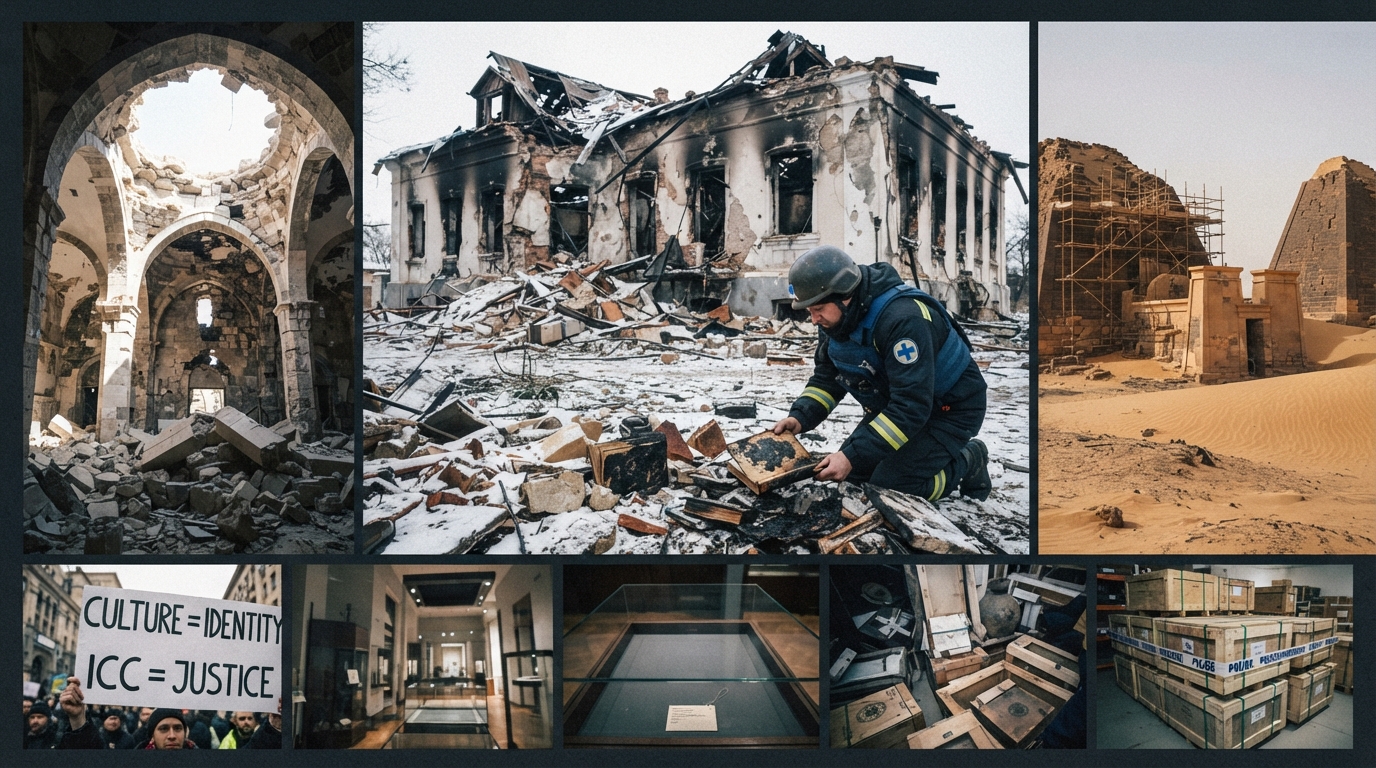
Cultural heritage is being wiped out by war, and many are demanding accountability
August was a devastating month for Ukraine. Russian air assaults surged sharply, with thousands of drones launched. Kyiv came under heavy bombardment, as did the southern cities of Mykolaiv and Odesa. Alongside the deaths and destruction, Odesa said six Unesco-protected sites were damaged, among them the salmon-pink 19th Century Alexandru Sturdza House.
Once again, that has revived the question of why it is so difficult to hold people responsible for destroying buildings and objects of genuine cultural importance.
Over the past month alone, Ukraine's Ministry of Culture said 148 cultural heritage sites were recorded as damaged or destroyed, including in Odesa.
Several Ukrainian activist groups have sought accountability by filing complaints with the International Criminal Court (ICC) against Russia over cultural destruction and looting, but no indictments have followed.
Bijan Rouhani, a senior researcher on the Endangered Archaeology in the Middle East and North Africa project, says the legal structure may look strong on paper, but in reality it almost always falls short. "No state actor has ever been tried for this offence. The obstacle is no longer evidence. We have satellite imagery, remote sensing and monitoring teams. The obstacle is jurisdiction and political will."
Against the backdrop of conflicts shaking the world, the question is increasingly urgent: can anything effective be done to stop the damage, or to ensure accountability when it happens?
The war in Ukraine is only one of many recent conflicts that have once again exposed the devastating effect of war on cultural heritage.
Tareq Abu Dayyeh sells crafts, souvenirs and antiquities in Gaza. The Great Omari Mosque appears on many of the items he sells. For him, it embodies Gaza’s identity, tracing its history through many forms: an ancient pagan temple, then a Byzantine church, then a Seventh Century mosque, then a Crusader Cathedral, and finally a mosque again.
The Great Omari Mosque was all but destroyed in an Israeli strike in 2023. The Israeli military said the strike was aimed at Hamas.
The Great Omari Mosque in Gaza was largely destroyed in an Israeli strike in 2023
Dayyeh says his heart breaks every time he sees the ruins. "When your past is destroyed, you have no present."
The war in Gaza has killed tens of thousands of people, and an estimated 200,000 buildings have been damaged or destroyed by Israeli bombardment. Yet even amid such overwhelming death and ruin, cultural losses cut deeply.
That feeling has echoed through history among people living through war.
In Sudan, Lebanon, Yemen and Iran, alarms have been raised again and again.
More than 100 sites in Iran are reported to have been damaged in the aerial war launched by the US and Israel in February. Among them are the Unesco-listed Golestan Palace in Tehran and Naqsh-e Jahan Square in Isfahan.
Sudan’s civil war has further endangered one of the ancient wonders of the world, the Meroe Pyramids, built during the flourishing civilisation of the Kingdom of Kush.
Unesco, which listed Meroe as a World Heritage Site in 2011, has warned that the fighting has stopped all preservation work there, leaving the fragile ancient structures vulnerable to erosion from advancing sand and vegetation.
In the aftermath of the vast destruction of World War Two, the first international treaty devoted solely to protecting cultural heritage during armed conflict was adopted in The Hague in 1954.
It covers monuments and architecture, but also works of art and books, and requires states to safeguard and respect cultural property and avoid any actions that could put it at risk.
Since the Hague Convention, there have been further efforts to strengthen protection for cultural heritage.
A Second Protocol to the Convention in 1999 stated that any site placed under enhanced protection because of its immense cultural significance must not be targeted militarily even if it is being used in a way that makes it a "military objective" - unless there is no other feasible way to stop that use.
When the International Criminal Court was created in The Hague in 2002, part of its role was to ensure accountability for deliberate wartime attacks on buildings of religious, artistic and educational value, as well as historical monuments, which had been defined as war crimes.
But that has proved a complicated and difficult mission.
So far, only one case has been successfully brought at the ICC. Ahmad al-Faqi al-Mahdi was a jihadist militant leader in Mali who was convicted of directing attacks that destroyed mausoleums and a mosque in Timbuktu. He received a nine-year prison sentence.
Ahmed al-Faqi al-Mahdi remains the only person successful prosecuted for this by the ICC
Rouhani says that without full support from major powers and a genuine commitment to international law and its enforcement, the world will keep watching the same destructive pattern repeat.
"For most governments, heritage is a secondary concern, unless it becomes useful for propaganda," Rouhani says. "The Hague Convention requires states to build protection into their military rules and to respect cultural property abroad as well as at home. Looking at the scale of damage in recent conflicts, it is difficult to conclude that these obligations are taken seriously."
In wars from Ukraine to Iran to Gaza, where combatants treat schools and hospitals as acceptable military targets, how likely is it that a museum or a heap of ancient stones, however rich in beauty, history and memory, will be spared?
In open countryside and in an isolated location, a museum devoted to the 18th Century Ukrainian philosopher and poet Hryhoriy Skovoroda was destroyed by Russian shelling in an overnight attack in 2022. Ukrainian President Volodymyr Zelensky said it left him speechless: "Targeted strikes against museums - not even terrorists would think of this. But this is the kind of army we are fighting against."
The building was set on fire and a caretaker was injured, though much of the collection had already been removed.
Joe Biden, then the US president, said Russian President Vladimir Putin was not only trying to seize Ukraine, but was "literally trying to wipe out the culture and identity of the Ukrainian people".
That pattern has been repeated across much of the Ukrainian front line, where local groups have worked with international organisations to protect national heritage from Russian attacks.
A museum dedicated to the 18th Century Ukrainian philosopher and poet Hryhoriy Skovoroda was destroyed in a Russian attack
One international organisation that has played a major role is the Aliph Foundation, founded in Geneva in 2017 to protect and restore cultural heritage.
Alexandra Fiebig, a project manager at Aliph, says the group has provided millions of dollars to Ukrainian museums racing to move their most valuable objects to safety.
That has included what she calls "heritage ambulances": "These vehicles that have specialised equipment and space with specialised teams and equipment, they were in the beginning travelling a lot to affected museums that were damaged through military action."
Now, she says, the teams also inspect artefacts that were hurriedly moved to safer places to ensure they remain in good condition.
Blue Shield International works in multiple war zones, cooperating with armed forces and local heritage officials to such an extent that it has become known as the Red Cross for culture.
Dr Emma Cunliffe, the group’s head of operations, says Ukrainians are risking their lives to protect their heritage.
"They are taking great measures to document the damage even when they are risking their own lives to do it. In fact one of the things we really see is that the government is taking huge steps despite the many many competing priorities and the struggles they are facing."
Other conflicts have seen civilians take similar steps to defend their culture.
In February 2015, Isis shifted from smashing ancient statues and artefacts in Mosul in northern Iraq to plundering its written heritage as its fighters devastated the city’s cherished public libraries. They burned the Central Library and destroyed or stole many thousands of books - many of them rare manuscripts telling the story of the city.
After seizing Mosul in 2014, Isis burned books in the city's Central Library
"These were not simply books or shelves, they represented decades of knowledge and research and formed an important part of the intellectual heritage of Mosul University and the wider community… Within days, everything was gone," Dr Mohammed Jasim Mohammed al-Hamdani says. The main library in Mosul has been central to his life - so much so that he is now its director.
"Seeing it destroyed felt like losing a part of myself. Many people in the city had a story connected to the University of Mosul and therefore the loss felt very close to home. And this is why when that part of Mosul was liberated from Isis, young people, old people rushed to the library to save what they could."
The opposite of communities taking matters into their own hands to protect cultural property is the looting of those same sites.
Again, this is a consequence of war that goes back to the dawn of history.
Cunliffe says understanding why looting happens - which can differ from place to place - is an essential first step: "That might then in turn result in greater sanctions, greater prosecutions to take it seriously as a threat." She says it is important, where possible, to make local communities understand that by helping with this, they are selling off their own heritage.
In Iraq and Syria, for example, both during and after the Isis rampage, priceless artefacts were looted on an industrial scale.
The valuable objects were smuggled out and trafficked abroad, including to the US.
A years-long investigation by the US Justice Department traced the smuggling routes and led to thousands of looted artefacts being returned to Iraq.
The looting of priceless artefacts in Iraq intensified during the Isis rampage
In Europe and elsewhere, coordinated multinational police and customs operations are carried out regularly, seizing large numbers of stolen antiquities and arresting some traffickers.
But the trade remains highly profitable, and the many conflicts create ever more opportunities.
In Sudan, the national museum in Khartoum was stripped of its treasures in 2023 when it fell under the control of one of the warring factions, the RSF, which loaded them onto trucks and left the display rooms empty.
As in other conflict zones such as Ukraine, specialised training has been given to those trying to recover the antiquities, with some success. But much of the museum’s display - which told the story of the region over thousands of years - may have vanished for good.
The challenge of limiting the destruction and looting of cultural heritage is enormous.
At international and state level, rules exist, but putting them into practice quickly is difficult enough - and often there is not even the will to try.
Local efforts supported by organisations like Aliph and Blue Shield International can make a difference on a small scale.
But if - as appears to be the case now - the chances of anyone facing consequences for destroying a heritage site are close to zero, then there is almost no real deterrent.
Khaled al-Asaad was killed for refusing to give up Palmyra's secrets
"What would change the calculation is not harsher sentences," says Dr Bijan Rouhani, "but a real prospect of being named - arrest warrants for the commanders who authorise these strikes, prosecutions in national courts under universal jurisdiction, and targeted sanctions on named individuals. Those measures don't require a new treaty. They require states to be willing to use the instruments they already have, against allies as well as adversaries."
Among the recent attempts to erase a cultural past embodied in stone, Palmyra in Syria still stands apart. Isis blew up temples there and might have done much worse if it had not been defeated.
One man became a symbol of resistance. For 40 years, archaeologist Khaled al-Asaad had been Palmyra’s chief custodian. He was in his eighties when Isis arrived in the ancient city.
They captured him and tortured him to learn where its most valuable artefacts had been hidden. When he refused to tell them, they beheaded him in a public square and hung his body from a traffic light.
Al-Asaad was honoured around the world as a heroic defender of culture against the forces of darkness. He received the Order of Civil Merit in Syria, and in Palmyra a school was named after him.
But nothing is free from political complications.
Years later, under Syria’s new authorities, his name has now been removed from the school.