

New sanctions: Russia's missile production may become more difficult
The European Union has imposed a record scale of sanctions against Russia's arms industry. The main targets are enterprises supplying microchips, equipment, and other components necessary for the production of missiles and drones. In addition to limiting Russia's military capability, Brussels is reportedly aiming to exert indirect pressure on the US, which has trade ties with the sanctioned companies.
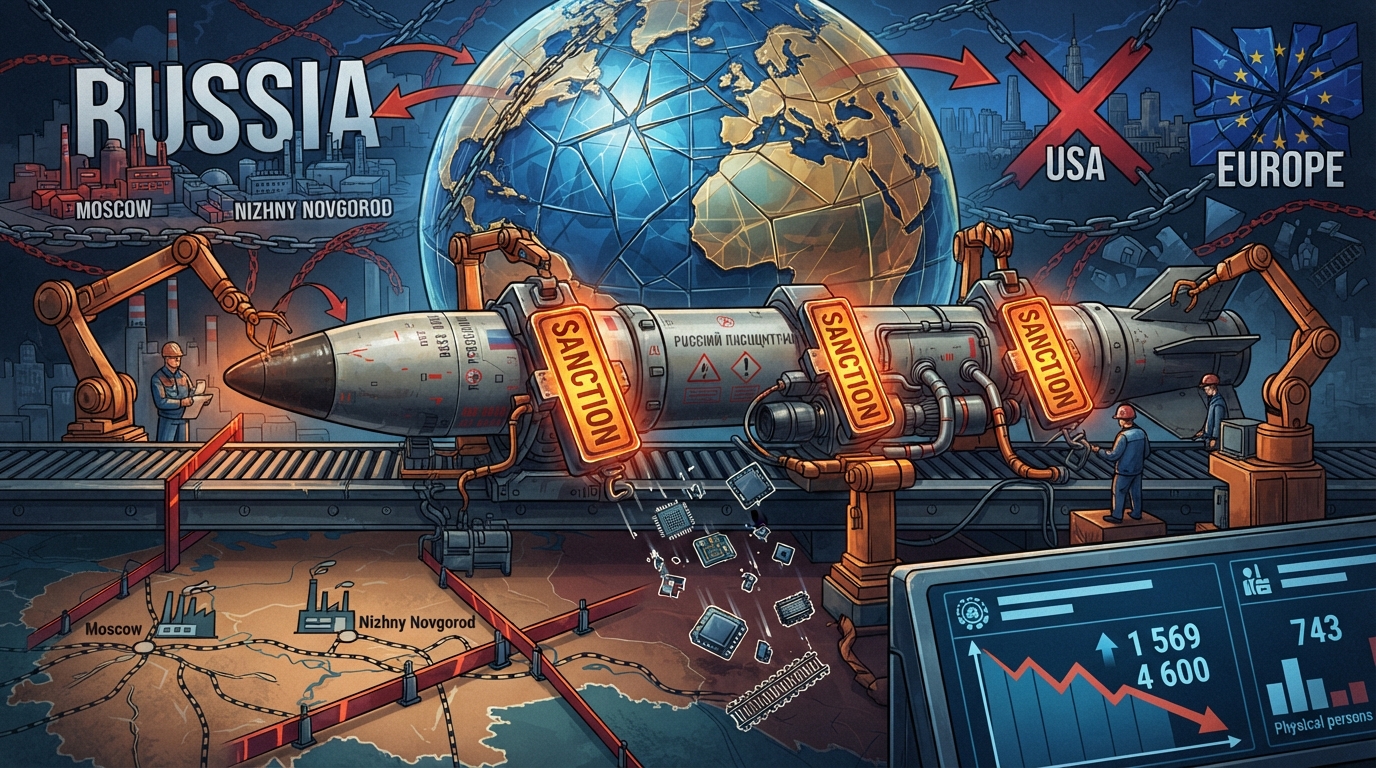
New sanctions: Russia's missile production could become more difficult
These measures, which constitute one of the largest restrictions applied to individuals and legal entities since the start of the war, covered 1,569 entities. Of these, 826 are companies and other legal entities, and 743 are individuals. Thus, the number of entities on the sanctions list rose from nearly 3,000 to 4,600. This represents an increase of almost 50 percent. Notably, the decision was adopted in a very short period. One of the main targets of the sanctions is companies that have been providing the Russian army with the necessary equipment to produce weapons, missiles, and drones. Among them is the GAZ automobile plant in Nizhny Novgorod, formerly known as Gorky.
Additionally, restrictions were applied to certain enterprises in Russia's nickel industry, organizations servicing the Moscow and Saint Petersburg railway system, and companies dealing with radio frequency and communication technologies crucial for the Russian armed forces.
One of the companies originally planned for inclusion in the sanctions list was removed at the request of Estonia. The reason for this was that the enterprise in question serves as an important source of raw materials for Estonia.
The new restrictions could affect the European Union assets and bank accounts of the sanctioned companies, limiting their economic ties with Europe. Furthermore, the EU may attempt to step up pressure on partners in third countries trading with these companies. In particular, this applies to trade relations conducted through countries such as Turkey and the United Arab Emirates.
This decision can be assessed as an important step toward increasing financial pressure on Russia.
It could also lay the groundwork for the European Union to develop its upcoming 22nd and 23rd sanctions packages. However, there is another important aspect to this decision: it could serve as a tool of indirect pressure on the United States as well. According to reports, nearly 100 of the sanctioned companies have trade ties with the US. Through this, the European Union may be trying to reinforce its position against any potential softening in Washington's sanction policy toward Russia.
Against the backdrop of the possibility that the US might temporarily ease or lift certain restrictions, this EU decision can also be interpreted as a preemptive economic and political measure. Thus, the new sanctions could impact not only the Russian economy and military-industrial complex, but also sanction policy within the framework of transatlantic cooperation.
The sanctions package reached a record level in terms of scope. One of its main targets is mid-tier enterprises involved in the missile production chain. In total, over 250,000 people work in these enterprises. Their directors were also subjected to sanctions. The 743 restrictions applied against individuals are among these measures.
Therefore, the main focus of the restrictions this time is directed not only at large companies, but also at mid-tier enterprises supplying microchips and other vital components used in missile production, as well as their directors.
In addition, sanctions were also imposed on 77 individuals who ran in the Russian State Duma elections on behalf of the Russian-occupied Ukrainian regions of Donetsk, Luhansk, Kherson, and Zaporizhzhia.