

Nepal bet nearly everything on hydropower - the floods show why that's a problem
More than 10% of Nepal's energy generation capacity was knocked out by last week's floods.
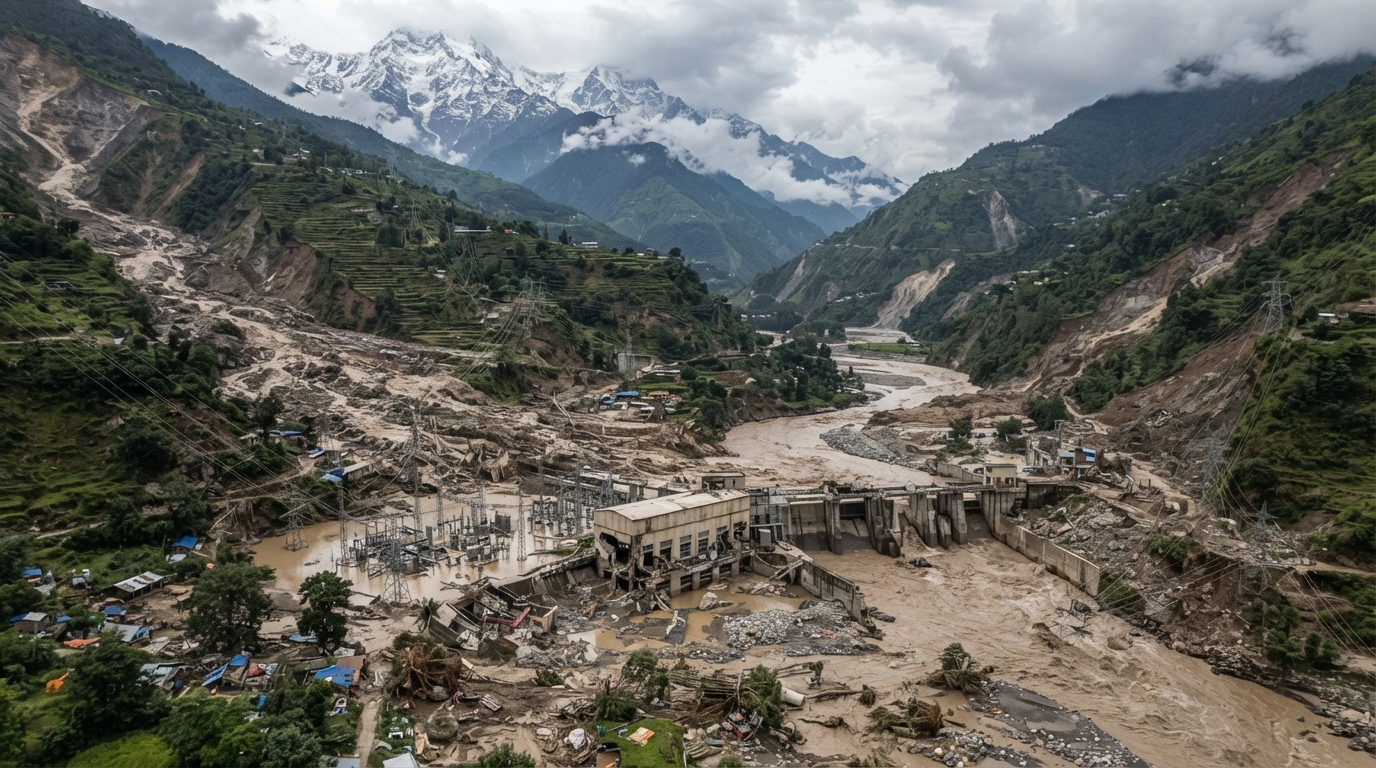
Nepal has staked almost everything on hydropower — and the floods have exposed why that is risky
Until eight years ago, Nepal was still dealing with long-lasting electricity cuts.
Nearly all of Nepal’s power now comes from hydropower, and the country generates so much of it that it earns almost $200m (£147m) a year by exporting hydroelectricity to India and Bangladesh.
Yet the glaciers and mountains that give Nepal this huge natural advantage are being affected by global warming, and last Wednesday’s deadly floods have highlighted the dangers facing the country’s hydropower plans.
More than 1,300 people were killed, and thousands more remain missing.
The floods, which wiped out whole villages near the Nepal-Tibet border, badly damaged 12 hydropower plants in the Trishuli River basin and removed more than 10% of Nepal’s total power generation capacity. Operators told the BBC they still do not know whether any of the facilities can be restored.
The state-owned Nepal Electricity Authority, which owns six of the 12 damaged plants, has told Nepalese households that electricity supply is still sufficient. But its spokesman Rajan Dhakal says that as climate-related disasters become more common, “the time has come for a rethink of our hydropower policy”.
More than 10% of Nepal’s total electricity generation capacity was wiped out by the massive flash floods
In 2010, only two-thirds of people in Nepal had access to electricity, and even connected homes could face outages of up to 16 hours a day.
Expanding hydropower infrastructure, along with efforts to curb corruption and increase electricity imports from India to cover seasonal shortfalls, meant that by 2018 most of Nepal had 24-hour power supply.
Today, Nepal has 225 hydropower plants with more than 3,900MW of installed capacity, according to the Nepal Electricity Authority — enough to power about three million households at once.
Hundreds more plants are being built or are in the pipeline. Most are located high in the mountains, where they can harness fast-moving water to produce electricity. These projects need little or no storage system.
But the high-altitude Himalayan regions are warming 50% faster than the global average, leaving them more exposed to environmental danger. Early investigations have suggested that a collapsed glacier and its bedrock caused last week’s flash flood.
Experts say Nepal needs to diversify its energy mix
Although scientists say it is too early to make any definite link to climate change, Nepal’s Disaster Risk Reduction and Management Authority has previously said that more than nine in 10 disaster events recorded between 2018 and 2024 were “related to climate”.
Nepal’s former Energy Minister Kulman Ghising, who described the devastating flood as a “once-in-a-century” event, says it offers lessons for how plants are designed and where they are built.
“We need to design the plants [to be more] resilient to the floods and, most importantly, adopt early-warning systems as well as robust emergency evacuation measures,” he told environmental news outlet Mongabay.
Potentially hundreds of hydropower workers, engineers and residents are believed to be trapped inside the mud-filled tunnels of these plants since the floods struck.
Dhakal of the Nepal Electricity Authority says a “rethink” of Nepal’s hydropower strategy could include reservoir-based plants that do not have to be built high in the mountains. These would make it possible to store water and release it when needed, but they would also bring major economic and environmental costs.
Some are questioning whether Nepal has become too dependent on hydropower.
“We should not be putting all our eggs in one basket in these dangerous times,” says renewable energy expert Kushal Gurung, founder of the clean tech company WindPower Nepal.
“We need to seriously embrace other alternatives as well, like solar and wind. And for that we will need to revise our energy policy that is at the moment very pro-hydropower,” he says.
That view is echoed by Vivek Shastry, a researcher at Columbia University’s Center on Global Energy Policy, who says that “meaningful additions of wind and solar generation is a resilience strategy that can limit single-point or interconnected electricity system failures in the future”.
Puspa Sharma, senior research fellow at the National University of Singapore’s Institute of South Asian Studies, agrees that Nepal must diversify its energy sources, but says this can be done “only to a limited extent”.
“While there is untapped capacity in wind and solar, hydropower really is the one that gives Nepal massive competitive advantage vis-a-vis its South Asian neighbours,” he says, citing several studies comparing renewable energy potential in the region.
Hydropower still dominates major investment in Nepal, and some climate activists say funding has continued despite known disaster risks.
The Upper Trishuli-1 project, which has been almost completely destroyed after last week’s floods, was one of Nepal’s biggest foreign direct investment projects, worth about $647m. Its supporters include the Asian Development Bank and the International Finance Corporation.
Upper Trishuli 3A, which has also been severely damaged, was financed by China’s Export-Import Bank.
Himanshu Thakkar, coordinator of the South Asia Network on Dams, Rivers & People, says international lenders were “acutely aware of the extreme danger to which they were exposing thousands of labourers, officials, residents, rivers, infrastructure and landscape”.
“Their own reports repeatedly highlighted it. But they did not take any preventive steps, did not demand stringent checks and balances, nor were they prepared for a calamity they knew could occur,” he says.
Thakkar says the Trishuli River basin has already shown itself to be unstable, pointing to floods there over the past two years. In September 2024, an unprecedented cloudburst over the Trishuli and Bhote Koshi river basins triggered flash floods in Rasuwa, Nuwakot and Dhading — riverside settlements that were also among the worst affected by last week’s floods.
Then in July 2025, a glacial lake in Tibet’s Gyirong county burst and surged down the same stretch of river into Nepal, killing at least 11 people. That flood damaged vital infrastructure and stopped trade along the busy Nepal-China corridor. The border crossing remained closed for nearly six months and only reopened on 1 January this year.
Dhakal of the Nepal Electricity Authority says that even if climate risk assessments were done properly, “the designing of the plants may not have been done accordingly”.
“Clearly we will need to improve in the way we build and operate our hydropower plants,” he adds.
Private operators are already facing financial losses. According to Uttam Bhlon Lama of the Independent Power Producers’ Association of Nepal, insurers have paid out about $40m for flood damage to more than 20 privately owned plants over the past three years.
He says insurance premiums are rising sharply and are making the cost of doing business “unfeasible”.
More than 1,300 people have died in Nepal during the recent disaster
This disaster shows that climate risks are global and cannot be handled by Nepal alone, says Manjeet Dhakal, a member of the country’s climate delegation at the UN Climate Change Conference.
He says governments and international organisations must work together to share data, assess impacts and build early-warning systems.
“Nepal is among the least responsible for the greenhouse emissions that led to these exacerbated risks.
“Ironically, our hydropower industry is an attempt to reduce our already minimal emissions... We cannot, and should not, be made to respond to these risks alone.”