

Floods in Nepal have completely destroyed many villages
Floods in Nepal have completely destroyed many villages
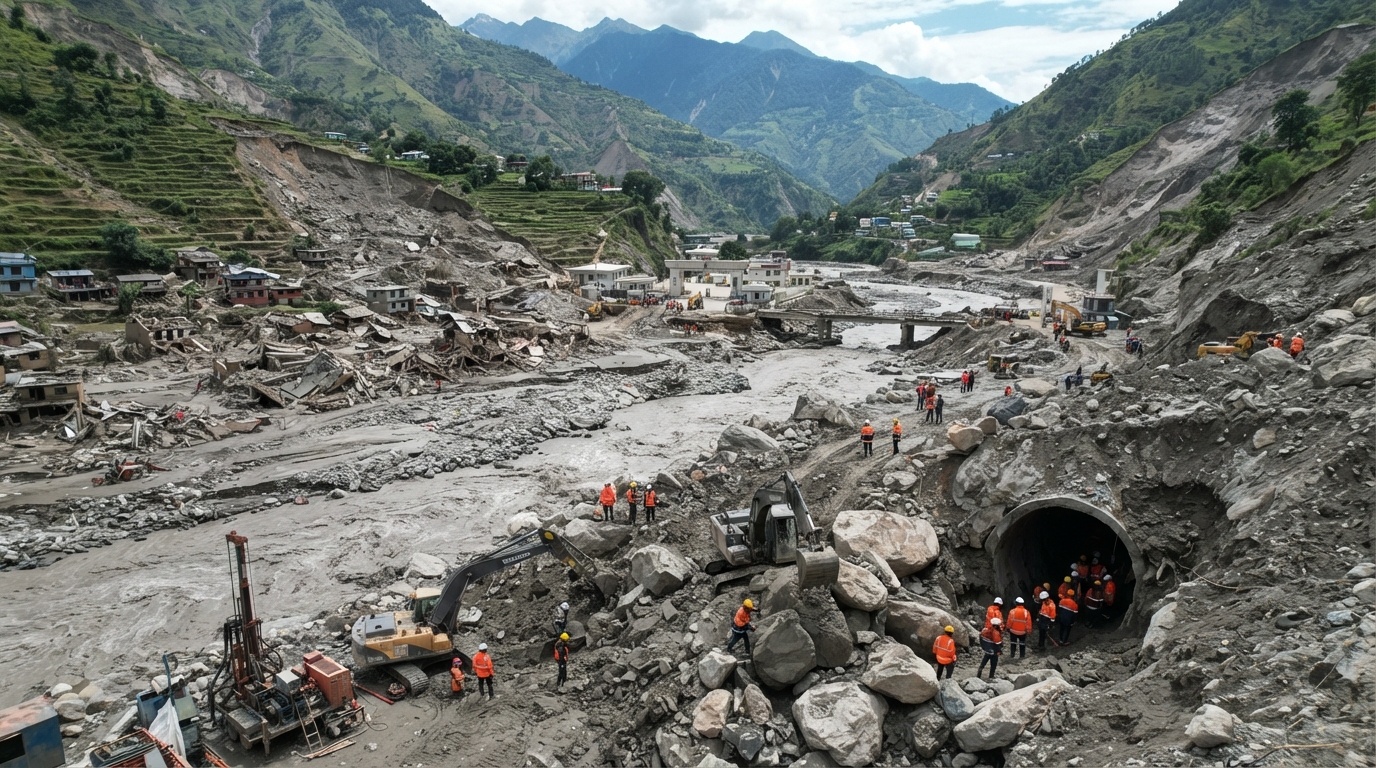
Large-scale destruction has occurred following heavy flooding and mudslides in Nepal's Trishuli River valley. Even though eight days have passed since the disaster, rescuers continue to search for hundreds of workers trapped at hydroelectric power plants.
Reuters correspondent's footage from a helicopter shows a large part of the area covered in gray mud and rocks, and in many places, no trace of residential settlements remains. In some areas, the ground has hardened like concrete, while in other places, the mud mass is still wet and slippery.
Officials estimate that nearly 900 people are trapped at six of Nepal's hydroelectric power plants. Last Wednesday, a glacier collapse triggered a massive flow of mud, rocks, and water down the mountain valleys. More than 1,200 people have died as a result of the natural disaster.
At the Upper Trishuli 3A hydroelectric power plant, rescuers are using excavators to remove huge boulders blocking the tunnel entrance. Because the entrance to the tunnel is very narrow, rescuers are forced to crawl inside. Workers are also drilling to drain water from inside the tunnel and conduct controlled explosions of large rocks.
In the village of Syabrubesi, an important route for trekking in the Himalayas, areas where many houses once stood are now covered in mud, with only a few buildings remaining.
The destruction is also severe at the Gyirong border crossing on the border between China and Nepal. Surveillance cameras captured people trying to flee the area just seconds before the mudslide hit. Now, rescuers and heavy machinery can be seen there, but no trace remains of the buildings, the border gate, and the bridge.
The flood in Nepal's high-altitude Rasuwa district, bordering Tibet, occurred on the morning of August 26. According to Nepal's Foreign Minister Shishir Khanal, the disaster may have been caused by a landslide. Meanwhile, Tibet remains virtually closed to foreign journalists. This makes it difficult to independently cover the scale of the disaster in the region.