

NASA will conduct a complex test before returning to the Moon
NASA presented a plan to test SpaceX's Starship and Blue Origin's Blue Moon landers in Earth orbit as part of the Artemis III mission. Astronauts aboard the Orion spacecraft will dock with both landers, but will only transfer aboard Blue Moon.
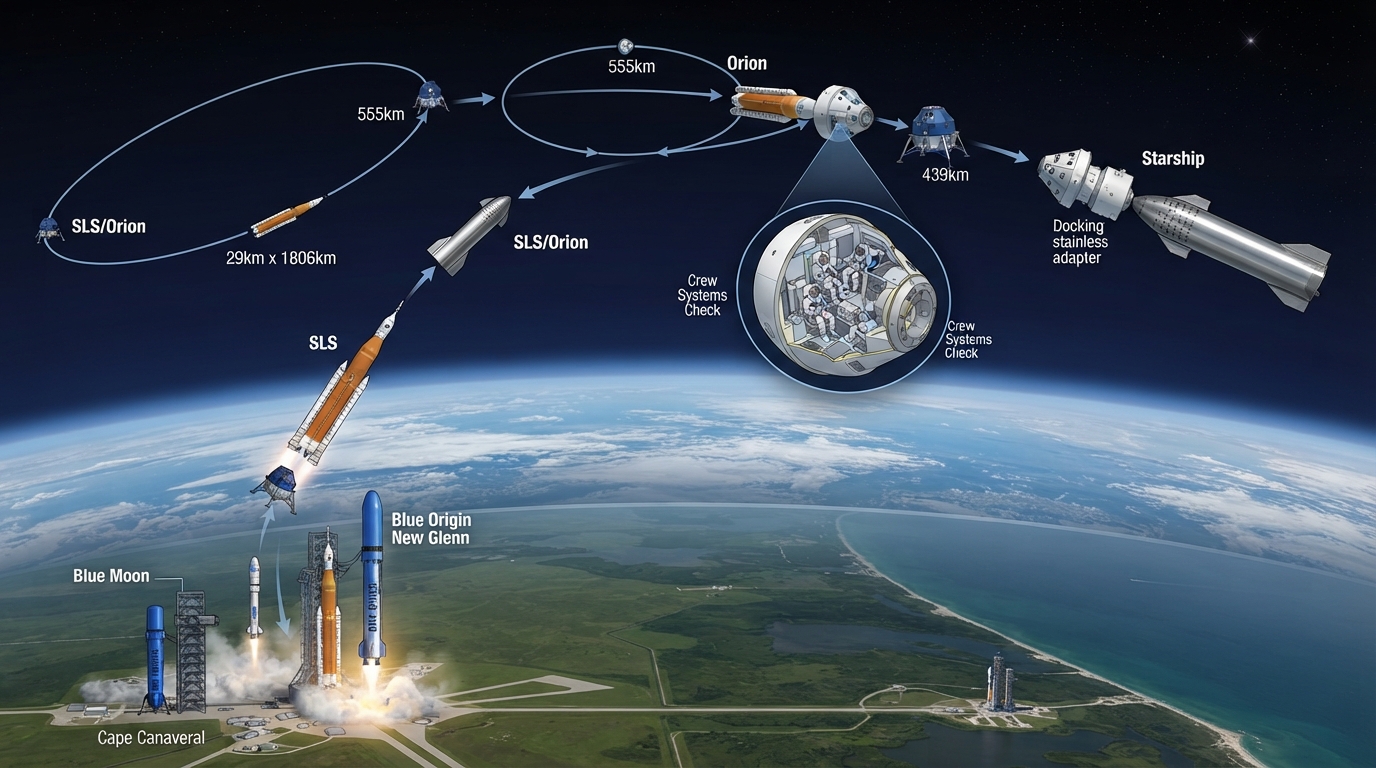
NASA to conduct complex test before returning to the Moon
Agency representatives provided information about the flight stages at a press conference held at the Kennedy Space Center in Florida. Jeremy Parsons, head of NASA's Artemis program, emphasized that this process could be one of the most complex launch campaigns the agency has ever executed.
The mission will involve NASA's Space Launch System (SLS) rocket, SpaceX's Starship system, and Blue Origin's New Glenn rocket. All of them are scheduled to launch from spaceports in Florida.
Blue Moon to launch first, followed by astronauts
According to the plan, the New Glenn rocket will initially carry the Blue Moon lander into low Earth orbit. Then, the SLS rocket will launch the Orion spacecraft carrying the Artemis III crew.
The crew includes NASA astronauts Randy Bresnik, Andre Douglas, and Frank Rubio, as well as European Space Agency representative Luca Parmitano.
SLS will first place Orion into an elliptical orbit ranging in altitude from approximately 29 kilometers to 1,806 kilometers. After that, the spacecraft will transfer to an orbit at an altitude of approximately 555 kilometers using its own engines.
At this stage, special attention will be paid to controlling the spacecraft's thermal regime. Since Orion was built for deep space flights, maintaining its thermal balance in low Earth orbit will be more complex.
Astronauts to test systems inside Blue Moon
During the first two days of the flight, the crew will inspect Orion and its systems. On the third day, the spacecraft is scheduled to rendezvous and dock with Blue Moon at an altitude of approximately 439 kilometers.
Over the next two days, the astronauts will open the hatch and transfer to the landing module. They will test the temperature control, life support, and environmental control systems. It will also be verified whether the spacecraft can maintain the necessary pressure in the sealed compartment.
The crew will also practice emergency procedures and controlling two docked spacecraft. The readiness of flight control centers for such operations will be evaluated.
Docking with Starship will last two hours
Once testing with Blue Moon is complete, around the sixth day of the mission, Starship will be launched. A special docking adapter will be installed on its nose section.