

NAPE will be able to independently fine stock market participants
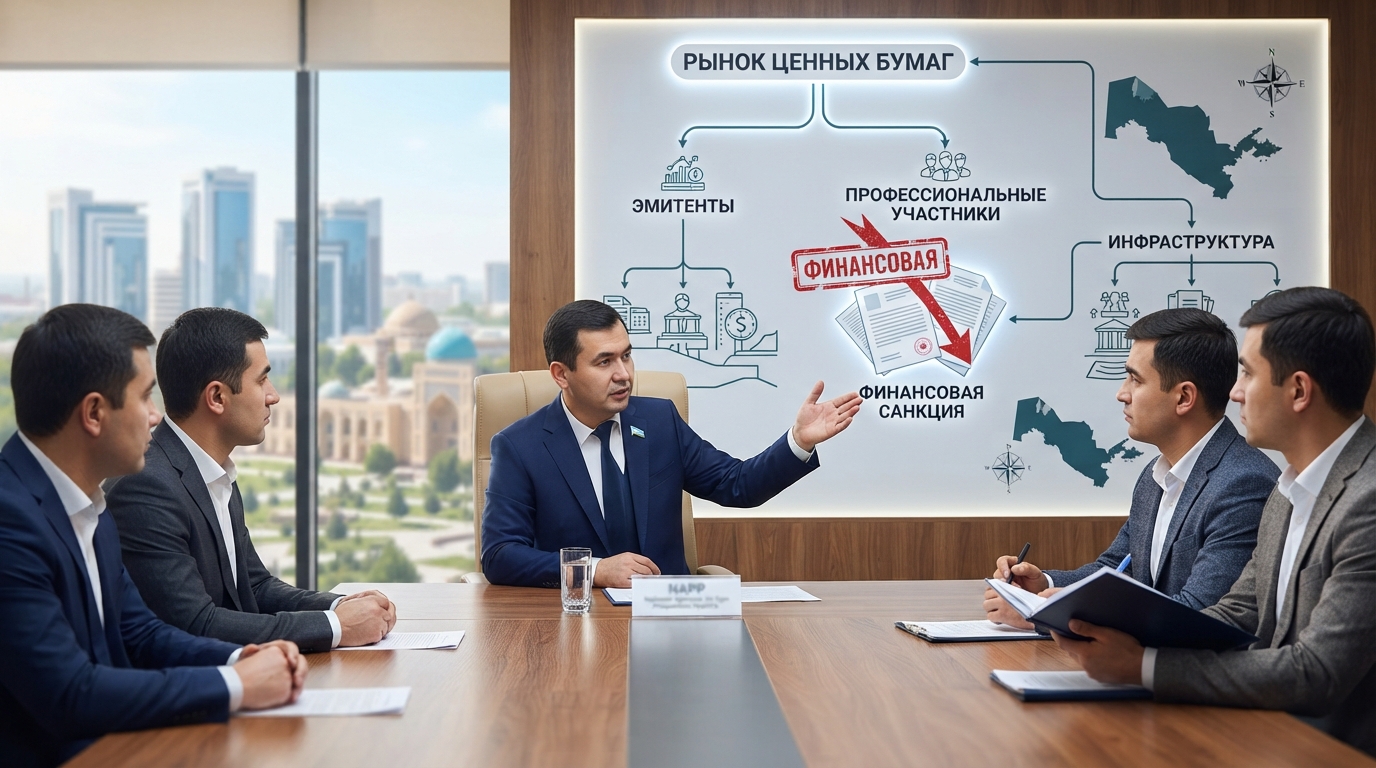
NAPP will receive the right to independently fine stock market participants
Uzbekistan intends to expand the powers of the National Agency for Perspective Projects (NAPP), which regulates the capital market. The agency will be able to independently apply financial sanctions to market participants and receive information constituting banking secrecy in cases provided for by law. The amendments will also affect information disclosure by companies, stock market infrastructure, and investor protection.
The new norms are contained in the draft law "On the Capital Market," which has already passed its first reading in the Legislative Chamber of the Oliy Majlis and is being prepared for the second. The document is designed to update capital market regulation and bring it into line with international standards.
One of the main innovations concerns the liability of companies issuing securities and professional participants in the stock market. According to NAPP representatives, current measures do not always allow for the timely disclosure of information necessary for investors to evaluate companies and their securities.
The draft law proposes granting the agency the right to apply financial sanctions independently. For professional market participants, the maximum fine could reach 2% of the authorized capital, and for issuers, 0.5%.
Thus, the penalty amount will depend not only on a fixed size, but also on the financial indicators of the organization. As intended by the developers, this will make liability more tangible and increase companies' interest in complying with the requirements.
Separately, tougher penalties are envisaged for non-disclosure and non-publication of information. This refers to data that helps investors assess the financial position of issuers and the risks associated with investments.
Another proposed power for NAPP is to receive information constituting banking secrecy in cases and according to procedures provided for by legislation. This should expand the tools available to the regulator for supervising market participants.
The changes are connected with bringing Uzbekistan's legislation into line with the principles of IOSCO — the International Organization of Securities Commissions, which unites stock market regulators from different countries.
These principles cover the independence of supervisory authorities, control over market participants, compliance with established rules, and investor protection. Effective supervision and transparency are also important for foreign institutional investors — for example, large funds investing in securities.
Before making investment decisions, it is important for them to understand how clear the market rules are, whether violations are detected, and whether the regulator can respond to them. Rating agencies consider similar factors when assessing the reliability of the market and its participants.
Therefore, alignment with IOSCO principles should not only update legislation, but also boost trust in the Uzbek capital market. However, the adoption of new norms in itself does not guarantee an inflow of foreign investment: much will depend on how they are applied in practice.
The draft law also provides for changes in the stock market infrastructure. In particular, it is proposed to introduce the institution of a central counterparty — an organization that acts as an intermediary between the parties to a transaction and ensures the fulfillment of their obligations. Such a mechanism helps reduce the risk of non-performance of a transaction by one of the parties.
Another direction is the regulation of custodial activities. A custodian is a financial organization that holds securities and maintains their accounting in the interests of clients. Such services are important, among other things, for foreign investors entering the national market.
As an example, at a press conference on October 14, agency representatives cited the IPO of the National Investment Fund of Uzbekistan (UzNIF). As part of a special regulatory regime, the custodial infrastructure of Bank of Georgia was used during the placement.
Now it is proposed to establish such activity in legislation as a separate area requiring a corresponding permit or license.
In addition, the draft law provides for the regulation of the activities of rating agencies, management companies, and investment funds. This should form a more complete market infrastructure, allowing investors to allocate funds, hold assets, and assess investment risks.
The proposed norms are aimed at increasing the transparency of the stock market, strengthening accountability for violations, and developing mechanisms for conducting transactions. For investors, this could mean clearer rules of operation and additional risk management tools.
For local companies, the development of the capital market, in turn, can expand opportunities for raising funds. The issuance of securities can become an alternative to bank lending and help businesses obtain financing from investors.
However, the final effect will depend on the practical application of sanctions, the quality of disclosed information, and the performance of new market participants. So far, the draft law has passed only its first reading in the Legislative Chamber of the Oliy Majlis. Its provisions may change during further consideration.